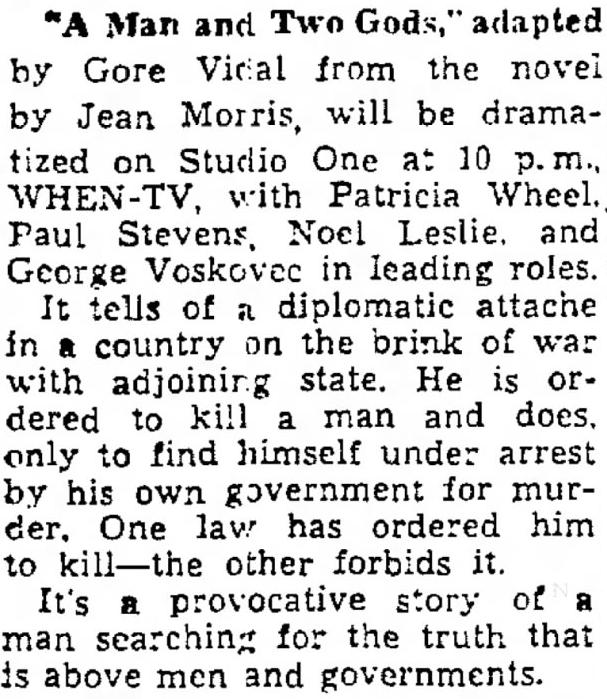
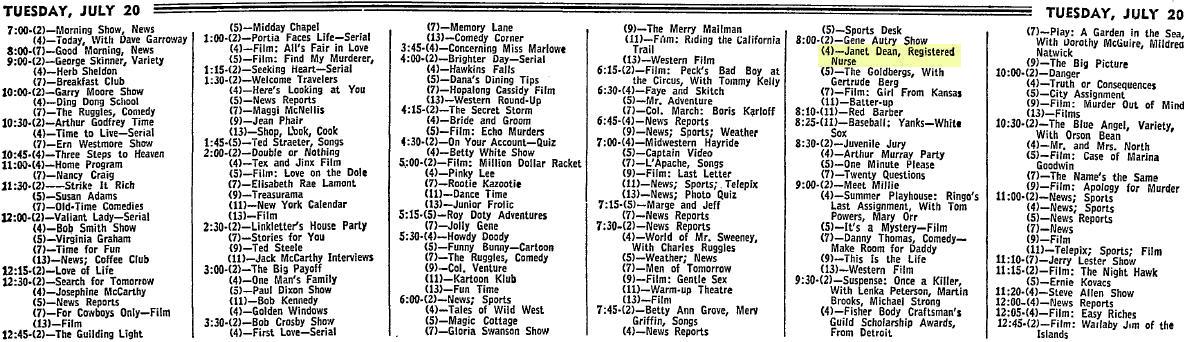
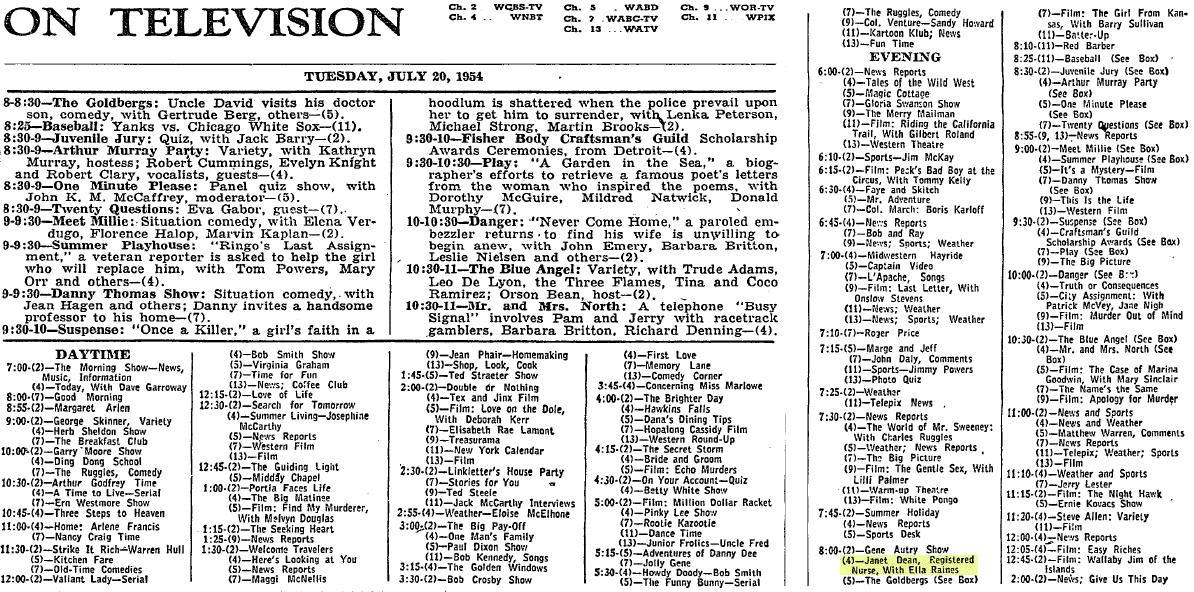
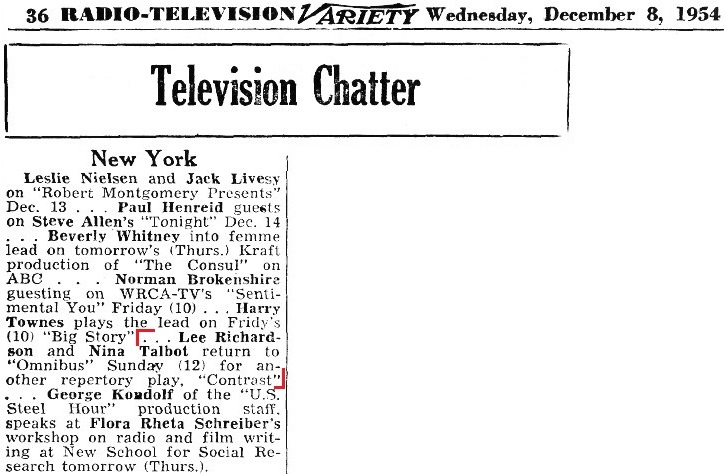
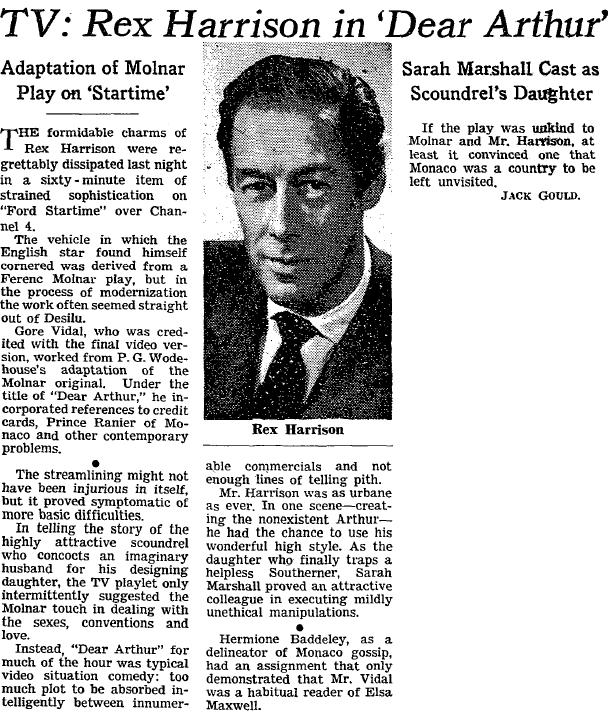
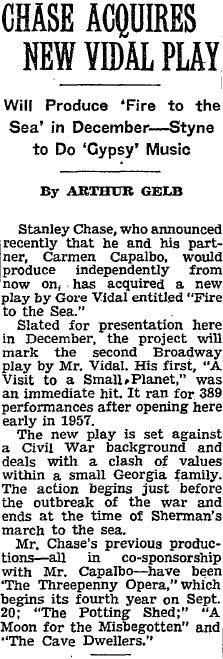
The clickables:
• IMDb doesn’t say anything much.
• CTVA — The Classic TV Archive —
has a complete episode list. If the link no longer works, I filed a back-up copy
here.
•
The Gore Vidal Finding Aid lists Container 274 The case of the jinx nurse : Tss with AMs corrections, [ca. 1953] 1 folder.
Two scripts written by GV under the pseudonym Cameron Kay, for the television series, Janet Dean, Registered Nurse.
A few variant corrections on each Tss. AMs annotation on first page of first Ts, “Gore Vidal / 1st TV script.
Air date of program is not known.”
BARN BURNING
Aired (live?) on Tuesday, 17 August 1954, 9:30–10:00pm EDT, on CBS,
as part of the “Suspense” anthology series,
season 6 episode 46 (whole number 260)
This is another piece adapted from a work by William Faulkner.
I haven’t had a chance to see this yet.
If you want to see it, I guess you have to fly to New York City
and visit the
Paley Center for Media
(formerly the Museum of Television & Radio) in Manhattan (media number 023713).
The references I have found, predictably, are few and minimal:
• “On Television,” The New York Times, Tuesday, 17 August 1954, p 28:
Clickables:
• TV.com
• IMDb
• Draft scripts available at Harvard, according to
Gore Vidal Finding Aid:
Container 270 Barn burning : Ts with AMs corrections, [ca. 1954] 1 folder. Draft. Aired on Suspense (CBS), 1954 Aug. 17.
Container 271 Barn burning : Ts with Ms corrections by Robert Mulligan, 1954. 1 folder.
Final draft. Annotation on second page, “Bob Mulligan,” director of the program.
SOVEREIGN STATE
As far as I know this was never produced.
Once again we have as our source Fred Kaplan’s biography,
Gore Vidal: A Biography (New York: Anchor Books, October 2000), p 377:
“In summer 1954, while working at Edgewater on another Edgar Box,
he outlined in detail ideas for two resonant television stories,
the first called Sovereign State, the second Billy the Kid.”
So I presume there must be some sort of paper trail about this,
and I presume that paper trail would be somewhere at Harvard.
If you can find it, please give me a holler. Thanks!
CASE OF THE DYING ACCUSATION
Aired (live?) on Thursday, 29 July 1954, on CBS,
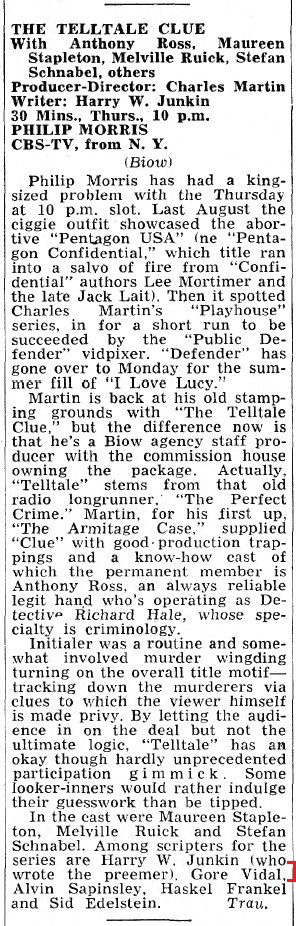
as part of Philip Morris’s “The Telltale Clue” series
In “The Art of Fiction, No. 50,” (The Paris Review, 1974-07)
Gore Vidal gave us his assessment of this work:
“Absence of money is a bad thing because you end up writing ‘The Telltale Clue’ on television — which I did.”
Vidal wrote this episode under a pseudonym that he can no longer recall (probably Cameron Kay, I would guess).
Some sources say that Gore Vidal wrote not one but two episodes for The Telltale Clue.
Do the CBS records or the Philip Morris records or Charles E Martin Productions records still survive somewhere?
If you know, please let me know. Thanks!
This program may still exist.
It’s definitive that two episodes still exist;
we know that because they’re on YouTube:
“The Case of the Talking Garden,”
15 July 1954, written by Haskel Frankel; and
“The Case of the Hit & Run,”
5 August 1954, written by James P. Cavanaugh.
Variety (weekly), Wednesday, 14 July 1954, p 31:
Clickables:
• CTVA — The Classic TV Archive
• The Gore Vidal Finding Aid
lists the following: Container 2997 Case of the dying accusation (television script) : contract, 1954. 1 folder.
I took a brief glance at this folder, and the contract caught my interest.
It was dated 30 June 1954 and was with producer/copyright owner Charles E. Martin Productions Inc:
“You agree that in the event we use the said script, which we are not required to do,
we have the option of making use of your name, if we so desire.”
• TV.com
THE CONTRAST
Aired live on Sunday, 12 December 1954, 5:00–6:30pm, EST, on CBS,
as part of the “Omnibus” anthology series
Now, I know something about American, or at least US, theatrical history,
and I know that Royall Tyler’s The Contrast,
which opened on Monday, 16 April 1787, was a turning point in the history of American theatre.
But I’ve never seen it.
I should read it, though.
And I shall.
When I get the time.
Soon.
You can read it for free by clicking here.
The Contrast was the first comedy written by an American that was performed professionally.
It introduced an archetypal character that would be expanded upon in the mid-nineteenth century,
the “Yankee” character, made most famous perhaps when George “Yankee” Hill,
then Dan Marble, and then Josh “Yankee” Silsbee
elaborated upon the Jonathan Ploughboy character in Samuel Woodworth’s The Forest Rose.
The Yankee character evolved into a brash, comical fellow, who dressed horribly in what he was convinced was the height of fashion,
and he was an embarrassment to his English cousins.
(The popular image of Uncle Sam, with his overly flashy, wrongly proportioned clothes,
is a patriotic reinterpretation/misinterpetation of the Yankee character.)
I should read this soon.
I’m astonished that two of my great interests,
early American theatre and Gore Vidal,
converged so neatly and so intensely.
Strangely, to conserve on time, Gore entirely deleted the Jonathan character!
The Ford Foundation apparently owns the rights,
and allegedly has kinescopes of all the episodes in storage.
But that’s all locked away.
It seems that no other archive in the world has this.
If you can locate a copy, please contact me.
Here are the references:
• Variety (weekly):
• “Television Programs This Week,” The New York Times, Sunday, 12 December 1954, p X16:
Clickables:
• TV.com
•
The Gore Vidal Finding Aid lists Container 275 The contrast : Ts, 1954. 1 folder.
First draft, revised, dated 1954 Dec. 1. Adapted by GV from Royall Tyler's play, The contrast: a comedy in five acts.
Aired on Omnibus (CBS), 1954 Dec. 12.
A SENSE OF JUSTICE
Aired live on Sunday, 6 February 1955, 9:00–10:00pm, on NBC,
as part of the Philco “Television Playhouse” anthology series, season 7 episode 234
This is sheer brilliance.
The title, “A Sense of Justice,” sums up the essence of Gore Vidal’s sense of his place in this world.
The story is preposterous,
and if anyone else had written it, or if anyone else had been in charge of the day-to-day production and rehearsals,
it would have been hopelessly unconvincing.
But in Vidal’s hands it worked magnificently.
E. G. Marshall gave a bravura performance in a most difficult rôle.
To my near-disbelief, I saw, in a lengthy scene,
both E. G. Marshall and Paul Tripp on screen at the same time,
on the same set, in the same shot, exchanging lines!
That was just too good to be true.
Mr I-Magination, Mr Birthday House himself!
Oh heavens be praised!
In a dramatic part, he was so believable and convincing!
And his lines were NOT easy to deliver!
But he delivered them perfectly, absolutely perfectly.
That was a scene to die for!
No matter where you live, visit the Paley Center for Media
(formerly the Museum of Television & Radio) in Manhattan (media number 030938) or in Beverly Hills (media number 121847)
and watch it!
By the way, this was one of those rare instances in which a director, namely Robert Mulligan,
actually enhanced the script immeasurably — with a single stage direction,
much to Vidal’s delight!
Here are the references:
• “Television Programs This Week,” The New York Times, Sunday, 6 February 1955, p X14:
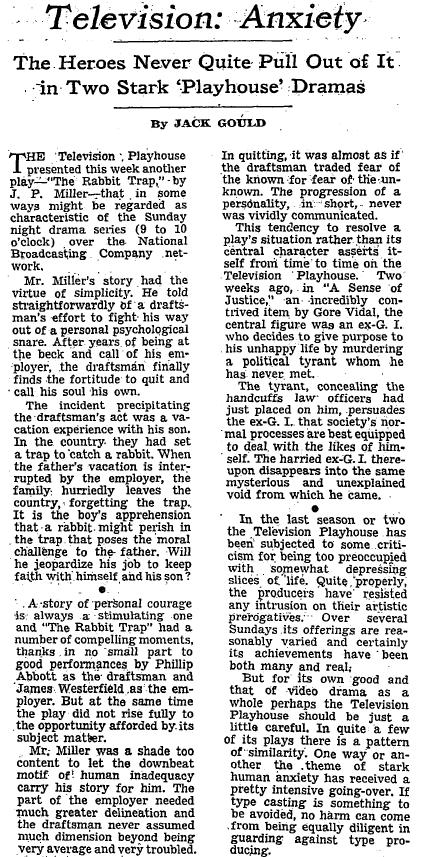
• Review: Jack Gould, “Television: Anxiety — The Heroes Never Quite Pull Out of It in Two Stark ‘Playhouse’ Dramas,”
The New York Times, Wednesday, 16 February 1955, p 40.
Clickables:
• TV.com
• IMDb
• The Gore Vidal Finding Aid
lists the following:
Container 4522 A sense of justice (Television program) : 16 mm film, 2000. 2 reels. Written by GV.
Film of the Philco Television Playhouse program that aired on the National Broadcasting Company, inc. on 1955 Feb. 6.
PAY ATTENTION! There is a kinescope of this at Harvard!!!
It may well be the only surviving kinescope.
It needs to be restored and duplicated — IMMEDIATELY!!!
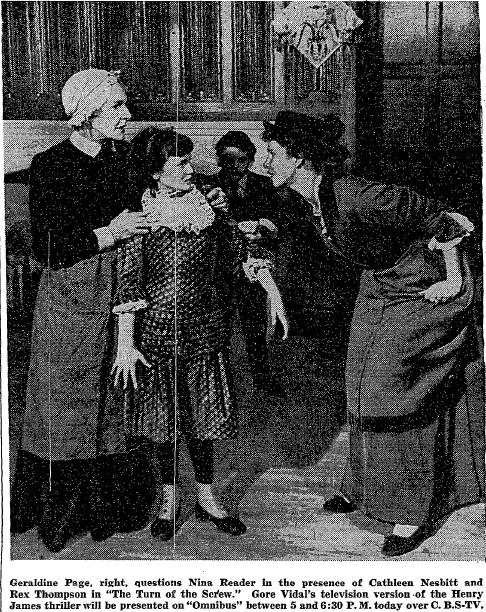
THE TURN OF THE SCREW
Aired live on Monday, 13 February 1955, 5:00–6:30pm EST, on CBS,
as part of the “Omnibus” anthology series, season 3 episode 39
All I know is that this was based on the Henry James novel of the same name.
And, because it’s part of the “Omnibus” series,
it’s owned by the
Ford Foundation, which surely has a kinescope in its vaults.
Here are the references:
• “Psychological Drama and Satiric Comedy on Video This Week,” The New York Times,
Monday, 13 February 1955, p 121:
Clickables:
• According to TV.com,
the actual title of this play was “The Last Turn of the Screw.”
•
IMDb
•
The Gore Vidal Finding Aid lists the following: Container 314 The turn of the screw :
Ts with AMs corrections, [ca. 1955] 1 folder. Draft of treatment. Includes draft of letter about the treatment.
Aired on Omnibus (CBS), 1955 Feb. 13.
THE BLUE HOTEL
Aired live on Tuesday, 22 February 19 10:00–11:30pm EST, on CBS,
as part of the “Danger” anthology series, series 5 episode 25 (whole number 226)
We know that this was based on Stephen Crane’s novel of the same name.
We know that Vidal’s script was not used.
Halsted Welles was brought in as script doctor, and he rewrote it.
References:
• “On Television,” The New York Times, 1955-02-22-Tue, p 26:
Clickables:
•
The Gore Vidal Finding Aid lists the following: Container 272 Blue hotel : Ts, [ca. 1955 ] 1 folder.
Treatment describing GV’s adaption of Stephen Crane’s story. Aired on Danger (CBS), 1955 Feb.22.
Container 273 Blue hotel : Ts (mimeograph), 1955. 1 folder. Script dated 1955 Feb. 10.
•
TV.com.
• IMDb
• A remake must have been proposed in 1968, as we can see from
University of Virginia Library.
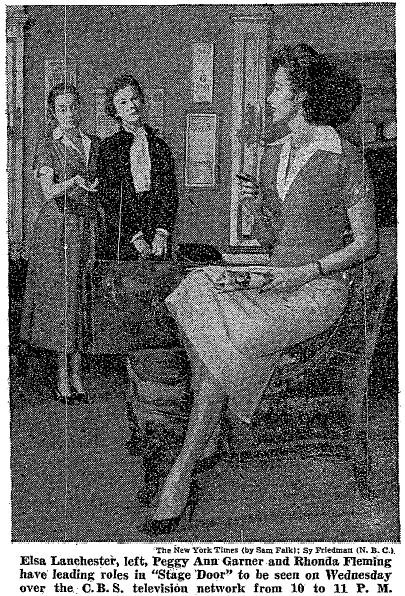
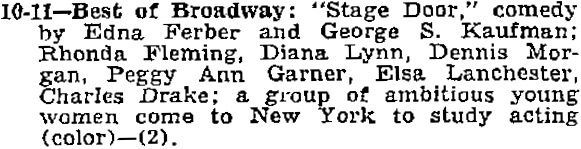
STAGE DOOR
Aired live on Wednesday, 6 April 1955, 10:00–11:00pm EST, on CBS,
as part of “The Best of Broadway,” season 1 episode 8
Gore Vidal adapted a play by George S. Kaufman and Edna Ferber?!?!?!?!?!
How did this disappear?
How could it disappear?
This is cruel!
Or maybe it didn’t disappear?
If you look at http://www.imdb.com/title/tt0046580/reviews
you will see that a color (lenticular?) kinescope of another program in this series, Arsenic and Old Lace,
still existed in private hands as late as the 1970s.
That would indicate that the series was indeed kinescoped.
And that means that those kinescopes might still be around somewhere.
Where?
References:
• “Romance, Warfare and Show Business in Three Television Plays This Week,” The New York Times,
Sunday, 3 April 1955, p X15:
• “On Television,” The New York Times, Wednesday, 6 April 1955, p 41:
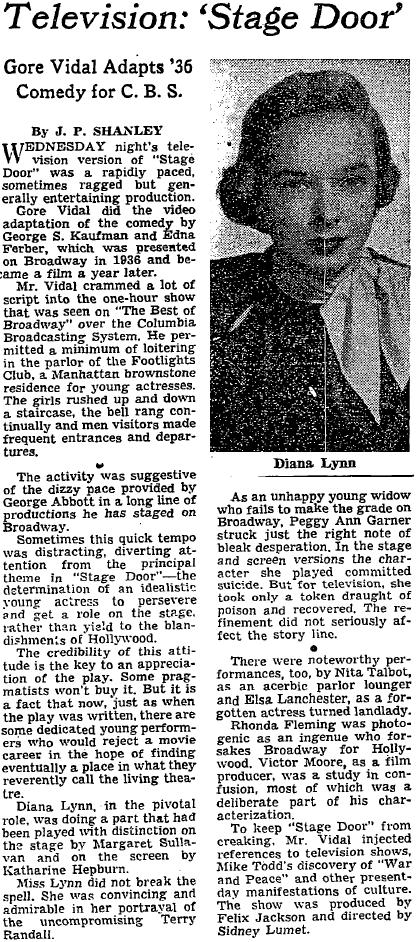
• Review: John P Shanley, “Television: ‘Stage Door’ — Gore Vidal Adapts ’36
Comedy for C.B.S.,” The New York Times, Friday, 8 April 1955, p 29.
Clickables:
• TV.com
• The Classic TV Archive
• IMDb
•
The Gore Vidal Finding Aid lists the following: Container 310 Stage door : Ts, [ca. 1955] 1 folder.
Possibly final draft. Adapted from the Broadway comedy by George S. Kaufman and Edna Ferber.
Aired on The best of Broadway (CBS), 1955 April 6.
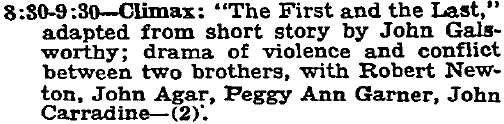
THE FIRST AND THE LAST
Aired live on Thursday, 28 April 1955, 8:30–9:30pm ET, on CBS,
as part of the “Climax!” anthology series, season 1 episode 23
This was based on John Galsworthy’s short story of the same name.
Here I must simply confess that I was careless with my note-taking.
Somewhere — and no, I cannot remember where — I read that Gore Vidal wrote the script of this program.
If he did, his script was rejected, as the credited writer is William Kozlenko.
As far as I know, this program has vanished off the face of the earth.
References:
• “Television Highlights of the Week,” The New York Times, Sunday, 24 April 1955, p X13:
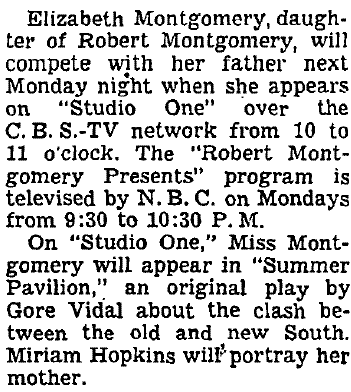
SUMMER PAVILION
Aired live on Monday, 2 May 1955, 10:00–11:00pm EDT, on CBS,
as part of the “
Studio One” anthology series, season 7 episode 33 (whole number 303)
This is available for viewing at the
Paley Center for Media
(formerly the Museum of Television & Radio) in Manhattan (media number 000302) and in Beverly Hills (media number 107778).
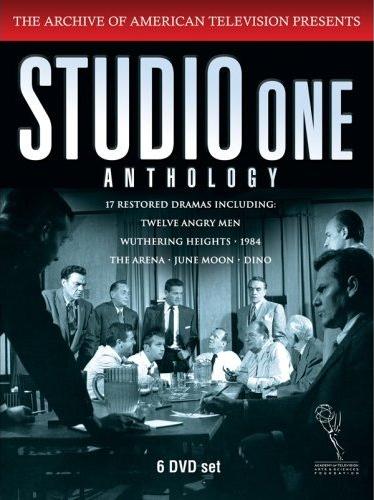
Better yet, it’s included in the new “Studio One” box set!
Click on the image below:
References:
• Val Adams, “Benny Will Lose Sponsor on Radio,” The New York Times, Monday, 25 April 1955, p 30:
• “On Television,” The New York Times, 1955-05-02-Mon, p 27:
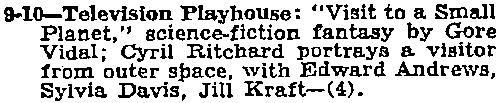
VISIT TO A SMALL PLANET
Aired live on Sunday, 8 May 1955, 9:00–10:00pm EDT, on NBC,
as part of the Goodyear “Television Playhouse” anthology series,
season 4 episode 16 (whole number 90)
More than anything else, this is what put Gore Vidal on the map.
If you had to read the published script for school, put that miserable experience out of your mind.
Performed live, this comes to life, and it’s pure magic!
And the happier and goofier it gets, the darker it gets.
In this play, we are rooting for the delightful, sparkling, eccentric, amusing, charming, magnetic,
irresistable, adorable character who attempts for his amusement to bring about world annihilation.
This show was a sensation, and led to a long-running Broadway adaption that is still occasionally performed in repertory.
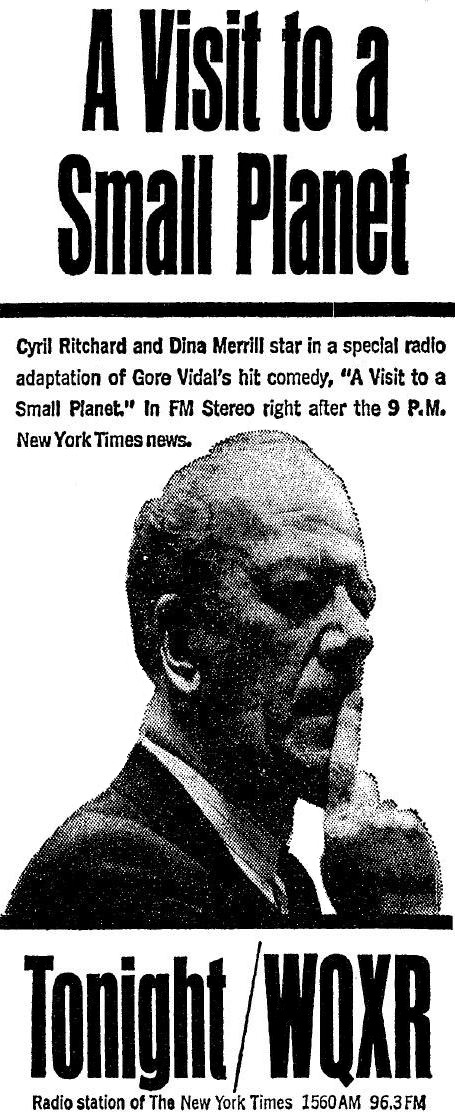
The lead character is played by Cyril Ritchard, who pronounced his surname simply as Richard,
though all his colleagues mysteriously pronounced it rit-chaahhhhrd, with the second syllable dragged out far too long.
Moral: Never get too obsessed with English spelling. Pay more attention to the pronunciation.
I had seen Cyril Ritchard only in Piccadilly (1929) in which he played a rather unlikeable nightclub dancer.
(Piccadilly should be an impossibility but isn’t: The script is wretched but the direction is ethereal.)
What a contrast with this rôle!
This wonderful, wonderful, wonderful show was instantly lost and was never seen again after the initial broadcast.
Then, around 2002 or thereabouts, two separate people made two separate donations to the UCLA Film and Video Archive.
One donation was of a 1" videotape off of a kinescope of this program,
and the other was of a 2" quad videotape off of a kinescope of this program!
Since both were playable, they were probably not all that old,
and that indicates that the kinescope must have been around rather recently.
The whereabouts of that kinescope, though, seem to be unknown.
But there’s another kinescope copy of this program on file.
It’s 16mm and it’s owned by
American Television Classics, though it’s not listed in their
on-line catalogue.
If you know the whereabouts of other original material,
please contact me without delay!!!
(The listing at Powell
Library’s Research Study Center at the University of California at Los Angeles makes no mention of the 2" quad.
So either I was misinformed about its existence, or, more likely, it has turned to goo.)
In the meantime, if you wish to watch this delightfully ominous little comedy,
you will not regret circumnavigating the globe to spend a day at the
Powell
Library’s Research Study Center at the University of California at Los Angeles.
Of course, if you just walk in unannounced and ask to see the video,
you’ll be promptly thrown out of the building.
You need to call first and set up an appointment.
UCLA has made a VHS reference copy, and that’s what you’ll see.
The experience of watching this little satire is magical.
And if you don’t like it, you’re a grouch.
References:
• “Television Highlights of the Week,” The New York Times, Sunday, 8 May 1955, p X13:
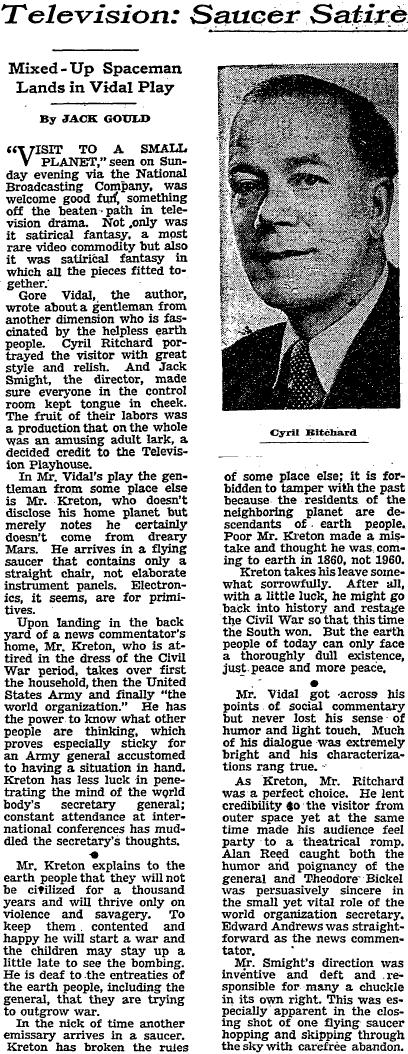
• Review: Jack Gould, “Television: Saucer Satire — Mixed-Up Spaceman Lands in Vidal Play,”
The New York Times, Wednesday, 11 May 1955, p 42.
Clickables:
• TV.com
• IMDb.com
• The Gore Vidal Finding Aid
lists the following:
Container 315 Visit to a small planet : Ts with AMs corrections, [ca. 1955] 1 folder. Draft of treatment.
Aired on Goodyear television playhouse (NBC), 1955 May 8.
Container 316 Visit to a small planet : Ts, 1955. 1 folder. Final version of treatment submitted to Goodyear television playhouse.
Container 317 Visit to a small planet : Ts (photocopy) with AMs corrections, undated. 1 folder. Draft.
Container 4480 Visit to a small planet (Play) : video recording, undated. 2 videocassettes. VHS videotapes.
Directed by Dean Rusu. Possibly a version of GV’s play [as opposed to the original teleplay].
Dean Rusu? Who is Dean Rusu?
Someone may have videotaped the stage-play version of Visit to a Small Planet???
All right, please, somebody, anybody, please go to Harvard and check on those videotapes.
Find out what they are!
And let me know!!!!!! Thanks!
Container 320 [Untitled science fiction satire] : Ts with AMs corrections, undated.
1 folder. First draft. Apparently not produced.
Should we assume that this was an earlier draft of Visit to a Small Planet?
We probably should.
There is another listing as well:
Container 321 [Untitled science fiction satire] : Ts with AMs corrections, undated.
1 folder. Second draft.
If you plan to spend a few hours at the Houghton Library at Harvard University,
why not take a little time out to check on this?
When you find out, please let me know. Thanks!
A FAREWELL TO ARMS
Aired live on Thursday, 26 May 1955, 8:30–9:30pm EDT, on CBS,
as part of the “Climax!” anthology series, season 1 episode 26
When I was in high school I was required to read this Hemingway novel.
I was so offended by its machismo that I refused to finish it and got very low marks.
Only recently have I come to see that there was a decent and tender and positive side to Ernest Hemingway.
That happened when I read one of his last novels, the much-ridiculed Across the River and into the Trees.
Yes, I understand why so many people find it an insignificant story poorly written.
There’s more to it than that, though,
for the badness and inept writing and bland, shallow characters are all deliberate,
making the novel far more subtle and subversive than most people would care to recognize.
If you’re in a bit of a soulful mood you’ll catch on easily enough.
So I shall soon dip into his work some more.
Now, I have long known that Gore Vidal was not in the least an admirer of Hemingway,
whom he regarded as a bad writer as well as a bad human being.
He must have had a more nuanced attitude back in 1955, because he did this adaption,
which I have not yet seen.
I must get back out to UCLA someday....
References:
• “Television Highlights of the Week,” The New York Times, Sunday, 22 May 1955, p 139:
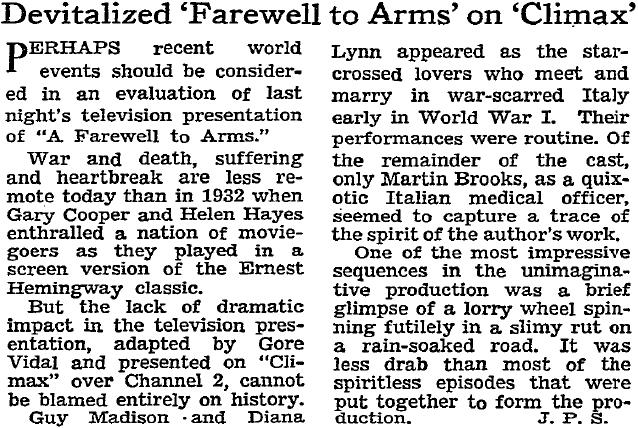
• John P Shanley, “Devitalized ‘Farewell to Arms’ on ‘Climax,’
The New York Times, Friday, 27 May 1955, p 45:
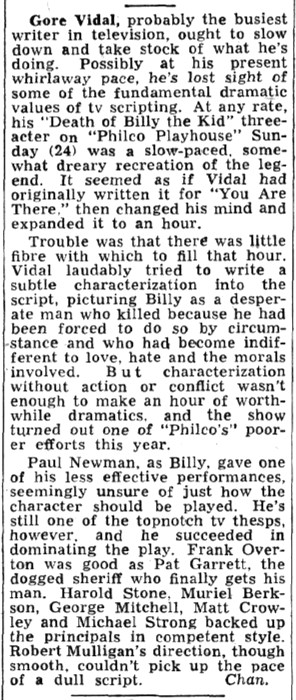
THE DEATH OF BILLY THE KID
Aired live on Sunday, 24 July 1955, 9:00–10:pm EDT, on NBC,
as part of the Philco “Television Playhouse” anthology series,
season 7 episode 23 (whole number 246)
Gore Vidal first became enchanted with this subject matter when he saw the ballet inspired by Billy the Kid’s life.
(Vidal is a life-long ballet enthusiast.)
Further, he spent some school time at Los Alamos, on a campus that was later demolished to make way for the Los Alamos National Laboratories
(ugh!).
And New Mexico, as anyone who has spent quality time there will know, is appropriately named the “Land of Enchantment.”
New Mexico was Billy the Kid’s stomping grounds,
and that background produced this little play, which featured Paul Newman in the title rôle.
And that is when Newman’s career took off.
I have read the published script, and to save my life I cannot picture it, but I’m sure it worked somehow.
The TV play was so well-received that Warner Bros. purchased the movie rights.
Vidal and Newman were happy about this, they chose a television director they liked,
and then Vidal walked away, completely trusting in everyone’s good faith.
That was a mistake, and it was a mistake he would repeat numerous times in the future.
He should not have walked away, and he should not have trusted.
The director was fired and replaced by Arthur Penn,
who then hired someone else to rewrite Vidal’s script from first page to last.
The result was the mediocre Left Handed Gun
(compound modifier unhyphenated — studio folks are not the most literate people),
which did not even open in major cinemas,
but was belatedly opened as the second B feature at some neighborhood houses before disappearing only a few days later.
For some reason that I cannot fathom, this movie has developed a small following.
It’s not bad, but it sure isn’t good. It’s simply forgettable.
In later years Vidal remade it once again, and he made sure he would be in charge.
The result was called Gore Vidal’s Billy the Kid,
which was quite amazing.
Not only was it affecting,
but the actors — 1980s actors! — knew how to act!
They had a feeling for the time and played it as though they were living in the late 1800s in New Mexico.
I could hardly believe that modern actors would have that much connection with the past.
But they did, and the result is certainly worth getting on video,
even though the sequence in which Billy catches frogs was deleted.
Oh how much I want to see that sequence!
References:
• “Video Will Swing a Bat for Youth,” The New York Times, Monday, 18 July 1955, p 41:
• “Television Highlights of the Week,” The New York Times, Sunday, 24 July 1955, p X10:
• “Tele Follow-Up Comment,” Variety (weekly), Wednesday, 27 July 1955, p 25:
Clickables:
• TV.com
• IMDb
• The Gore Vidal Finding Aid
lists the following:
Container 282 The death of Billy the kid : Ts with AMs corrections, [ca. 1955] 1 folder. Treatment.
Aired on Philco television playhouse (NBC), 1955 July 24.
Container 4429 The death of Billy the kid (Television script) : video recording, undated. 1 videocassette. VHS videotape.
Possibly includes the television program written by GV that aired on the Philco Television Playhouse (NBC), 1955 July 24.
WHAT?!?!?! The VHS included in this container might contain The Death of Billy the Kid?!?!?!?!?!
And nobody is rushing to Harvard to check on this?
Why isn’t anyone checking on this?
Why? Why? Why?
Come on!
If you’re in the Boston/Cambridge area, rush in — NOW!!! — and check on this.
Please!
And let me know what you find!
If this really is the program, then we MUST get it preserved,
and we MUST find the kinescope it derived from!
Here’s a possible lead:
American Television Classics
owns or co-owns the rights to many of the Philco “Television Playhouse” programs.
Take a look at their online catalogue, and you’ll see that they claim ownership or co-ownership of
22 January 1950 through 9 May 1954,
as well as 4 September 1955 through 12 February 1956, which they have on kinescope.
But their online catalogue is not complete.
Might they also own the 24 July 1955 program as well?
DR. JEKYLL & MR. HYDE
Aired on Thursday, 28 July 1955, 8:30–9:30pm EDT, on CBS,
as part of the “Climax!” anthology series, season 1 episode 34
This is a strange little play, based on Robert Louis Stevenson’s strange little novelette.
This program, though, is not too remarkable.
If this is your introduction to Gore Vidal’s screenwriting career, please don’t judge him on this.
Alas, that might not be too easy, as this is the most easily available of any of his teleplays,
which is unfortunate.
Again, it’s not bad, not at all, but it doesn’t have the punch and the excitement that his other plays have.
The theme fits in perfectly with Vidal’s usual television theme, that of the dual nature of the personality,
with good and evil inhabiting the same person at the same time.
Vidal seems convinced that this is an expression of a basic truth about human nature.
This is one of the few points on which I don’t quite agree with him.
But no matter.
If you’re in the area,
you might wish to view this program at the
Powell Library’s Research Study Center at the University of California at Los Angeles,
where it is available for viewing by appointment only.
It was also once available on VHS, complete with commercials,
but is now available on DVD from Rhino Home Video, catalogue number R2 2453, unfortunately in an altered form.
The commercials, introduction, afterword, and series titles were all deleted,
and the title music was replaced with something more modern.
Terrible shame.
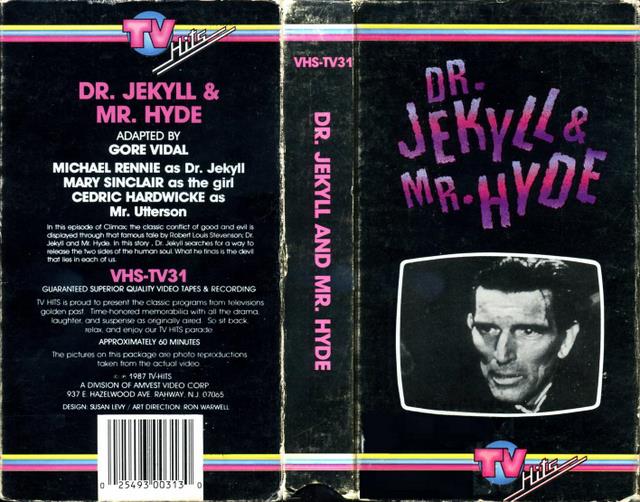
Out-of-print VHS which is complete, with original music, all the credits, and all the original commercials!
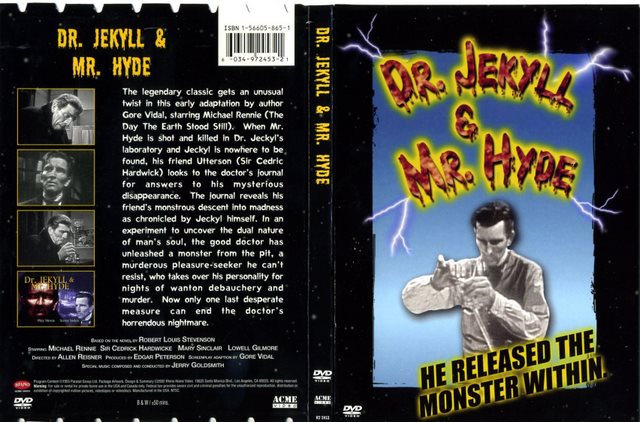
The new DVD, which is a rather nice transfer, considering the poor kinescope source,
but infuriatingly the title music was changed and the main credits were deleted, as were the commercials.
There’s a rival DVD available from Alpha Home Entertainment.
No. Don’t even think about it.
References:
• “On Television,” The New York Times, 1955-07-28-Thu, p 47:
Clickables:
• TV.com
• IMDb
•
The Gore Vidal Finding Aid
lists the following: Container 283 Dr. Jekyll and Mr. Hyde : Ts, 1955. 1 folder. Final draft. Aired on Climax! (CBS), 1955 July 28.
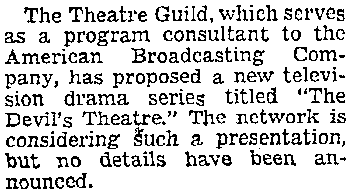
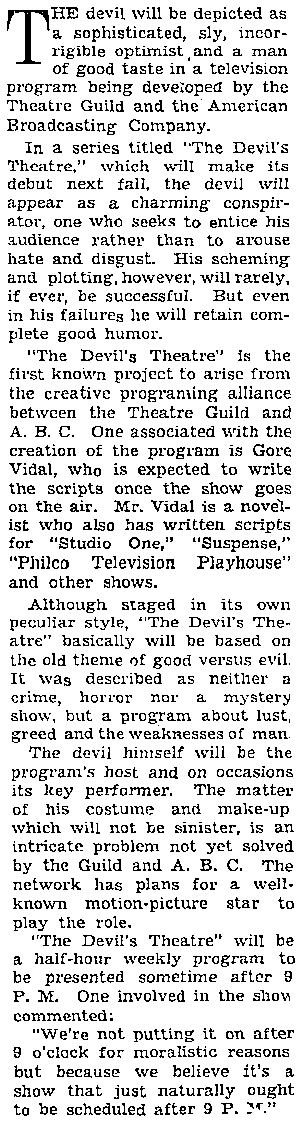
THE DEVIL’S THEATRE
This one sounds like it had potential.
But it was never made.
Here are the stories.
Fascinating, yes?
• Val Adams, “Churchill Agrees to Story on Radio: Escape as War Correspondent Will Be Given on C.B.S. &145;Hall of Fame’ Jan. 30,” The New York Times, Friday, 21 January 1955, p 29:
• Val Adams, “News Gathered from the Studios,” The New York Times, 1955-02-13, p 121:
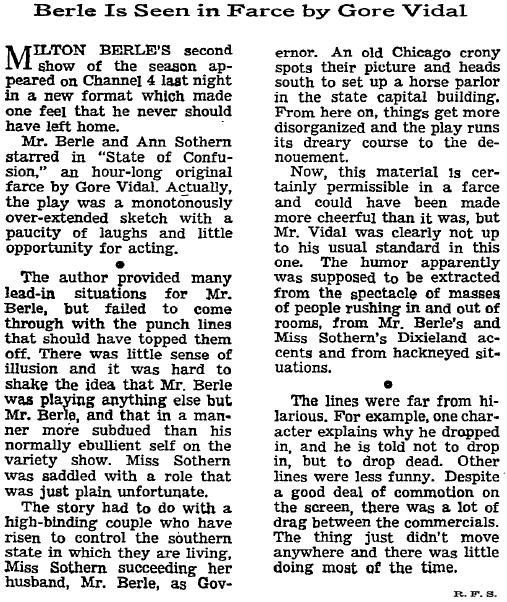
STATE OF CONFUSION
Aired (live?) on Tuesday, 18 October 1955, 8:00–9:00pm EST, on NBC,
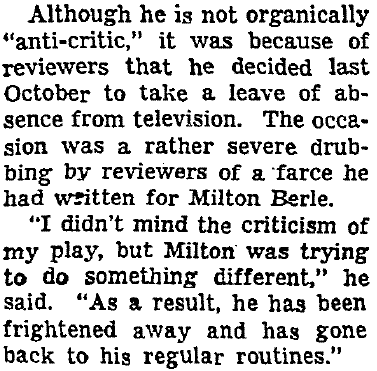
as part of the “Texaco Star Theatre: The Milton Berle Show”
I would love so much to see this.
It probably still exists, since Milton Berle’s estate seems to have kept his shows somewhere, though heaven knows where.
There are a few sites on the Internet that supposedly offer this, but they insist that first you install malware. Uh uh.
I won’t do that.
Here are the references:
• “On Television,” The New York Times, Tuesday, 18 October 1955, p 75:
• Review: Richard F. Shephard, “Berle Is Seen in Farce by Gore Vidal,” The New York Times, Wednesday, 19 October 1955, p 67.
• Richard F. Shephard, “What Makes a Television Play?” The New York Times, Sunday, 17 June 1956, p 107:
Clickables:
• TV.com.
•
The Gore Vidal Finding Aid lists the following: Container 311 State of confusion : Ts, [ca. 1955] 1 folder.
Written by GV especially for Milton Berle. Production information incomplete. The show possibly aired on an unknown program on 1955 Oct. 18.
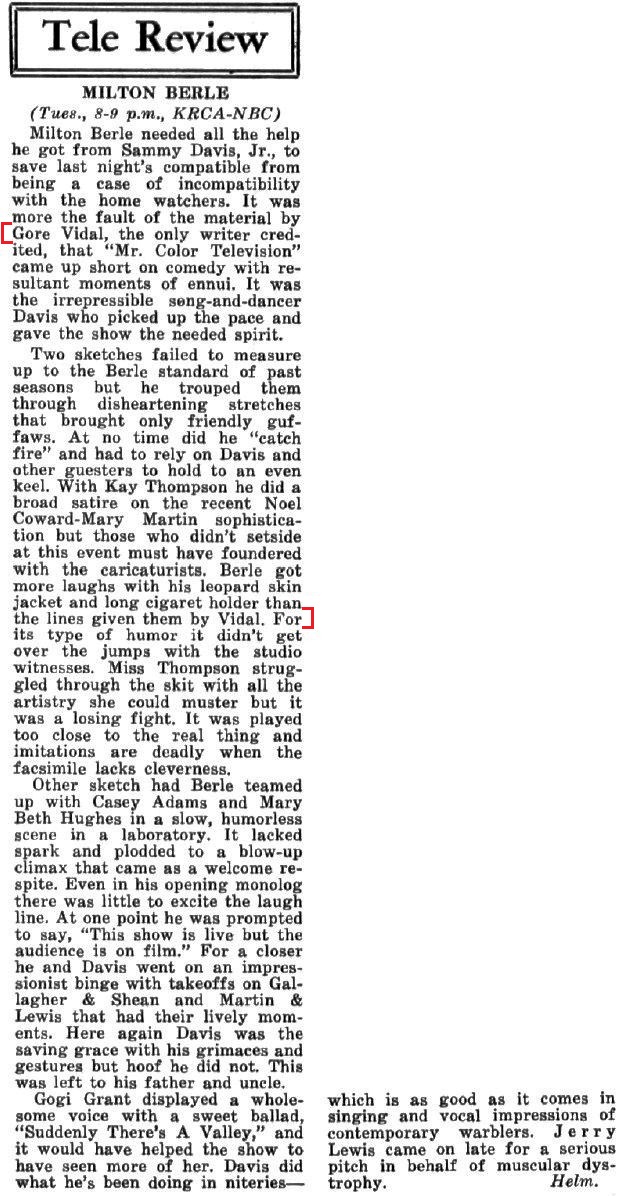
Now, don’t be fooled by the mistake.
The color episode (kinescoped only in b&w) of The Milton Berle Show from Tuesday, 8 November 1955, 8:00–9:00pm,
had a mistake in the credits.
That’s probably why the credits are missing from all of the Paley Center’s copies.
“Helm.” of Variety made note of those credits,
which is the only reason we know what they once said.
Daily Variety, Wednesday, 9 November 1955, p 13;
Not too complimentary, what?
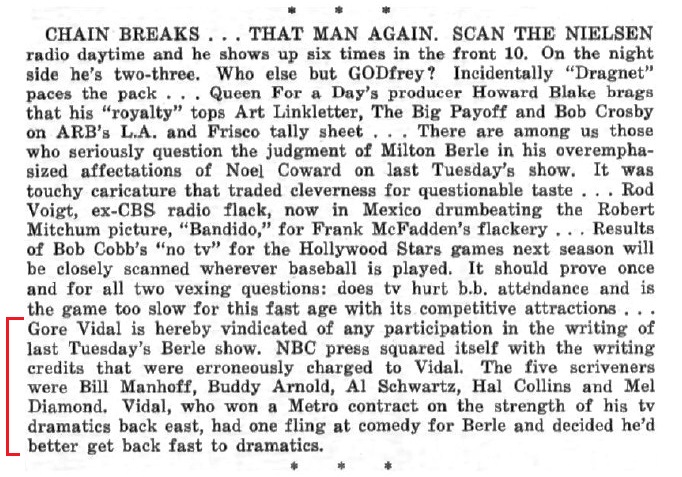
Well, the mistake was soon corrected.
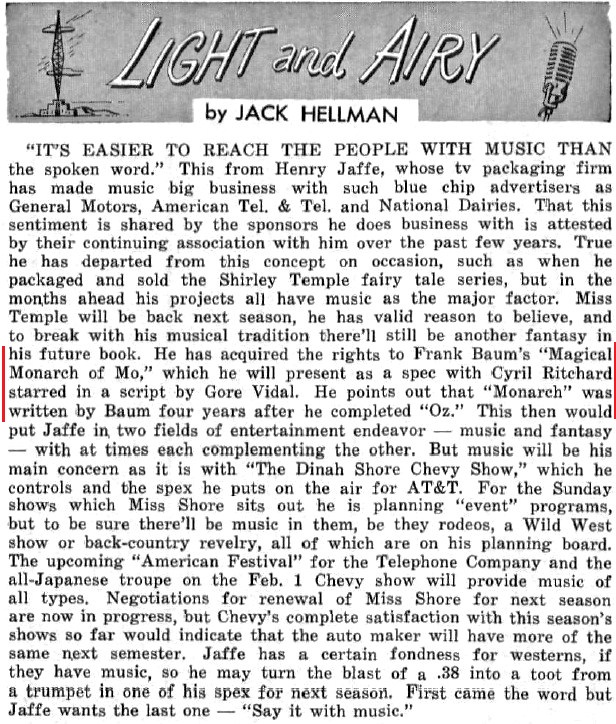
Jack Hellman, “Light and Airy,” Daily Variety, Thursday, 10 November 1955, p 14:
RADIO FREE EUROPE
I know of only one tantalizing reference:
•
The Gore Vidal Finding Aid lists the following: Container 3057 Radio Free Europe (television script) : contract, 1955. 1 folder.
So what was this? A play?
Or was this, more likely, a gig on Radio Free Europe, possibly an interview?
If you can dig through the Harvard files,
please write to me and let me know. Thanks!
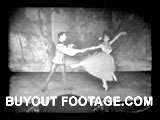
PORTRAIT OF A BALLERINA
Aired live on Sunday, 1 January 1956, on CBS,
as part of the “General Electric Theatre” anthology series,
season 4 episode 14 (whole number 79)
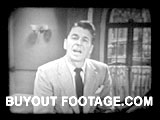
A Gore Vidal play hosted by Ronald Reagan?
Portrait of a Ballerina, like Gore’s other ballet piece,
Death in the Fifth Position, was written under the name of Edgar Box.
A distributor called Buyout Footage has this available for purchase or rental as a public-domain item.
If you wish to spend lots and lots of money to purchase a copy of this episode,
click here.
A video copy, transferred from a 16mm kinescope, is also on file at the
‘Ronald Reagan Presidential Library,
National Archives and Records Administration.’
Of course, all this leaves unanswered the primary question of where the kinescope is located.
“Portrait of a Ballerina” was an outgrowth of a contract
signed with the General Electric Theatre on Tuesday, 27 July 1954:
1. We hereby employ you to prepare and furnish to us an original script...
entitled ‘DEGAS
BALLET STORY’ and to be written by you.
2. You agree to write said script as required and directed by us, in complete form ready for telecasting,
and you further agree to promptly make all changes and additions required by us.
You also agree to attend all rehearsals, previews, script and story conferences as and when requested or directed by us.
3. As an inducement to our employing you hereunder and making the payments hereinafter provided for,
and with the knowledge that we are relying thereon, you hereby represent and warrant to us that said script or any part thereof,
is completely original with you and that you are the sole and exclusive owner and author thereof,
and that our use of the said Script including the production, performance and telecast thereof
shall not constitute an infringement of the legal, equitable or any other rights of any person, firm or corporation.
|
The contract goes on to stipulate that the episode must be broadcast no later than Sunday, 19 June 1955.
See The
Gore Vidal Finding Aid, which lists the following:
• Container 3010 Degas ballet story [television script] : contract, 1954. 1 folder.
I was just now (23 February 2015) contacted about a web page devoted to
Edgar Degas,
which is well worth studying.
Here are the other references:
• “TV Programs This Week,” The New York Times, 1956-01-01-Sun, p X10:
Clickables:
• TV.com
• IMDb
• The Gore Vidal Finding Aid lists the following: Container 303 Portrait of a ballerina : Ts, 1955. 1 folder. Revised draft of television script. Dated 1955 Sept. 21. Based on the novel Death in the Fifth Position by Edgar Box, pseudonym of GV. Aired on CBS, 1956 Jan. 1.
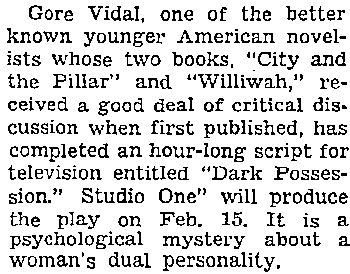
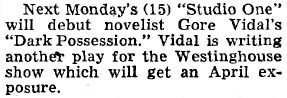
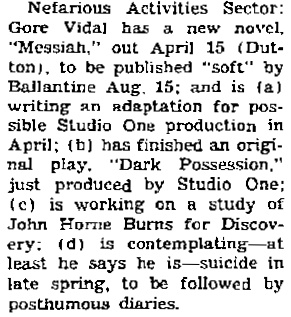
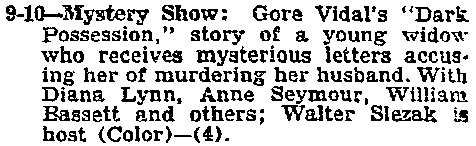
DARK POSSESSION
Aired live in color on Thursday, 2 February 1956, 3:00–4:00pm EST, on NBC,
as part of the “NBC Matinee Theatre,”
season 1 episode 67
This was NOT a repeat.
It was a new performance, with a new cast and a new crew,
of Vidal’s first teleplay.
Where did it go?
Who has it?
Where can we see it?
Does it still exist?
References:
• “Television Programs: Wednesday through Saturday,” The New York Times, Sunday, 29 January 1956, p 109:
DARK POSSESSION
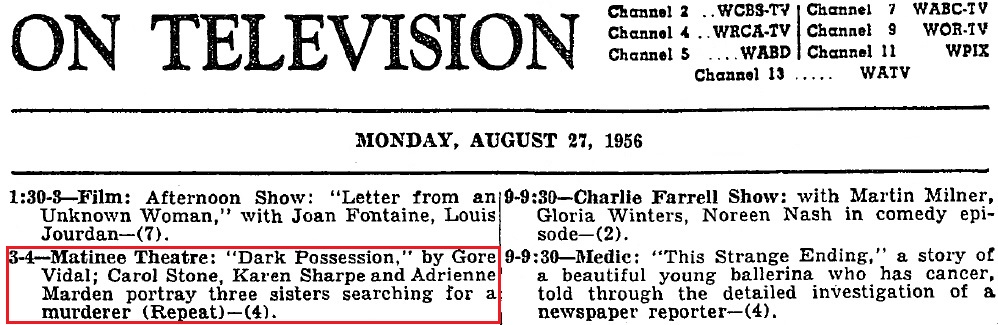
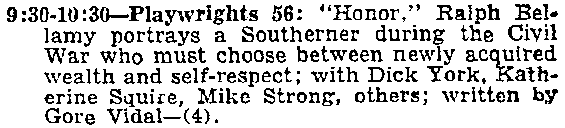
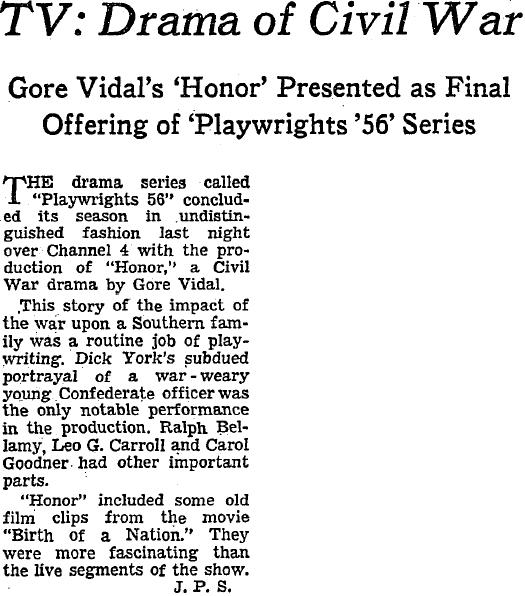
Aired Monday, 27 August 1956, on NBC,
as part of the “NBC Matinee Theatre”
Third performance. The New York Times (Monday, 27 August 1956, p 41) said it was a repeat (not in color).
And the IMDb’s listing for
“NBC Matinee Theatre”
indicates that the only performance of Dark Possession was on 2 February 1956,
and that there was no original broadcast on 27 August 1956.
Despite all that, look below at what Variety had to say.
Furthermore, compare the cast listings.
That’s why I’m pretty sure this was a third performance.
|