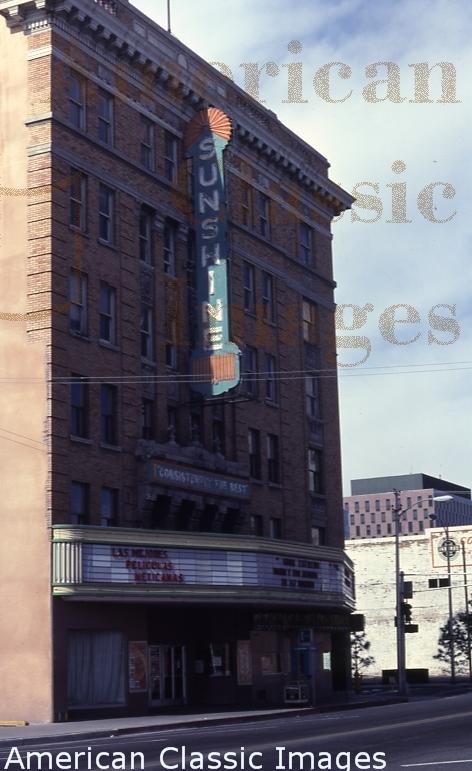
 The Sunshine Building as it looked in 1981, just before the vertical sign was removed |
The Sunshine TheatreA Most Informal and Personal Story
|
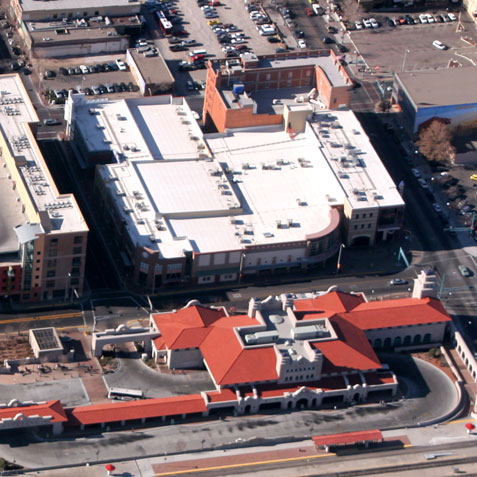
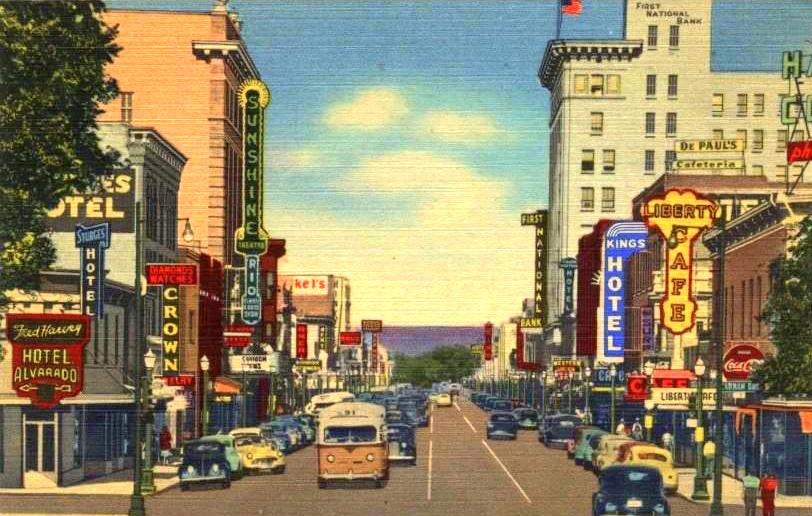 Courtesy of Mo Palmer, here’s a linen postcard from the 1940’s, showing downtown Albuquerque when it was still a real downtown. (Note the cast-stone trophies on the ballustrade atop the Sunshine Building, which are no longer there.) Almost everything has been demolished, in a purported attempt to improve business. The result was doom for small businesses, which I’m sure was one of the principal points of the exercise. Perhaps the saddest loss of all was the Hotel Alvarado. 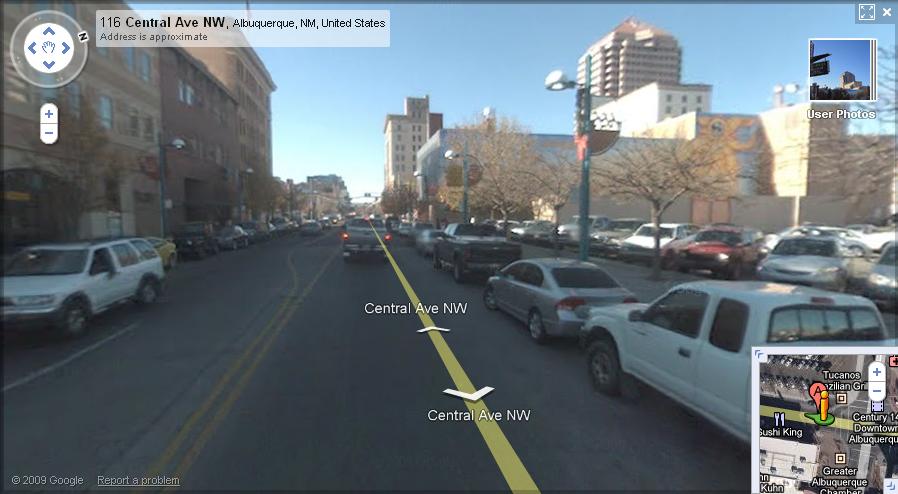 Here’s the view today, according to Google Maps. (The fisheye lens exaggerates the perspective, making objects look much, much more distant than they really are.) All the character and excitement are gone. When downtown was effectively wiped off the map, Albuquerque underwent an unexpected transformation as small businesses started opening on Central Avenue between University Boulevard and Carlisle Boulevard, creating a new sort of semi-downtown – nice, not bad, but without the glamour, adventure, or warmth. I never liked anything in Albuquerque east of Carlisle. Unfortunately, many of my formative years were spent in the sprawling suburbs east of Carlisle. Irony, you know.... |
The owner of the building, Francis A. Peloso – Frank to his intimates, Mr. Peloso to everybody else – decided to try something different. Rather than lease the theatre out to another chain, he operated it himself, running a program of repertory movies, mostly from the 1930’s and 1940’s. How wonderful! He hired a contractor to fix the east side of the building. It had originally been attached to other buildings that had recently been demolished, and the outlines of what was once there made the place look like a slum. The contractors stuccoed it, and then it looked fine. I attended as often as possible, especially when the programming went a little out of its usual realm and delved into the 1910’s and 1920’s. It was there that I would watch Charlie Chaplin and Harold Lloyd and Mae West and the Marx Brothers and Buster Keaton and WC Fields. It was there that I discovered such trivial but thoroughly enjoyable junk as Libeled Lady and It Happened One Night and North by Northwest and so forth. Delightful days. I enjoyed myself. It was sad that so few people showed up. In an auditorium the size of the Carlsbad Caverns, it was disheartening that the typical audience was only a dozen or so people. But something else was wrong too.
I had just recently purchased the Bramhall reprint of Ben Hall’s pathbreaking book on movie palaces,
The Best Remaining Seats, and that’s the book that began to show me what was wrong.
The Sunshine Theatre as I knew it was not the Sunshine Theatre that had opened on the first of May 1924.
It had been changed.
The stage had been extended and completely covered the orchestra pit,
and new footlights had been improvised at the end of what had once been that orchestra pit.
The auditorium was not inviting, but forbidding, merely an enormous hollow space.
A projectionist friend, Bob Schaeffer, had once told me that of all the projection booths he had ever worked in,
the most intimidating was the one at the Sunshine.
“The Sunshine’s booth will scare you to death!” he exclaimed.
What an enticing statement! I determined to take a look.
One day in 1977 I attended a showing of The Philadelphia Story,
and I was astonished at how horrible the picture quality was.
It was all blurry grain, so indistinct that it was nearly headache-inducing.
I couldn’t understand why.
The preview had looked just fine, so why did the feature look so awful?
Ross Cacavalli was the manager in those days, always dressed in suit and tie,
and I asked him if I could visit the projection booth.
Of course! He would be delighted to escort me up to the projection booth and introduce me to his projectionist, Bob Manke, Sr.
Ross was quite proud of the booth, because not only could it run 35mm and 70mm, it could also run 16mm.
He told me that the theatre had just purchased and installed a 16mm pedestal machine,
and that The Philadelphia Story had been presented in 16mm.
“Oh that’s why it looked so bad!” I blurted out, but Ross pretended not to hear me.
Didn’t it look good? he asked. Would anyone realize that it was in 16mm? Surely not!
He was thrilled that 16mm at the Sunshine looked every bit as good as 35mm.
My view was a bit different, but I didn’t press it.
So a few minutes after the next show started, once the audience was all settled in,
Ross walked me up to the mezzanine, unlocked the door to the balcony, walked me up the ramp to the loge,
then turned around and walked me up a balcony that was several stories tall,
so steep that it seemed to verge on 90 degrees, up what seemed half a mile to the projection booth,
which jutted out from the back wall, as so many 1920’s projection booths did.
After making that Everest-like ascent, we turned into what was probably once a followspot booth or Brenograph booth,
which was up another few very steep steps, and then a few more steep steps up to the projection booth,
where we were greeted by the delightfully friendly Bob Manke, Sr., who was thrilled to have a visitor.
One look inside and I understood what Bob Schaeffer had meant by a booth scaring him to death.
This one would do it. The machines looked three times larger than normal projectors.
I couldn’t understand why, because they were normal-sized machines.
But in a moment I saw the source of the illusion.
Each projector was resting atop a foot-tall concrete slab.
To reach the feed reel one would need to use a step ladder,
which is precisely what Bob Manke used when I saw him reload the 35mm preview.
The new Norelco 16mm (an FP-16, I think) was purring away.
It was a backwards machine, with the film side and the gear side reversed, which facilitated squeezing it into a tight booth.
It was huddled up against the regular machine # 2, so closely that it was almost touching.
Bob showed me around the booth, and pointed out numerous switches and push buttons that were once connected to something or other,
but all memory of their purposes was lost.
The wires had been pulled, and nobody coud figure out what they had done back in the 1920’s.
He also showed me his little invention.
A new porthole had been cut into the wall for the 16mm movies,
and it had then been discovered that the resulting image was too tall for the screen.
Bob bolted some metal plates to the top and bottom of the porthole window
to crop the height of the image to force-fit it onto the screen. Why, I asked? Why not just get a longer lens? Unavailable.
But the proportions looked right, and I complimented him on running 35mm movies in the Academy aperture,
a feat that no other cinema or theatre in Albuquerque could match.
He confessed to me that he was not using the Academy aperture.
He pulled out an aperture plate for me to examine.
It was a 1:1.75 plate with extra height filed out.
It approached the .600" minimum required for Academy, but wasn’t quite there.
It was maybe .520".
All films were cropped.
I saw how he had filed the aperture with a reverse keystone, severely,
to help return the image on screen back to something vaguely resembling a rectangle.
And he also filed all his apertures curved, like a smile, to compensate for the curvature of the screen.
From the booth the screen’s curvature was far more noticeable than it was down on the orchestra level.
It was curved not only left and right, but also up and down, in the shape of a deep bowl.
And it was even more obvious that the screen was tilted back, more than a few degrees.
It seemed to be tilted back more than thirty degrees, though that was surely another illusion.
The projectors were tilted forward as far as they would go, about 30 degrees,
and even with the screen tilted back, the keystoning was extreme.
I pondered the setup for a few moments, and saw that, since the balcony extended almost all the way out to the stage,
if the projectors were on the floor, the bottom of the image would hit the balcony and never reach the screen.
That accounted for the foot-high concrete slabs. Clearly the architect had miscalculated!
The lamphouses were by Strong.
I can’t remember the exact model, but I think it was Futura.
The bases were exceptionally sturdy, possibly Simplex Heavy Duty, but I don’t remember.
The magnetic penthouses, picture heads, and sound heads were
Century JJ.
I had never seen a Century JJ before, nor had I indeed seen any 70mm equipment.
So Bob talked me through the machines.
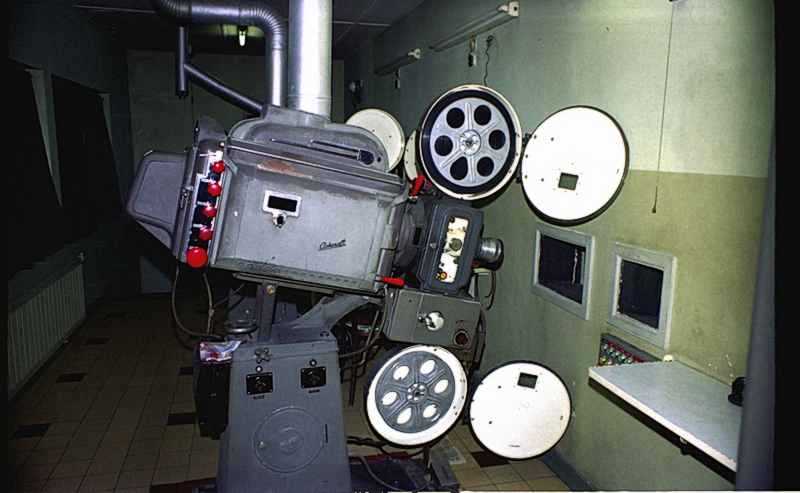 No, this is NOT the Sunshine’s booth. This is the much larger and far more spacious booth at the Ciné Capitol in Antwerp. I include this photo only to give you the vaguest idea of what a booth looks like. The Sunshine’s booth was cramped. The projectionists had removed the “magazines,” leaving the reels open rather than enclosed. And the reels usually in use were not the 2000' (20-minute) size shown here, but the much larger 6000' size holding over an hour of film. The projectors were also raised on platforms, making the top reel impossible to reach without a stepladder. Here’s a video about a projection booth in Nauvoo, Illinois – an RCA booth, with Brenkert heads and Enarc lamps. So now you can see the big secret, the machines that no owner or manager ever wanted you to see, because they were too dangerous to show to mere mortals. This was the mystery that we were never allowed to know anything about. So what was the big deal? Can you figure it out? I can’t. If you want more, here’s a video of a booth that’s slightly more like the Sunshine’s. |
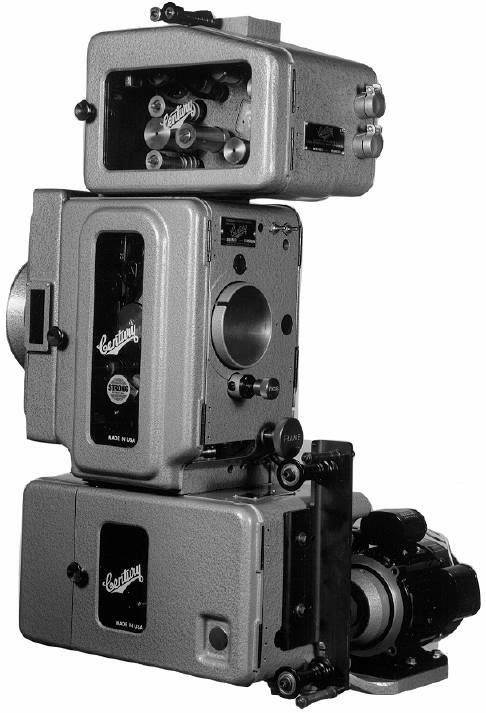 A considerably more modern version of the Century JJ components used at the Sunshine. I think the ones at the Sunshine were painted wrinkle black, not metallic grey. The top piece is the “penthouse,” used to reproduce the stereophonic magnetic stripes. The middle unit is the picture head, which, of course, reproduces the picture. The bottom piece is the optical sound head, which reproduces the then-monaural optical sound tracks. The drive is a single-phase AC motor. |
At age 17, pretty much all I knew about 70mm was that it was large, wide, had six-track magnetic sound, and that it was supposed to run on wraparound Cinerama screens. But a Cinerama screen was an impossibility in a theatre of the Sunshine’s design. True, he said; 70mm was run on the Sunshine’s screen at the Cinemascope setting. The extra value was in the clarity, not the resulting screen size or shape. What about the 16mm machine? Why was the Sunshine, with its gigantic screen, running 16mm, which was designed only for small screens? Because, he said, most of the repertory movies that the Sunshine wanted to show were no longer available in 35mm. So the choice was either to switch programming altogether, or program in 16mm. I was heartsick. (It turns out that the claim was untrue. Most of these films were easily available in 35mm, but 16mm rentals and shipping were cheaper.)
I asked about the organ, the stage, the equipment for silent movies, but on these subjects Bob knew precisely nothing.
It was not that he knew nothing about the specifics of the Sunshine’s old presentations
of silent movies accompanied by an organist and/or orchestra, preceded by a few vaudeville acts.
No. That wasn’t the problem.
He knew nothing about silent movies or organs or vaudeville acts at all, at the Sunshine or anywhere else.
I think it was Bob, though, who told me a different story, a story about the time a few years previously
when some kids sliced the bottom of the beautiful red curtain off.
I think they were caught and arrested, if memory serves, and the theatre had to pay a fortune to get the curtain replaced.
Though Mr. Peloso was rightly proud of what he called the “waterfall curtain,”
the correct term is “Austrian Drape,”
and you can see one in action on YouTube.
We continued to chat, not only about the Sunshine, or about movies, or about machines, but about everything under the sun.
Now, back in the 1970’s all managers everywhere frowned upon visitors to the projection booth,
and most would not allow visitors at all.
I was thrilled to get so much time to explore, but I knew that my visit must soon come to an end, else sparks would fly.
Yet I did want to stay around to see the 35mm preview, which would mean I would have to stick around for another hour or so.
Then came a loud scraping sound.
The intercom between the office downstairs and the booth upstairs must have been installed around 1930.
The units were large, metal, with black enamel paint,
and gave no warning buzz or beep or alarm of any kind to attract the other party’s attention.
So to let the other side know that you wanted to chat, you had to run your fingernail against the steel grating.
And that accounted for the scraping sound.
Bob said “Yes?” and Ross answered back in a pleasant voice, “Is Ranjit still up there?”
“Yes he is,” said Bob pleasantly,
to which Ross inhospitably barked back, “Well tell him I think an hour is long enough to see a booth!!!”
Bob turned to me with a sad smile on his face and said, “He’s also part a**hole.”
Did Ross hear him say that? Probably, I fear.
Bob and I exchanged our good-byes, and I climbed down from the booth and got instantly confused.
Why wasn’t I on the balcony? Where was I? Ah!
I was in the side room, what I now guess was once a follow-spot booth or maybe a Brenograph booth.
I stepped down from that and took one last look down that magnificent balcony.
I had been in a few balconies before, but this was just the bee’s knees.
It was so tall, so majestic, and the screen was so many stories below and was so easy to look at, that one never wanted to leave.
At the top of that balcony, one felt as though one were sitting at the top of the world.
It was exhilarating. But I knew I had to go.
I walked down the treacherously steep balcony and reached the loge level,
turned right to go down the ramp to the locked door and back to the mezzanine,
and noticed that I was once again passing by a door.
Why was there a door at the side of a balcony?
I looked more carefully. It was a double door.
Between the two doors there was just enough space for me to see through.
I put my eye directly against the doors and looked in.
Behind the double doors was a short corridor, which led to the office-building portion of the Sunshine Building.
At the other end of that corridor was an old door, surely original from 1924,
with a frosted-glass window, with what was surely the original sign painted onto it, in gold letters with black bordering.
I wish I could remember the name, but it was “DR. [SOMEBODY], DENTIST.”
Why on earth would a dentist’s office be directly connected to a theatre’s balcony?
But there was no time to tarry.
I had to get downstairs before I got into even more trouble and put Bob’s job on the line.
Ross was waiting for me, and he was not happy.
I thanked him for allowing me to visit the booth, but he was fuming.
I explained that I just wanted to stay until I could see the 35mm machine run,
and he huffed that I had already seen enough 35mm machines run and that this one would be no different.
I thanked him again, but he wanted me gone,
and angrily explained that he had done me a favor by letting me up to the booth and that I had taken advantage of his kindness. Oy.
I left, glad to get away from Ross, but sad to get away from the theatre.
A week or two later, when I could see that Ross had calmed down and was his usual gentle, happy, carefree self,
I mentioned to him that it would behoove him to look into getting different lenses, as all the films were cropped.
He knew about that, but it was all right, he was sure.
For instance, during the recent run of Pat & Mike, the golf ball in the golfing sequence was never visible,
being cropped off the bottom of the screen, but that was acceptable, he happily said,
as it did nothing to ruin the enjoyment of the movie.
Of course, I couldn’t agree, but I didn’t get into an argument by disagreeing.
As I kept on going back to see the movies, I got more and more irritated.
Not only was the auditorium changed, so was the lobby, so was the office, so was the mezzanine.
The lobby and mezzanine were in art moderne style, which didn’t exist in 1924.
Then, needing more office space, Mr. Peloso had a new office built up in the mezzanine, between the two small restrooms,
making the lounge area even smaller.
And unlike other theatres, where it was possible to arrive early and chat with the crew, this one was coldly efficient.
The doors would open just before a show, the staff and crew were safely positioned,
and nobody was available for any sort of small talk.
The house rule was the traditional “get ’em in here, get their money, get ’em out again” ideology
so beloved of businessmen.
Though the building would never be restored, at least the presentations improved.
Gone with the Wind was scheduled yet again,
and the 35mm preview that MGM shipped over advertised the new 70mm print.
Little did most people know that the movie would be presented in 16mm.
I didn’t bother to attend.
I had seen the movie before and had no desire to see it again, especially not in 16mm.
There must have been large audiences that week – and there must have been large complaints.
The Sunshine never ran 16mm again.
All future presentations were in 35mm, except for Jolson Sings Again which was in 70mm (and which I missed for some reason).
One day I saw Bad Day at Black Rock, to which my mother had sung praises.
I did not know that the movie was Cinemascope,
and once I saw that the masking was opened to the Cinemascope ratio, filling nearly the entire width of the proscenium arch,
I knew we were in for trouble.
If keystoning is bad on Academy-aperture movies, it will be twice as bad with Cinemascope,
because Cinemascope squeezes the image on the film and the lenses stretch it out again on screen.
So if keystoning makes the bottom of an Academy movie ten feet wider than the top of the image,
then Cinemascope will make the bottom twenty feet wider than the top.
And that’s about the way it was.
The curvature of the screen was more drastic than I had thought, and the tilting was more obvious, as was the bowl-shape.
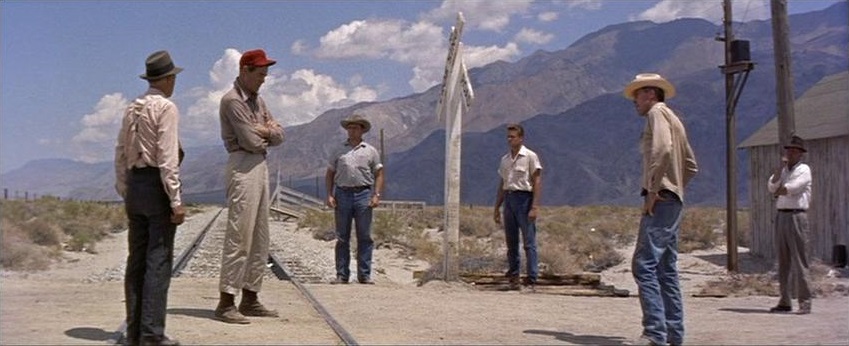 Sort of the way it looks at a regular cinema. As you can see, the composition intended to be slightly disorienting. 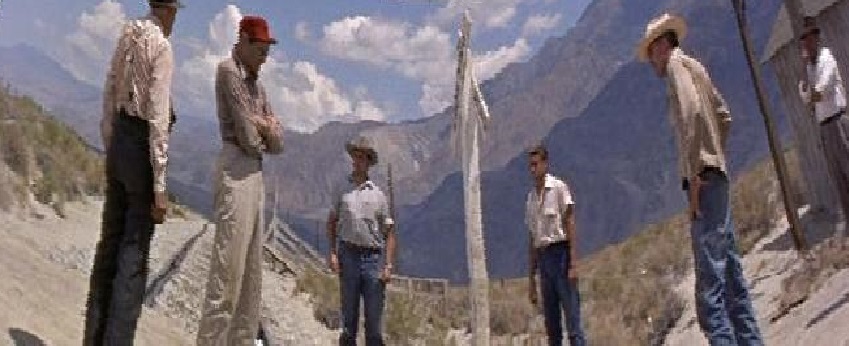 At the Sunshine it was more disorienting than the filmmakers ever intended. Did audiences complain? Of course not! Nobody noticed – until I pointed it out. “Oh. Yeah. Wow. Look at that. I never noticed that before.” |
The two
Bob Sr. was getting ready to retire, which is why he started to train Bob Jr., but, alas, other projectionists were brought in.
Some of them I knew and some of them I was on friendly terms with.
I asked one if I could visit him in the booth.
“You’ll have to ask Mr. Peloso.”
So I asked Mr. Peloso. He was distinguished-looking, in his 60’s, stocky, white hair, white mustache, and a beautifully genteel voice.
Looking past me, in his condescending way, he replied absolutely not.
No visitors are allowed to the booth, at any time, for any reason, no matter who they are,
not even if they’re union projectionists themselves, under any circumstances, no matter what.
Well, I informed him, you do know that Ross Cacavalli had once walked me up to the booth?
“I know. And he shouldn’t have. And he knew he shouldn’t have. I talked with him about that.
But it’s okay. You didn’t know. No harm done. But you’re not going to do it again.”
So I gave up on that venture, and returned only to see the movies and to wonder what the building had originally been like in 1924.
I couldn’t picture it. Surely there was decorative plaster molding, along with a nice color scheme.
The only remaining decorative plaster was that surrounding the proscenium.
I paid a visit to the downtown library to go through the microfilms of the newspapers on the day of the opening. Precious little.
There was a two-page advertisement spread, consisting partly of press releases,
and those two pages included boasts about the opening première, Ramón Novarro in
Scaramouche. That was it.
There was only one illustration of the interior, which was an artist’s rendering, probably drawn prior to construction.
Here it is:
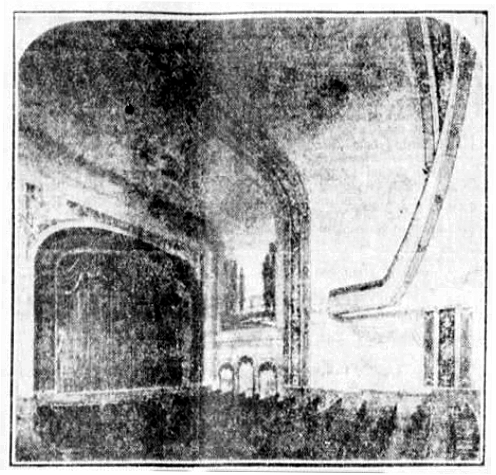
The newspaper apologized that a number of other illustrations got lost in the post and hence could not be published.
Blast it all!
You can see the two pages of ads and press releases here.
The articles are largely illegible, and so I hereby transcribe the important sections.
|
SUNSHINE THEATER MOST
MODERN TO BE FOUND IN SOUTHWESTERN DISTRICT
Seating, Stage Equipment, Heating and
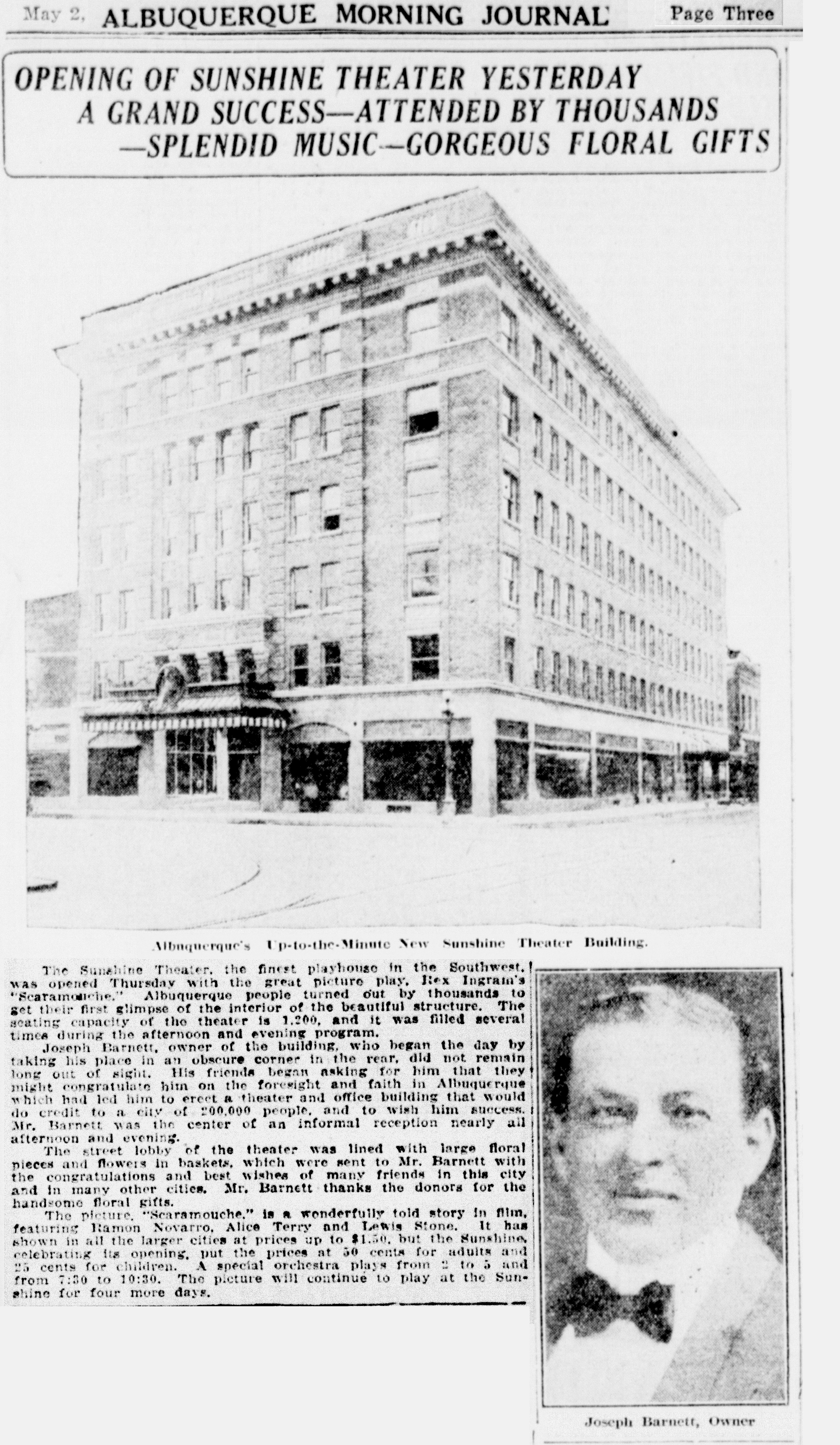
Ventilation Unsurpassed; Structure Entirely Fireproof; Contains 72 Offices and Five Business Rooms; Cost Over $200,000
Joseph Barnett’s new Sunshine
building at the southeast corner
of Central avenue and Second
street, is one of the principal
“show” places of Albuquerque
for two reasons:
First — Because it is one of the
most handsome and commanding
structures in the entire state.
Second — Because it contains the
Sunshine theater, pronounced by
architects and members of the
theatrical profession as the most
modern and beautiful theater in
the southwest. Denver may have
larger theaters, but none so up-to-the-minute
in design and equipment.
The entire structure is strictly
fire proof, and the patrons of
the theater or the occupants of
the stores and offices are assured
of absolute safety from
fire.
The building has a frontage of
75 feet on Central avenue and 142
feet on Second street. It is six
stories in height and its roof is
85 feet above the street. Its cost
was over $200,000.
The building contains 72 office
rooms. Five business rooms occupy
the ground floor, three facing
Central avenue and two on
Second street.
The building has a heavily reinforced
concrete skeleton, the
first of this type in New Mexico.
The facings of the entire first
floor are of marble and the remainder
of the structure, towering
high into the air, is faced
with smooth golden brick, handsomely
trimmed.
Most Modern Theater
The theater has a seating capacity
of 1,200. Eight hundred
seats are on the orchestra floor
and 400 in the gallery. The pitch
of the floor and the arrangement
of the seats is such that there is
no seat in the theater from which
a full view of the stage cannot
be had. The acoustics are perfect,
having been perfected from the
result of a study of the subject
from its scientific aspect, and a
scrutiny of the most modern
theaters and auditoriums in the
country.
The stage has a width of 42 feet
and a depth of 29 feet. The
arch is 27 feet feet in width and 24
feet in height. The fly gallery is
22 feet above the stage and the
gridiron 52 feet. This will permit
of the handling of all the
scenery accessories of any theatrical
production. The interior
decorations of the theater are
beautiful. They are restful to
the eye and give a feeling of comfort
and repose. Artistic simplicity
has been attained in a remarkable
way. This work was done
by artists and sculptors who devoted
months to the task.
The theater is entered through
a large lobby finished in marble,
facing on Central avenue. From
the interior lobby, flights of stairs
go up on each side to the gallery.
On a mezzanine floor, half way
up to the gallery, are located a
large rest room for women and
another for men. Four large
dressing rooms are provided for
the stage.
Perfect Ventilation
The heating and ventilating
system assures a constant current
of warm fresh air through all
parts of the theater in winter and
cool air in summer. The air is
taken in at the roof level, above
the dust and odors of the street,
and is conveyed to the basement,
where it is washed and distributed
through the theater by means of
vents under the seats. It escapes
through a large grill in the roof.
Thirty-five thousand cubic feet of
air will circulate through the
theater every minute, without
draught. The heating and cooling
apparatus is in the basement.
A large pipe organ is now being
installed in the theater. All
the pipes and other mechanism,
aside from the player’s keyboard
in the orchestra pit, will be out
of sight. The music will come
through a grating in the ceiling.
The entrance to the offices is
on Second street where a good
sized lobby leads to the marble
stairway and the two elevators.
The office rooms and stores are
heated by steam. Every room has
running water, both hot and cold.
Pure water is piped to drinking
fountains in the theater and on
every floor of the office part of
the building.
Four of the five business rooms
have been rented and tenants are
moving into the offices.
Who Did the Work
The building was designed and
its construction supervised by
Trost and Trost, Albuquerque
architects.
Robert M. McKee, Albuquerque and El Paso, was general contractor.
Arno Huning, Albuquerque, installed the wiring. The
Sanitary Plumbing and Heating
company of Albuquerque, installed
the heating and ventilation.
Raabe and Mauger, Albuquerque,
furnished the foofing and much of
the heavy hardware. The Mead
Hardware company, Albuquerque,
furnished the finished hardware.
E. R. Berry, Albuquerque, did
the plastering. The decorations
are by the Mitchel-Halbach company,
of Chicago. McFee and
McGinnity, Denver, furnished the
mill work. The Albuquerque Paint
and Glass company supplied the
glass for the entire structure, and
Frank Yelston, of El Paso, did
the painting. P. O. Sorensen, Albuquerque,
furnished the cement,
wall and ceiling material. The
brick were furnished by the International
Brick company, with
offices in El Paso and plant in
New Mexico and owned by the International
Brick Layers’ Union.
The Owner
Joseph Barnett, owner of the
building, has lived in Albuquerque
for more than thirty years.
He has such faith in the future of
Albuquerque that he is investing
the savings of a lifetime in Albuquerque
property. He is the
owner of the Barnett building, a
three-story structure on the corner
immediately west of the Sunshine
building, and other valuable
pieces of improved and unimproved
property in the business section.
INTERIOR DECORATION SCHEME OF
THEATER BEAUTIFUL AND RESTFUL
The interior decorations of the
Sunshine theater are characterized
by simplicity and restfulness.
George Hodel, of the Mitchel-Halbach
company, of Chicago, which
designed and installed the decorations,
attained the desired effect —
one that will give the visitor to
the theater a feeling of pleasure
and repose.
There are no discordant notes,
no concessions to what was once
called the “popular taste” before
the fallacy passed that foisted
so many bizarre and hopelessly
ugly decorative ideas upon the
many under the mistaken idea
that they were “pleasing all
tastes.”
The proscenium arch is of elaborate
design in the conventional
gold finish. Embellishing it there
is draped the only arresting note,
in an otherwise even blend of design
that quickens the pulse of the
artist. These curtains, caught to
the arch by heavy cords, are of a
vivid green. The heavy curtain
of the stage is of purple plush.
Above the arch there is designed
a charming idyllic scene, merging
across the house in a fine hymmetry [sic]
and well planned excellence
of detail.
The great inter-arch, stretching
across the width of the usual stage
boxes, is the notable point in the
composition. At the base of this
decoration plan is a sunset scene
with graceful trees and vista in
which the sunset merges across the
dome of the building in the typical
brilliance and purple shadows
peculiar to the southwest. In the
body of the theater the less decorative
treatment blends from the
dome in graduations of color
down to the glazed tile finish of
the lower wall, reaching to the
balcony. A bright effective arch
sweeps overhead across the aduditorium [sic]
about the middle of the
balcony from floor to floor. A
similar arch divides the sunset
panels from the main part of the auditorium.
FIRST BUILDING ON SITE
OF SUNSHINE STRUCTURE HOUSED FEARLESS JUDGE
Thomas Harrison of Beatrice, Neb., Erected It in 1881; Drug Store Occupied Ground Floor and Justice of Pease Sullivan Presided Upstairs; Later Was Saloon for Years
By W. T. McCREIGHT
The old “White Elephant” building,
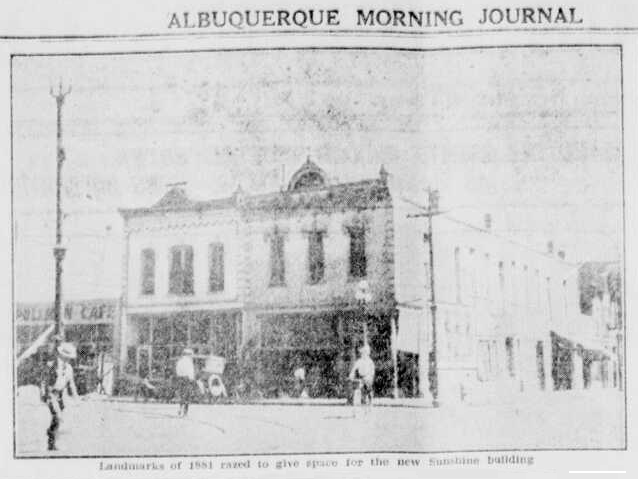
_____ which occupied the corner of Second street and Central avenue, which was part of the site on which now stands the handsome Sunshine theater and office building, was one of the landmarks of Albu- querque for many years. It was George K. Neher who first ope- ned a saloon in the building and named it the “White Elephant.” In those days it was one of the most popular drinking places in New Mexico and many of the best known politicians, business men, railmen and sheepmen have quenched their thirst at its bar.
Joseph Barnett, owner of the
Sunshine building, became owner of the White Elephant structure in the early part of 1910, when he purchased it at what was con- sidered a high price, but which, judged by present realty values _____ was really a bargain figure. Barnett at that time was the owner of adjoining property which ____ is covered now by the big Sunshine building.
With the the tearing down of the
old two-story adobe “White Ele- phant” building, there has been some speculation as to who built it and was its first owner.
One alleged “old-timer” said he
was in Albuquerque at the time it was built and that Col. Perfecto Armijo, now deceased, was the owner. When this “old-timer” met a real “old-timer” and the latter put a few questions to him, he was off in his calculations by over six years.
Hede’s Real Facts
Now here is the “dope” on the
old building, and the writer will ___ go into the long history of the years following its construc- tion.
In the summer of 1881, Thomas
____ Harrison, of Beatrice, Neb., arrived in the village of Albu- querque. He was looking around for investments, and he finally purchased the lot, corner of Sec- ond and the then Railroad avenue, with either Fred Kent or Harry ____g, both now deceased, who represented the New Mexico Town- ship Company. After securing the lot and the necessary papers, Mr. Harrison commended the erection of the building in the name of his wife, Mrs. Matilda Harrison, com- pleted it in the fall of 1881, the year after the arrival of the rail- road.
Drug Store First
____n completed, Thomas F.
______ and George D. Pinger rent- ed the building and opened a drug store. A short time afterwards James Phelan, who was a rising young lawyer in those early days, retired from the drug business, selling his interests to his brother, John Phelan. The upstairs part of the building was partitioned off into office rooms and for several years, Dan Sullivan, the best and most fearless justice of the peace in those early days of cowsboys [sic] and bad men generally, had his offices there.
“Five Dollars and Costs”
Judge Sullivan was an ex-bare
knuckle prize-fighter of the old school, claimed relationship with
the noted John L. Sullivan, and
had the reputation of spotting a
five dollar bill in the pocket of law
violators with an eagle eye, so he
gained the name of “Five Dollars
and Costs,” that being the minimum
fine practically for all who
came before His Honor.
George K. Neher was living
then, he was in the saloon business,
and he wanted the Harrison
building. He tried to buy it from
Col. John Borradaile, who represented
Mrs. Harrison. Mr. Harrison
having died in the meantime,
but could not come to terms with
the colonel, so Neher left to visit
his people at Crete, Neb., and
went to see Mrs. Harrison at Beatrice,
where he negotiated the
purchase of the building from the
owner over the head of Col. Borradaile.
Frank and Al. Harrison, two
sons of the builder, visited Albuquerque frequently during those
early days.
The Boyles Build
Adjoining the Harrison building
on the east, was a vacant lot.
John and Mary Boyle, who followed
the building of the Santa Fe
railroad, and who had charge of
one of the boarding trains on the
old Atlantic and Pacific, came into
Albuquerque with several thousands
of dollars in their pockets;
purchased the lot and built a two-story
frame, where they conducted
a saloon, lunch counter and rooming
house, and believe me, it was
a dandy place.
Next to the Boyle building, was
“Moses Summer Garden,” and it
was all right too in those free-for-all,
good old days that the
real “old-timers” — only a few of
us left — can talk about and tell
some mighty rich stories about.
This article merely takes in a
few years of the early eighties.
We can tell lots since then, but
the story is too long. Maybe
sometime we will write a few real
facts about the early history of
Albuquerque, some of the stories
I reported when connected with
the papers of those days.
|
So, what do we make of all that? The sparseness of the auditorium design was a flaw from the beginning, excused with the facetious claim of deliberately not following a false “popular taste.” Interesting to learn about the marble, which is all gone now. The lobby and mezzanine must have been nice, but they were converted to art moderne in 1950. The murals in the auditorium were removed, probably as a sop to art moderne, and the nice Persian arches were deleted as well. The artist’s sketch seems to indicate that the pilasters that encircled the walls and ceiling were rather ornate originally. They were most definitely not ornate with the 1950 remodeling. Why could I never find any trace of the left and right organ chambers? Because there were none. All the pipes poured out their music through a rather small ceiling grill, which was still there the last time I was there in the early 1980’s. So there’s the answer. To cut down on costs, Barnett made sure that the auditorium would be plain and boring.
Oh, the Persian arches.
Apparently the middle arch was the actual access to the corridor leading to the emergency exit.
The two side arches must have been decorative, and nothing more.
So next time I attended a movie at the Sunshine,
I walked up to the exit doors and tried to find any telltale clue of a three-arch gateway to the emergency exit.
Not a single remaining trace.
The auditorium had obviously been replastered, and all the original decorations had been destroyed, undoubtedly.
At the time, I kept on madly wondering what on earth the auditorium might originally have looked like.
I asked around for photos. Nobody had any, and nobody seemed to care in the least.
Nobody ever accused me back in those days of being intelligent.
Looking back on it, I see the reason for that: I was not at all intelligent.
For now that I’ve decided to write this essay, I can recall that there was actually interest.
Before the movies started, there were occasional women (never men, for some reason) who would look around at the building carefully,
walk down to the remnants of the orchestra pit and look up into the balcony with deep interest,
trying to see everything they could.
I should have introduced myself and found allies.
But I didn’t even think to.
(For years my memories were trying to trigger something, but I never knew what.
Now I know.
I later met someone who reminded me of Mr. Peloso in every way –
demeanor, bearing, voice, manner of dress, appearance, everything –
except that this other person was personable and approachable and – there’s no other word – honorable.
And that other person was exploitation-movie producer Dave Friedman.
Heavens! I so wanted to call him, but I lost his number! Drat! And then he died. Horrible.)
After some time had passed, I risked speaking to Mr. Peloso again.
Ross Cacavalli was no longer working as manager,
and so it was Mr. Peloso himself, wearing his suit and tie, who stood in the lobby tearing tickets.
Or if someone else was available to tear tickets,
he would stand by the ticket-tearer in order to watch, warily, every customer who entered.
I asked Mr. Peloso if he had any remnants of the old days of the Sunshine, or any photos.
Looking past me, he provided an answer that, if not especially loquacious, was certainly rather eloquent: “No.” I let it go.
By the way, it was only Mr. Peloso and Ross who wore suits and ties.
They were owner and manager and had to dress accordingly.
Had any underlings dared to dress so formally they would have been considered insubordinate, I’m sure.
More time passed. I began to understand that Mr. Peloso would never deign to give his full attention to a mere commoner.
Nonetheless, I took a chance at attempting to talk with him again. I knew that there was a stage.
Indeed, the loading door back stage was still visible from the alleyway outside,
the flyloft was perched above the city’s skyline for everyone to see,
and the corridors leading to the exit doors in back were about 30 feet long, maybe 40 feet, flanking the stage.
And some fellow theatre students at UNM had told me that they had recently, circa 1977,
gotten permission to go back stage and take the vaudeville drops that had been hanging there since the 1920’s.
They told me that those drops were now in the university’s storage (I never got to see them),
and they told me how amused they were to see that the fly system was still weighted by sandbags
and that the lighting board was a huge wall of resistance dimmers.
They had heard of such things, but had never seen any such setup before.
So I asked Mr. Peloso if I could get someone to escort me on a tour of the stage.
Looking away from me, he replied, “Stage? What stage? There’s no stage.”
I let it go.
Later I asked a projectionist I knew if someday, after hours, he could give me a tour of the stage behind that movie screen.
“Stage? What stage? There’s no stage.”
I let it go.
All memory of the reason has vanished,
but one day I needed to chat with J–, the projectionist, briefly about something or other.
I asked one of the candy-counter kids if he could ask J–
if he had time between shows to come down to see me.
This kid smiled, invited me to follow him as bounded up the stairs.
He unlocked the balcony door for me and invited me in. I was nervous.
“But Mr. Peloso told me not to come up here.” “Oh it’s okay. Go in.” Yikes. What if I get caught?
I walked up the ramp to the loge, looked in again through the double doors into the corridor,
and the “DR. [SOMEBODY], DENTIST” sign was still on the door. I made my way up the balcony.
J– was sitting in a balcony seat by the booth door, watching the movie,
and he looked awfully confused as he saw me approach.
I explained who had let me up, and he looked worried sick.
“That’s not good. I’ll be in a lot of trouble with Mr. Peloso if he finds out that you’re here.”
So I left, immediately.
Some months went by, and I risked talking with Mr. Peloso again.
I asked why 70mm had been installed if there was no possibility of installing a Cinerama screen.
Looking away from me, he answered, tersely, “We had a Cinerama screen once,
but it made people physically ill so we took it out.”
He turned and walked off, not wishing to say anything more.
More months went by. And one day I said to Mr. Peloso how much I loved the Sunshine Building.
Looking away from me, he said he felt the same way, and that so long as he lived,
he would keep it in his possession and maintain it and make sure that it would never be endangered.
A few weeks later the newspapers revealed that he had just sold the building. I asked him why.
Looking away from me, he said that the new owners would show Méxican movies, which were exceptionally fine,
and that they would serve the building well.
He would say no more.
The last show was another double feature, The Time Machine and Forbidden Planet.
Not my type of movies at all, but it was possibly my last chance to visit the Sunshine. So I went.
The doors opened just before showtime, I walked in, and the two candy-counter kids were not sad at losing their jobs.
They were acting as though this were the greatest and happiest day of their lives,
for today was that day that E– (my old boss from another cinema, who had fired me not too long before)
would come by to visit J– in the projection booth. I was a bit stunned.
How could that be, if Mr. Peloso would not allow anyone to the booth?
Well, they answered, E– was privileged, because he was a working projectionist,
unlike me, and so he had full rights to visit any booth he so pleased at any time he so pleased.
They continued to boast of E–’s worth and achievements, contrasting them sharply with my own professional failure.
Was I taking this the wrong way?
Or were those two candy-counter kids just trying to rub my nose in it?
Their remarks were entirely unnecessary.
Mr. Peloso walked in just a minute later.
I said Hi and remarked that I had just heard that E– was going to visit the projection booth.
Looking away from me, he said,
“Who’s E–? He can’t go to the booth. No one’s allowed in the booth.”
He had not known.
This was all confusing, and I felt as though someone were playing a trick on me.
I dropped the subject as though it were a hot potato.
I saw the two movies, which I disliked entirely,
and as the beautiful red curtain came down at the end of the second feature, I felt sad at witnessing the end of an era.
As I walked out of the auditorium I saw a smiling E– bounce down the stairs and leave the building,
happy to have seen J– again and happy to have seen such an oddball booth, I’m sure.
He didn’t notice me, or pretended not to have noticed me.
He was the last person I wanted to see,
and I felt insulted that the candy-counter kids were lavishing praise on this guy whom they had never even met,
and had been lavishing praise on him apparently only because he had fired me from a different cinema.
The new owners took off with a bang. They ran Méxican movies, and they did quite well indeed.
In 1981 they sold the three-story-tall SUNSHINE vertical sign to a museum.
After a few years I finally worked up the courage to attend a Saturday matinée.
Chile Picante was the first offering, and I can’t remember the title of the second movie
(three guys say they have business meetings, but they’re really headed out to Acapulco together for fun and games and gals;
with a single phone call their wives catch them all, and that was one of the funniest scenes I’ve ever seen,
and ever since seeing that movie I laugh every time I hear the name Raúl).
The movies were quite silly, but the audience for them was large.
There must have been several hundred people in the auditorium.
And even though Chile Picante consisted almost entirely of nude scenes (it’s only selling point),
the audience consisted almost entirely of grandparents, parents, and their small children.
Different culture, yes, but it was not until that afternoon that I began to realize just how different.
After the show I talked with the manager-on-duty and asked who the projectionist was.
J– , he told me. I was delighted.
I hadn’t seen him in several years and would love to say hello.
The manager rubbed his fingernail against the intercom, and J– answered.
“There’s someone here who wants to see you.”
J– sounded completely confused. “Who? Well, I guess you can send him up.”
At that moment I blurted out, “Hi J– , it’s me, Ranjit.”
Silence. Long silence.
“I don’t want you up here. I’m still sore at you for what you did.”
“What did I do?”
“You got me into a lot of trouble when you told Mr. Peloso on me that E– was visiting the booth.
A lot of trouble. That was a real dirty thing to do. I don’t want to talk to you.”
Should I defend myself? No. What would be the use? “Okay. Bye.”
So now, at last, several years later, I finally understood the fiendish glee of those two candy-counter kids.
They knew that if they relentlessly rubbed my nose into it by boasting of E–’s special privileges,
that I would mention this to Mr. Peloso, who would become indignant and get J– into career-threatening trouble.
And then they could explain to J– that it was I who had blabbed and caused the upset.
They knew that J– would never think things through and would simply accept their version unquestioningly.
They calculated correctly every step of the way, and their prank worked wonders.
I feel confident that they spent the next several weeks laughing themselves into convulsions
over the splendid success of their little plan.
Moral: This is the inevitable result of élitism.
This is what happens when an élitist employer thinks of employees as naught more than unworthy peons.
The employer’s idea becomes self-fulfilling prophecy, for that employer will hire only people with peon mentality.
(I exempt the projectionists, since in this case the employer did not hire them; the union supplied them.)
The peons will then get back at said employer by behaving deplorably and playing stupid, sneaky, childish games.
So as much as I hope that those candy-counter kids get run over by a steam roller,
I realize that, once again, this problem, like all job-related problems, was a top-down problem.
By the way, now that I think of it, I can’t recall that any woman ever worked at the Sunshine
while Mr. Peloso was doing his own programming.
I could be wrong, but I think Mr. Peloso hired only the male of the species, for whatever reason.
If there was ever a woman there, it would have been in only the lowliest capacity as ticket seller.
And now that this obvious situation finally filters through my thick skull three decades later,
I can recognize how deep the problem there really was.
(NOTE ADDED TUESDAY, 1 MAY 2012: I have been assured by those in the know that Mr. Peloso did indeed hire women,
but I’ll stand by my statement that they were in the minority and relegated to the lower-paying tasks.)
Despite all that, when I left, I felt a little better, knowing that the building was indeed being cared for
and that tickets were selling far better than at any other cinema in town.
But at the same time there were strange things happening.
The newspapers began to report that some real-estate developers were talking City Hall into acquiring the Sunshine Building,
demolishing it, and building a public pool in its place.
Commentators were in favor of the idea, leading me to suspect that they were on more than one payroll.
The very thought of demolition gave me nightmares.
A friend suggested to me that it would be a better idea to combine the two ventures.
The orchestra level could be replaced by a pool, but theatrical shows could continue on stage.
I was too sad to laugh at first, but soon we both got the giggles, inventing a stage show called The Emergent Sea,
in which characters would not walk about on stage but pretend to swim in the air above the stage floor as prop fish were floated around.
Characters would make their entrances by jumping off a high dive visible at either end of the proscenium
and swim down to join the other characters.
When an actor’s mind would go blank, he would call out “Line”
and the dialogue would be delivered to him on a fish hook cast down by someone perched by the top of the proscenium.
The EMERGENCY EXIT signs would be replaced by EMERGENT SEA EXIT signs.
All the while the audience, dressed in top hats and tails, would be treading water,
vocally criticizing the performance during the show.
“He is an actor of the first water, but this play is all wet.”
Despite the few minutes of giggles I was worried, terribly.
What was going to happen to my beloved building?
I discovered that there was a new group, just founded in response to the threat of demolition.
It was called Save the Sunshine, and it was run by
Edna Heatherington Bergman.
I can’t remember who it was who gave me her number, but I called her right away and we had a nice long chat.
She had seen as little of the building as I had,
since managers were not happy about letting people see more than the lobby and auditorium.
I mentioned to her the obvious.
The only major stage venue in Albuquerque was UNM’s Popejoy Hall,
and it could not accommodate all the touring shows that wanted to play in Albuquerque.
The Sunshine had a fully rigged stage, and the building was surrounded by acres of parking.
If someone could just open up that stage and do a tiny little bit to bring it up to date,
the auditorium could be filled for almost every show.
She agreed. She had never seen the stage,
but in her talks with people who had joined her Save the Sunshine group, she kept hearing that,
“You know, there’s a stage back there.”
I had no job and no money at the time, and so I did not join the Save the Sunshine,
and I attended no meetings because I didn’t have a car.
That was our only conversation. I would love to talk with her again, but I can’t locate her anywhere.
It’s as though she vanished off the face of the map.
Almost by accident, in early 1984 I got a job at – well, if I mention it I’ll probably get sued. So never mind.
But I was once again a projectionist of sorts.
The machines I was running had partially melted because a previous projectionist had habitually neglected to close the dowsers.
They were falling apart. The amplifiers were overheating.
The exhaust system was so badly constructed that every time there was a slight breeze outside, the $1,200 reflectors would shatter.
Suffice it to say that it was a mess.
And the owners had no budget, or claimed not to have a budget, to pay for any replacements or repairs.
This was not a job I was going to keep, but in Albuquerque, where jobs were as scarce as hen’s teeth,
I couldn’t cavalierly walk away either.
In order to stay, I needed some expert advice.
Since the Sunshine had similar lamphouses, I called to see if I could visit to chat with the projectionist.
I can no longer remember his name, but he was a nice young fellow
who still maintained the massive collection of Playboy and Penthouse magazines
that had been there when I visited Bob Senior, and this nice young fellow complained about Bob Guccione’s photography.
“Who wants to look at a blurry picture?” he loudly griped.
Upon entering the booth for the first time in so many years,
I saw that it was as scary as it ever had been,
but that it was now in about as sad a shape as the booth that I was trying and failing to run.
The lamphouse wiring had crumbled, and this young fellow had put in a requisition for replacements.
No. No budget. No replacements.
So he pulled the covers off of the bases, gathered up all the scrap copper bars he could find,
bolted them together, and improvised some DC wiring. I looked at it in terror. What if I slip? I would fry.
He told me that the local business agent, Rudy Napoleone, had visited the booth recently and asked,
“Isn’t that dangerous?”
The young projectionist replied, “I never touch it to find out.”
(Incidentally, I noticed something else that afternoon.
I think the house lights were on a simple on-off switch.
But the footlights that shone upon the Austrian drape were on a dimmer,
a resistance dimmer operated by an old-fashioned handle on the wall between the two projectors.
But it was so high up on the wall, maybe nine or ten feet, that nobody could reach it.
To operate it someone had dangled a long wooden handle from the dimmer handle.
What a curious sight!)
I can’t remember precisely what all I asked him, but I do remember that he was as forlorn as I,
and that no solutions were forthcoming.
I did ask him, though, why he was cropping all the Méxican movies at 1:2.00.
He asked, What choice was there?
I said that back in the repertory days, the projectionists had used longer lenses and larger apertures.
“Oh they must have taken that away. There are no other lenses here.”
“I’d be very surprised if they took them away. They should have been part of the building sale.
I bet they’re here.” Pause.
He looked confused, thought for a few moments, looked up at the top of a cabinet,
and pulled down a pair of long lenses, to each of which was taped the old pseudo-Academy aperture.
He looked at the apertures and said, “That would be a lot better! Yeah! But it would overfill the screen.”
“No, not if you put those lenses on. Those make the picture smaller.
You bring in the side masking, and you’ll get the whole picture on screen.”
He was completely confused, never having heard such a concept before.
He didn’t know that different lenses enlarged the image to different sizes.
Oh well, I could see that this was about to lead into that same old argument that I could never win.
I just urged him to try it. He noncomittally said he would.
After having looked at the balcony again, I couldn’t help but praise it, and mourn its closing.
Actually, he told me, the balcony had been opened numerous times for the Méxican movies,
but he preferred it when it was closed.
“I wish those people would just crawl back under whatever rock they crawled out from.”
I was puzzled. He explained.
The balcony audiences were rowdy, and worse than rowdy.
There was one day when he heard a woman just outside the booth door repeatedly cry out “Rape!”
“I tried to run out to help, but someone in the balcony was holding the door closed,
and I couldn’t open it no matter how hard I tried.
Strange thing was, it didn’t seem like a rape; it sounded like the girl was enjoying it.
I don’t know. It’s just weird. I just wish these people would go away.
And they should keep the balcony closed.”
What a disturbing story.
I left and never saw him again.
And then my bosses at the other cinema, well, they did some horrid, horrid things,
and it was impossible for me to work there anymore. It was no loss.
Then in 1987 I moved to Buffalo.
An Albuquerquean friend told me two years later that the Sunshine was now a rock venue.
Méxican movies were a thing of the past.
(I learned only recently that pretty much all Méxican cinemas closed down at the time, because the product completely dried up.)
The screen was gone, the stage was opened, the auditorium floor was leveled,
and whenever something went wrong with the audio, the operators turned up the volume even louder, to the point of being deafening.
For eight years I hated Buffalo.
Then I discovered it’s glorious history,
and so for the next eight years I was in love with it and decided never to leave.
But I had the worst job in the world, and once 9/11 happened, life there became impossible, and so I left and wandered.
Finally, in November 2008, I returned for a brief visit to Albuquerque. Downtown has changed.
A few changes are for the better, as a few lots have been built up rather tastefully.
But even more has been destroyed.
The ugly new stuff remains, even if it’s abandoned,
but a number of breathtaking and irreplaceable antique buildings, which were still in operation, were leveled.
The Sunshine looked to be falling to pieces. But at least it still stood. It was time to do some history.
The three-story-tall SUNSHINE vertical sign, it turns out, was not original. It was added later.
Now, that doesn’t mean that I’m happy it was sold to a museum. Not at all.
It was a beautiful sign, it did nothing to harm the building’s integrity, and did much to enhance it,
besides which it was a great advertising tool.
I asked around some more for photos of the original 1924 interior, and came up empty-handed.
An archive houses the surviving papers of the architect, Henry C. Trost of El Paso, but it has no information about the Sunshine.
The UNM Center for Southwest Studies has plans for the hideous 1950 remodeling, but not of the original.
Gail Rasmussen of the Albuquerque Special Collections Library told me of a family newsletter, The Barnett Banner, which may or may not be related to our Joseph Barnett.
It is no longer being published and its staff are impossible to locate.
She also put me in touch with Mo Palmer, author of Albuquerque: Then and Now,
who informed me that the Peloso family appears to have no historical materials on the Sunshine Building.
It turns out that Frank Peloso was Joseph Barnett’s nephew and principal heir.
Barnett’s business papers were probably housed in the nearby Barnett Building when it burned to the ground.
Back when I was in Buffalo I made the acquaintance of numerous theatre buffs, and we exchanged notes.
That’s how I discovered that the Sunshine’s organ, installed in 1923,
was a 3-manual 14-rank Hillgreen-Lane, opus 755,
and that it was sold to the military base at Roswell, where I presume it’s still being used.
Hillgreen-Lane is long out of business, and I have never seen any of its promotional materials.
Mo asked me a simple question: When was the Sunshine’s stage sealed off?
I was shocked at myself for never having thought about that before.
And now that I finally thought about it, I could see that it was an easy problem to work out,
because I had more information at my fingertips than I had realized.
But it took me three days to piece the story together.
As mentioned above, the Cinemascope screen was bowl-shaped and tilted back at a fairly extreme angle.
That information supplies us with a number of clues.
The screen frame was deep, probably ten or fifteen feet deep, and it weighed probably a thousand pounds or more.
Now, why was the screen bowl-shaped?
For focus, of course, but most cinemas get perfectly acceptable focus with flat screens –
not perfect focus by any means, but more than close enough to be perfectly acceptable.
So why not the Sunshine? That’s the clue we’re looking for.
When Bausch & Lomb first introduced Cinemascope in December 1953,
the spherical aberration was horrendous (and the cylindrical aberration was also quite bad, but that was not as important).
Those lenses would not focus on a flat screen.
But not long afterwards, probably less than a year afterwards,
there were greatly improved lenses on the market, which could get reasonable focus on a flat screen,
with far less distortion than Bausch & Lomb’s original Cinemascope lenses.
So the screen was installed in December 1953 or very early 1954 at the latest.
If a Cinemascope screen had been installed any later, it would have been flat and could have been flown out of the way when not needed.
Because the screen frame was so large and deep and heavy, it was essentially a permanent fixture at the front of the stage,
effectively making any sort of stage show an impossibility.
Indeed, when we sift through the newspapers, we do see that Cinemascope was installed at the Sunshine in December 1953:
“Theaters Kept Up on Periodic Basis,”
The Albuquerque Journal, 20 November 1961, p 9: ...The theater, part of the Sunshine Building, is leased from the Barnett estate. Last major renovation occurred in 1953, when the lobby was enlarged and equipment installed for cinemascope. Since then new carpets and new screens have been added.... |
I do not have access to the December 1953 papers, unfortunately,
but before the 1st of January 1954 the Sunshine was running How to Marry a Millionaire,
a Cinemascope extravaganza, and for the next few months (maybe years?) all its offerings were Cinemascope.
Now, I reasoned to myself that the Century JJ machines must have been installed at that time,
but I discovered that my history was far off the mark.
I found an essay entitled
“Film-Tech: The Projectionist’s Projector”
which tells me that Century introduced its JJ model in 1960, and it was at that time strictly 70mm, with no capability of running 35mm.
It was not until the late 1960’s that a 35mm retrofit was invented for the JJ model. So that ended my theory.
Clearly the older machines were kept in use, but with new lenses,
new magnetic penthouses, new components in the sound rack, and new speakers backstage and all around the auditorium.
(As a side note,
“Film-Tech: The Projectionist’s Projector”
makes mincemeat of those eminent historians who now declare that no 55mm projector was ever built,
that Carousel and The King and I were originally presented in 35mm,
and that any advertisements that stated otherwise were false.
So much for eminent historians!
Maybe they’re right about 55mm never being shown publicly, though I strongly doubt it,
but the machines and the capabilities were certainly there.)
If Mr. Peloso was right when he said that a Cinerama screen was temporarily installed,
when did that occur?
70mm was shown on Cinerama screens for Todd-AO ,
which was invented in the early 1950’s (the Regent Theatre in Buffalo, coincidentally, played some minor part in Todd-AO ).
Todd-AO was out of fashion just over ten years later,
because studios didn’t like the expense.
They reverted to essentially the worst 35mm format ever devised, 1:1.85,
and taught us to mock anything that came earlier as being laughably primitive.
When we look through the newspapers, we can make a discovery:
“‘Cleopatra’ Gets Largest Guarantee,”
The Albuquerque Tribune, 5 September 1963,
“...Mr. [Harold W.] Evans said that 20th Century Fox also has a promise from the Albuquerque Theatres that the picture will run at least 20 weeks here.
Albuquerque Theaters will spend about $75,000 in a renovation project
at the downtown theater to prepare it for “Cleopatra,” Mr. [Lou] Avolio said.
The theater will be recarpeted and repainted.
New projection and sound equipment to take the
Mr. Avolio said that the projection system will be a flexible one
that can use
The Sunshine will be closed on Sept. 26 for the renovation project.... |
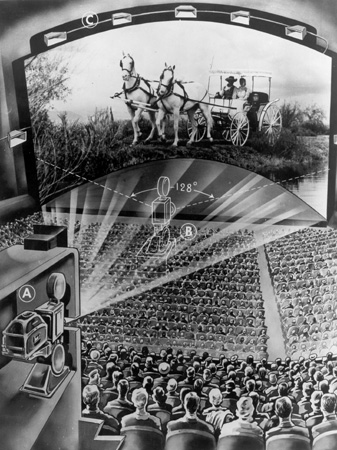 A somewhat exaggerated publicity illustration of 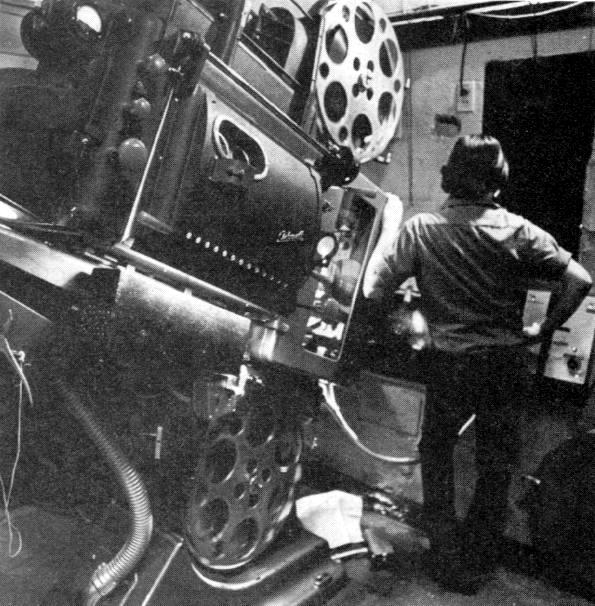 Once again, this is NOT a photo of the Sunshine, but it does give you an idea of what a |
Now we have to put on our thinking caps again. A Cinerama screen, of course, cannot possibly fit at the Sunshine. The only way to mimic Cinerama in that building is to have a large (louvered?) screen recede onto the stage floor and to have the sides protrude only a few feet outside the left and right sides of the proscenium. The distortion from keystoning plus curvature would make the resulting image all but unusable and certainly unwatchable, even if the lab had created a reverse keystone on the print to compensate for a rake as extreme as the Sunshine’s. After the guaranteed 20-week run, it was undoubtedly with great relief that the Cinerama screen was taken down. The Norelco AA
Of course, none of that explains the presence of the Century JJ machines that had been retrofitted to run both 70mm and 35mm.
When were they installed?
A look through the newspapers reveals nothing definitive, though it does reveal a most likely date: the first week of May 1968.
That’s when the Sunshine revived Gone with the Wind.
It had played there in 1939 as an Albuquerque première,
and now in the spring of 1968 it was being re-released in a modified version.
The top and bottom of the picture were lopped off, the center was enlarged to 70mm,
and six-track sound was simulated from the original monaural.
That is almost surely when the JJs were installed, and since they were versatile machines, there was no reason to replace them.
What happened to the older machines, heaven only knows.
(“Doing ‘Gone with Wind’ Marquee Is an Old Story for A. J. Holder,”
The Albuquerque Tribune, 2 May 1968, p B-15.)
And all this just because I want to know what the original interior looked like! Well, life is nothing but tangents.
My thankfulness knows no bounds when it comes to the changes in attitude.
When I was a teen, I recognized that the stage show or the movie was only a small fraction of the entertainment.
The building and the décor and the audience and the ambience were the better part of the show.
I fantasized about having my own theatre,
where audiences would see not only the show but the back stage and the basement and the boiler room and the offices
and the booths and the attic and the roof, and would then relax in the restaurant housed in the same building.
Now, at last, more than 30 years later, I see that I was not the only person thinking along those lines.
Theatre tours are becoming popular. People want to climb through every tiny little niche of old theatres.
They want to feel a sense of ownership.
This is much more important to many people than the show itself,
which many people (especially me) can easily do without.
Where Frank Peloso went wrong – and not only Frank Peloso, but pretty much all theatre owners and managers –
was in regarding theatre and cinema as strictly a business, entirely cold and impersonal.
By way of illustration, I recall that one afternoon I asked Ross Cacavalli for something –
maybe a few extra calendars to give out to friends, or something else trivial, I can’t remember.
He went to the office just off the lobby to help me, when suddenly there was a buzzing alarm.
And it kept buzzing and buzzing for several seconds.
Mr. Peloso was sitting at his desk, and he looked terribly concerned.
“That’s the back door. Someone’s sneaking in the back door.
Go inside and see if you can find someone without a ticket.”
Ross responded that it was already too late, for whoever snuck in was surely already seated and would be impossible to pick out.
Mr. Peloso agreed, and realized that in the future they would all have to be more vigilant
to guard against people sneaking in the back way.
I kept trying to cut in, but could never get more than a syllable out before they spoke over me as though I didn’t exist.
Finally I gave up.
But what I was trying to say was that a few weeks earlier I had myself opened both exit doors and looked out,
just because I love exploring old buildings.
The alarm this time was probably in response to someone else just like me who loves to explore old buildings.
Further, the idea that anyone would want to sneak into a forty-year-old black-and-white movie was delusional.
I see now that there was no hope that I could have communicated those ideas to them.
They were under the impression that people came only to see a hit movie.
They would never have understood that people actually came just to enjoy the surroundings,
or because they enjoyed what little was left of downtown,
and the movies simply gave them an excuse to spend a day in the vicinity.
But Mr. Peloso and Ross apparently believed, and believed firmly, that business was business,
and that the only aim of business was to get money out of customers’ pockets.
Any verbal conversation beyond “Two adults, two children,” “That will be six dollars please”
would have been considered fraternizing with the customers,
and fraternizing was regarded as immoral and was severely frowned upon.
That whole attitude is so wrong.
People don’t want to drive ten or twenty miles just to see a movie and then drive away again.
They want to feel welcomed. They want to feel at home. They want to luxuriate in their surroundings.
They want to be corrupted by pleasure. They want to make the outing a part of a larger field trip.
The old “get ’em in here, get their money, and get ’em out again” strategy will simply result in bankruptcy,
to say nothing of hard feelings.
The above is extremely informal and personal, and is not to be taken as a final word.
It is not even properly publishable, though I do publish it here, on the Internet,
where it can have a tentative life until I learn more details and finally construct a respectable essay.
In the course of this brief research I discovered that there was a 1999 crime novel entitled Murder in the Sunshine.
Horrifyingly, that novel pretty much came true a few years ago
when a retarded sex maniac, working at the theatre as a janitor, raped and murdered a 16-year-old girl there.
If only we could undo such horrid crimes. Alas. We shall build a proper memorial to her.
I
just learned that her friends have set up a scholarship fund in the hopes of preventing further acts of violence.
The band members who were performing that night left for another leg of their tour,
oblivious to the events.
When the news finally reached them several days later, they were all devastated.
They had to rethink this celebrity junk culture that encourages irresponsibility
and which is destroying our entire society from within.
We should all rethink it.
Fortunately, the Sunshine Building was at last placed on the National Register of Historic Places (# 85003619),
but that doesn’t guarantee any real protection, nor does it guard against a complete gutting and remodeling.
We need to be on our guard.
In the meantime, please send me any comments or reminiscences. Let’s reconstruct the building’s history.
Mo Palmer helped me to locate the original plans, or at least some of them, and I hope to get copies in the foreseeable future.
Let’s find illustrations of the original interior (we need to look through all the newspapers from 1922 through 1924).
Let’s restore that theatre, and let’s get the show on the road!
After suffering through decades of wanton destruction, Albuquerqueans deserve to have something wonderful again,
and they deserve to know their own history and heritage.
Here are some images I just discovered on the Internet. It looks like the glorious Austrian drape is gone. If so, that is a tragic loss.
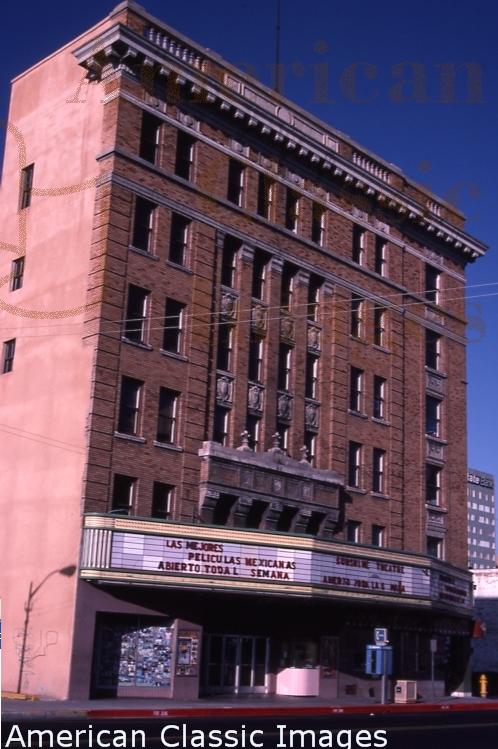
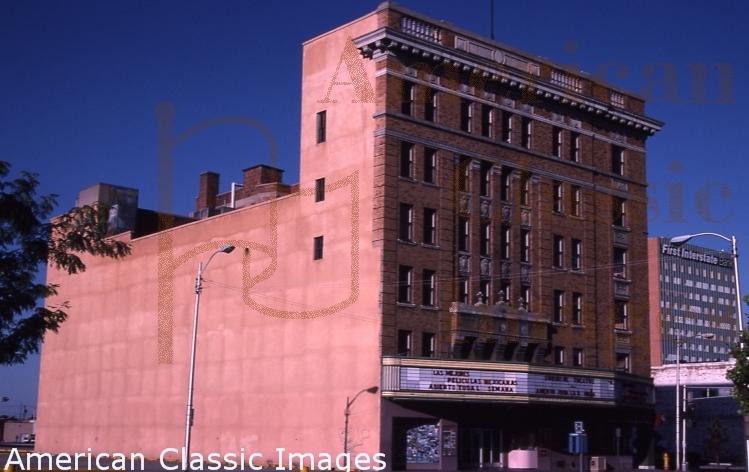
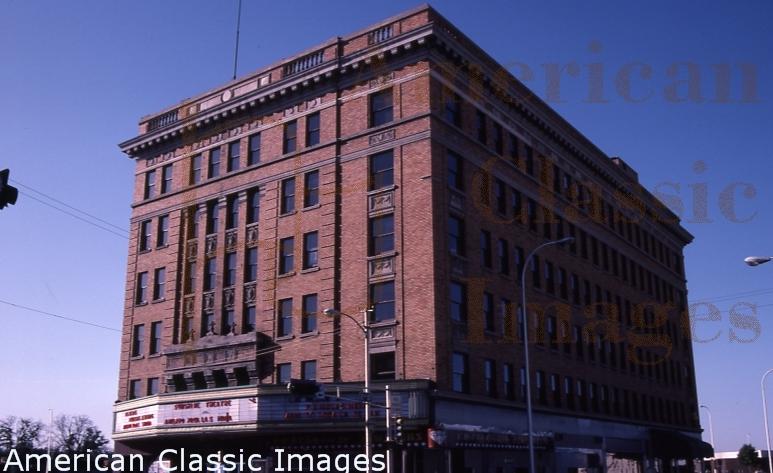

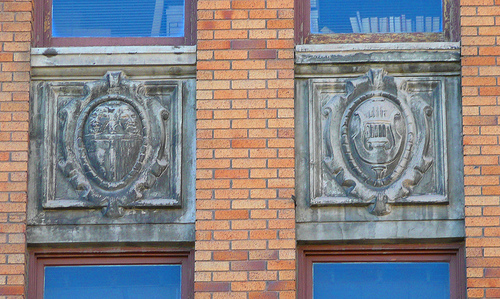
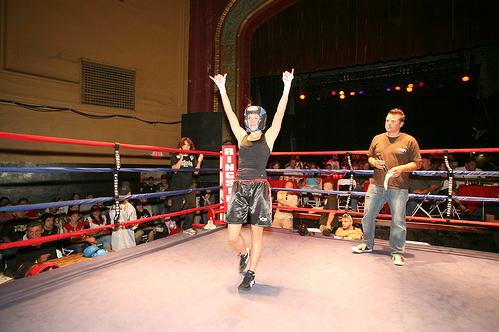
The grills off to the sides are, if memory serves, late-added (circa 1950’s?) ventilation.
The gigantic frames that they interrupt were probably originally frames for some of the 1924 decor.
Text copyright © 2009 by Ranjit Sandhu