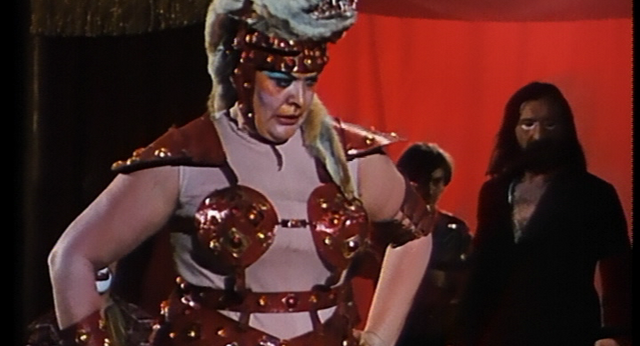
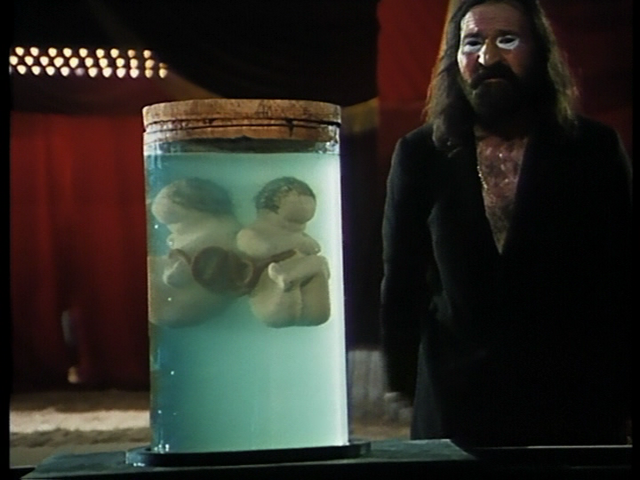
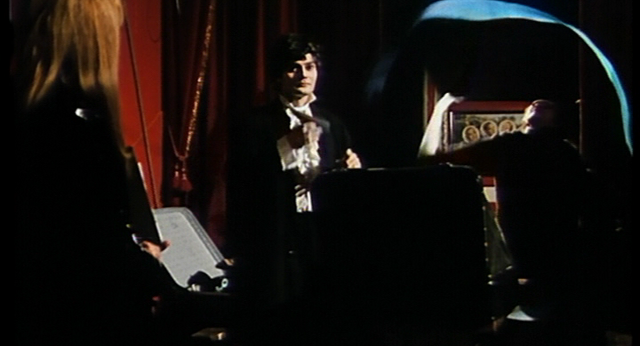
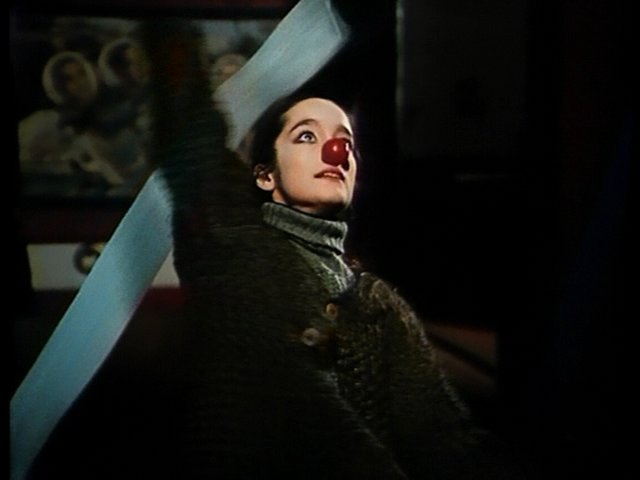
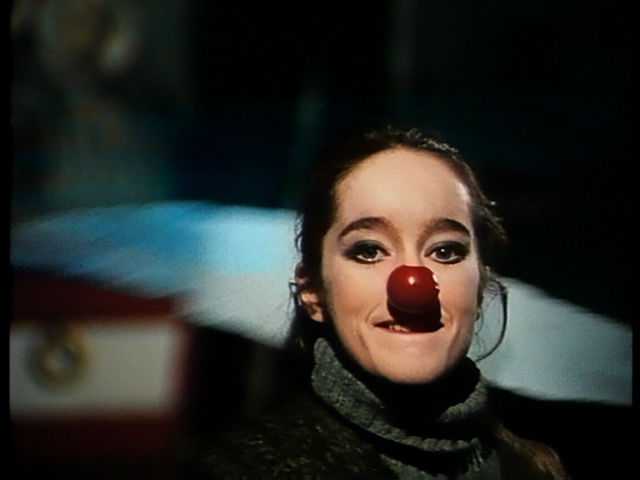
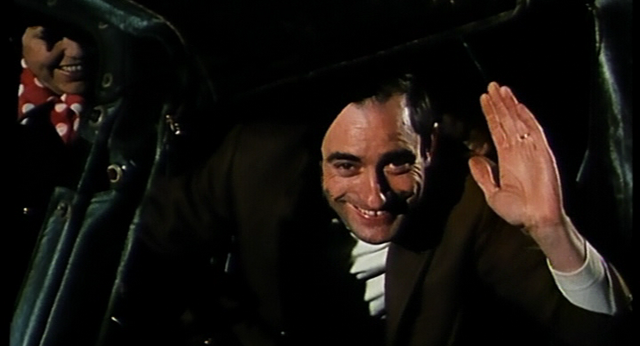
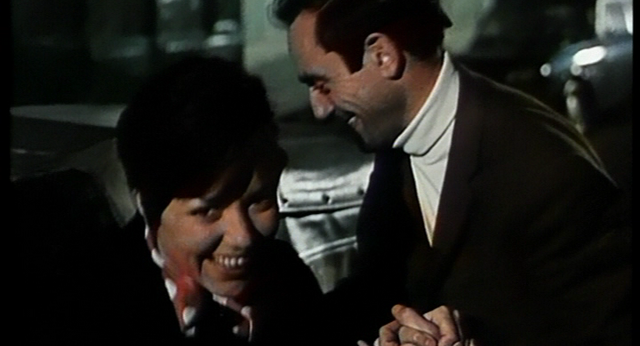
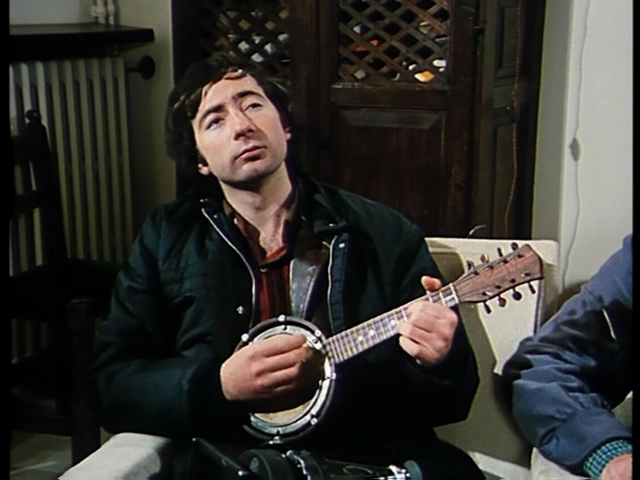
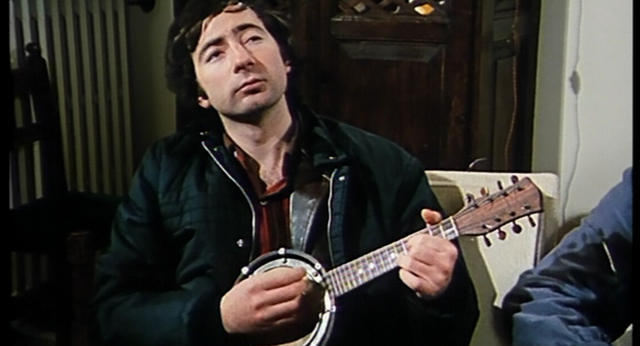
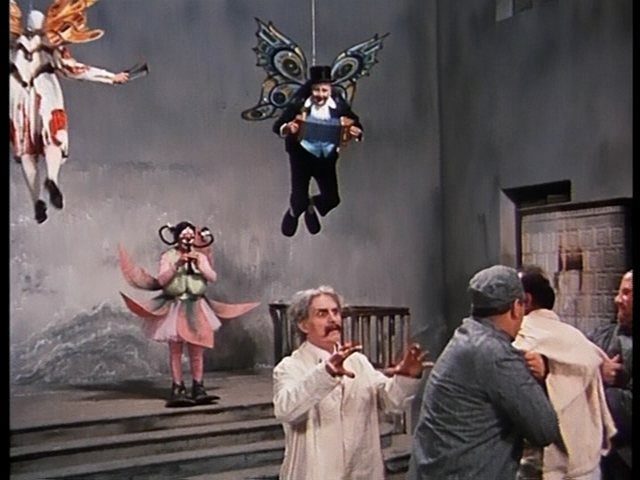
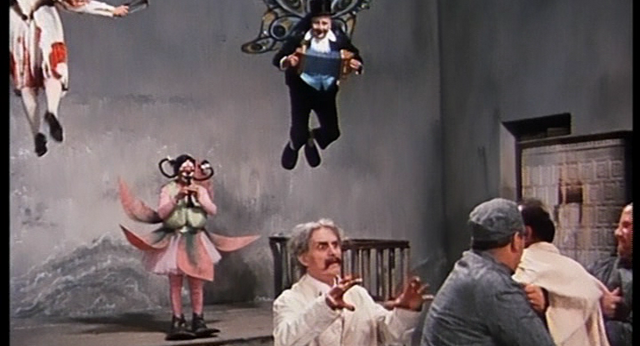
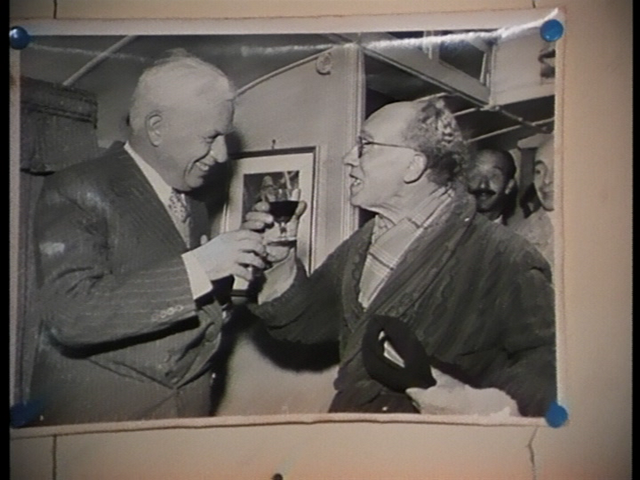
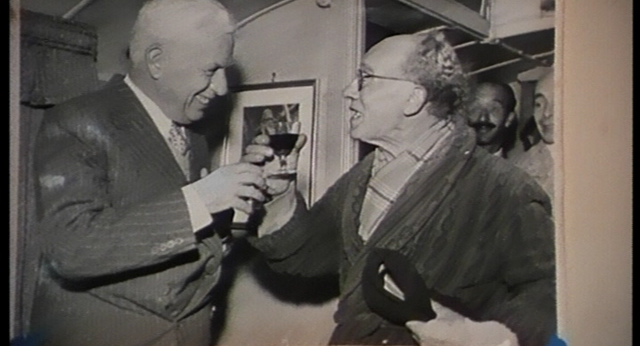
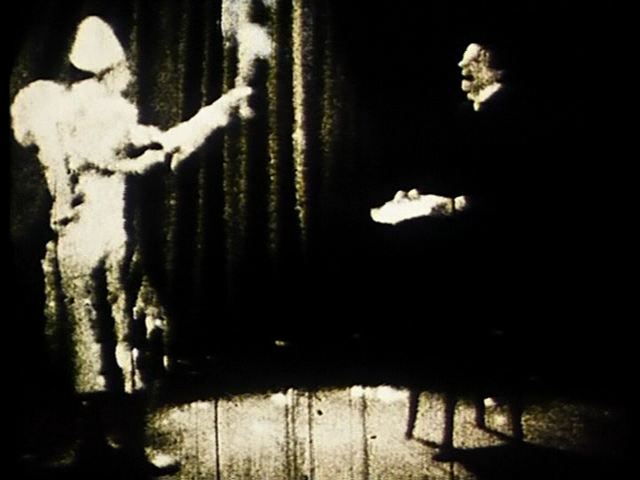
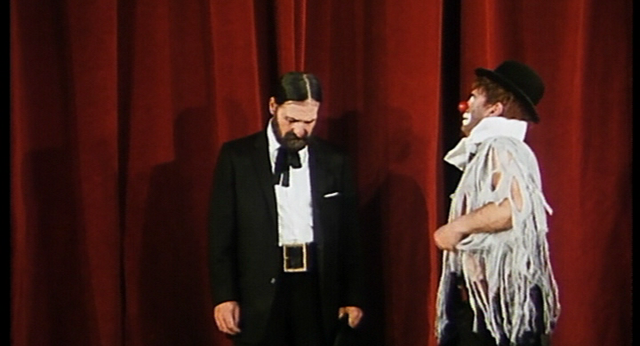
If you own the copyright to these images, please contact me. Thanks!
So much has been written about Federico
Fellini and his films, and so much of what has been written
is quite good. But there’s one aspect of
Fellini’s work about which all the books avoid going
into detail.
Have you ever been surprised on a second
viewing of a movie to find that it was significantly
different from what you remembered? Memory is a malleable
thing. We remember things differently from the reality,
differently from the way others remember them. We even
remember events that never happened at all. And, as has
been demonstrated repeatedly, it is easy for one person to
cause another person to remember events that never
happened, or to misremember them, or not to remember things
that did happen. (Past-life regressionists, pseudo-shrinks
who dredge up your “repressed memories,”
journalists, and politicians deliberately do this to us
all the time.)
It’s even more surprising, though,
to discover, on a third viewing of a movie, that our
memories were not tricking us after all, that we had
in fact seen two noticeably different versions of the same
film! I, for one, have had the gratification to prove this
on at least a few occasions, when I would collect different
versions of the same film on video. A few years ago I even
had the pleasure of showing a small gathering of Buster Keaton fans
two remarkably different versions of a scene from a Keaton
short film, back to back so that there would be no question
in anyone’s mind.
Federico Fellini is one of my favorite
filmmakers, and I make it a point to see his films on the
big screen at every opportunity. And, of course, I’ve
seen differences. The differences are less dramatic than
they are with many other films. I never see different
camera angles or different takes, I never hear different
dialogue or different music, but I do see different cuts,
differing lab work, different language choices.
Let’s start with a quote from the
book of interviews by Charlotte Chandler entitled
I, Fellini (NY: Random House, 1995,
p 112):
One reason I never want to see my films after
I’ve completed them is they exist in my
memory as I shot them, with all the footage I
wanted to include. In my memory, my films
exist in a different running time than the
exhibitor’s version. Many times, I had to
cut fast, under duress by the producer, who
always wanted less, to save money. If I were
to see my films as the audiences are seeing
them in theaters around the world, I would be
sitting there and saying, “Where is the
scene about this?” and “Where is the
scene about that?” and I would feel
destroyed for the sake of my poor creature, as
it has been destroyed. When the film is
complete, I must cut the bond. Or I must try to.
In April 2004 filmmaker Nico B flew
me to Rome to interview Tinto
Brass. It was the most insane journey of my life, as I
could not take time off from my regular job and had to make
the trip over the Easter weekend. Almost as soon as I
landed in Rome I had to fly back. Tinto and his wife Tinta
were wonderful hosts for the two or three hours that I was
at their house (though because of my fatigue and stress I
fear I was a rather scatterbrained guest), and one of the
first things Tinto said in the videotaped interview was
that he and Fellini would commiserate about the cuts that
their distributors demanded, especially for the releases
outside of Italy. Fellini would say to Tinto something
like, “What can we do? If we don’t agree to the
cuts, they don’t release the films. So we have to
agree. There’s nothing we can do.” (Tinto also
said, in no uncertain terms: Fellini was the BEST
Italian filmmaker — EVER! I hope that
some day Nico gives me a video copy of that interview and
allows me to transcribe and publish it. Sigh....)
So let’s go through the films, one
by one. I’ll provide what little technical information
I know, and I’ll note the differences that I remember.
I’m certain that there’s much more to be
unearthed. Please write to
me with any additions or corrections. Thanks!
All of Fellini’s films
originally had intermissions, which are almost always
deleted now. This is sad. Very sad. The intermissions were
strategically placed, and even written into the scripts!
For instance, in Le notti di Cabiria the
intermission came after the cripple who had not been healed
after all discarded his crutches and then collapsed onto
the floor. The modern prints cut this short and dissolve
into the first scene of the second half. And that ruins the
dramatic impact terribly.
I know of only one version each of the
first few films. The most interesting differences are with
some of the later films: 8 ½, Spirits of the
Dead, Roma, and Casanova.
The DVD
The poster
LUCI DEL VARIETÀ / VARIETY LIGHTS
(1950)
I have seen only one version of this
film, once on VHS and once in 35mm. They seemed to be
identical. I must see it again, because I didn’t
recognize Vittorio Caprioli or Alberto Lattuada. The film
was shot with the Academy 1:1.375 aperture. So if your
local cinema runs it in widescreen (lopping off the top or
bottom — or both), complain loudly. Demand your
money back. Protest. Picket.
The DVD
The poster
LO SCEICCO BIANCO / THE WHITE SHEIK
(1952)
Again, I’ve seen this only twice,
on VHS and in 35mm, and the two copies seemed identical.
This is the most lightweight of all Fellini films, but
it’s still well worth watching for the great Alberto
Sordi. Again, it’s Academy 1:1.375, so make life
miserable for anyone who runs it in widescreen, as almost
every cinema in the world will now do....
The DVD
The poster
I VITELLONI /
THE
YOUNG AND THE
PASSIONATE /
THE
SPIVS
(1953)
I hated this when I saw it in a
miserable-looking VHS, but I loved it when I saw a crisp
brand-new 35mm print lovingly made by caring lab workers.
There must be an English-language dub floating
around somewhere, but I don’t know where. The title
I vitelloni, as an Italian friend explained to
me, literally translates as The Veals, a slang
expression used as an equivalent to the English expression
The Good-for-Nothings. Again, Academy 1:1.375, and
don’t tolerate any dippy drippy cinema manager who
tries to justify running this in widescreen.
The Italian VHS, no English subtitles (PAL system, which will not play on US/Canadian equipment)
The new DVD of the Italian version with optional English subtitles. (Region-2 PAL, which will not play on most US/Canadian equipment.)
The poster
AMORE IN CITTÀ / LOVE IN THE CITY
(1953)
There are at least two versions of this,
but I’ve only seen one, and only once: the American
version, with English-language main titles and an American
narrating between the episodes. Other than that the film
was in Italian with subtitles. Academy 1:1.375. I think
this was the only Fellini film unreleased on DVD — until now! It was finally released on 25 October 2006!
The DVD
The poster
LA STRADA /
THE
ROAD
(1954)
Two versions! But not radically
different. The film was written in Italian and originally
recorded in Italian, but the two male leads, Anthony Quinn
and Richard Basehart, spoke English on camera. And, to make
their lives easier, Giulietta Masina also spoke English on
camera at times. The Italian dubbing was exquisite. Whoever
dubbed Anthony Quinn sounded quite like him, and matched the
lip movements so well that it would be difficult to guess
that he was really mouthing English. Ditto for Richard
Basehart. Giulietta Masina did her own voice, of course. In
the English recording, which was not directed by
Fellini, Quinn and Basehart did their own voices, but
Geraldine Murphy dubbed Masina’s voice. Which is more
authentic? I argue that they are equally authentic. Back in
the days when the only available copies of the Italian
version had Herman Weinberg’s minimalist subtitles, I
couldn’t get through more than about three minutes.
But now that the subtitles have been remade, the Italian
version is a delight. Criterion released this on laserdisc
and DVD with options for either soundtrack. The DVD
version has an awful defect in the English soundtrack,
which goes silent twice toward the beginning,
and not just momentarily! Academy 1:1.375.
For me, the most interesting aspect of
this film is that Fellini took the name of Anthony
Quinn’s character, Zampanò, from circus performer
Osiride
Pevarello (or Peverello), who was using that stage name at the time.
I can’t think of a performer anywhere in the world I
would more want to meet than Osiride Pevarello.
The very short US DVD
The poster
The somewhat longer UK DVD
IL BIDONE /
THE
SWINDLE
(1955)
To quote Fellini (Charlotte Chandler,
I, Fellini [New York: Random House,
1995], pp 110–111):
As it turned out, the whole picture was too
ambiguous for audiences, according to my
producer, who said I had to cut the original
two-and-a-half-hour version, which did not
make it less ambiguous. I was told it was
necessary so it would have a better chance
at the Venice Film Festival of that year. That
was not an argument of consequence for me, but
producers seem to love film festivals.
Parties. Girls. When it was ignored there —
worse than ignored — I was forced to
cut it some more, down to 112 minutes, and
then 104, finally even shorter for its
belated American appearance.... Cutting Il
bidone was a sad experience for me, and
certainly hurt the film. I didn’t want to
cut it. When I completed Il bidone, it
was my film, the film I had made. Forced to cut
more, I wasn’t certain at all about what
to cut.... Whatever I had to cut, I knew I
would have regrets. I had the “final cut”
of my film, but it didn’t matter. Orson
Welles told me later how he had felt about
what was done to The Magnificent Ambersons.
Sad. I thought it was such a great film; I didn’t
realize what they had done. It is not imaginable
what his film would have been if we could have
seen it as he intended it to be.
A great many meaningful scenes were cut from Il
bidone and, along with them, important strands
of the story which develop the characters. I couldn’t
save my favorite scenes because I had to concentrate
on the story making sense after the loss of so much
footage. One scene I tried to save, but couldn’t,
was the one in which Iris, who has left Picasso,
confronts Augusto, blaming him for her husband’s
life of crime, and he defends himself with his own
warped, but deeply ingrained, logic.
In this scene, Augusto encourages her to take her
husband back. Once he has his freedom, he warns her,
Picasso won’t be coming back to her and their
child, because “freedom is too beautiful.”
His theory is that Iris wouldn’t have left
Picasso, even though he was supporting her in a
dishonest way, if he’d been more successful.
He tells her that a man who has money has
everything and a man who doesn’t have it is
nothing. As he extols the beauty of money, Iris stands
up to him.
Originally, this was a key scene, but as I cut the
film, this scene along with others disappeared. Story
lines and character development ended abruptly without
explanation, creating in the minds of some critics a
deliberate stylistic intention that never existed.
Professionally, I knew I would be unable to face
the finished Il bidone. Personally, it was
hard for me to cut so much of Giulietta’s fine
performance. She was so good, especially in
the parts I cut. I hoped she would be understanding,
because she is my wife. But she was not understanding,
because she is also an actress....
On top of the cuts, we must remember that two of the leads,
Broderick Crawford and Richard Basehart, spoke English on
camera, and almost certainly dubbed themselves for the English
version. I’ve never been able to locate a copy of this.
Academy 1:1.375.
The DVD
The French poster
LE NOTTI DI
CABIRIA /
THE NIGHTS
OF CABIRIA
(1957)
The man-with-the-sack episode was long
missing, since the church censor demanded that it be cut,
and since producer Dino De Laurentiis, to get Fellini
to give up on it, claimed that it had been destroyed.
Fellini suspected that he was not telling the truth, but
let it go. When it came time to make A Director’s
Notebook, Fellini asked De Laurentiis once again,
and the producer let him use the footage in the new film.
It’s a marvelous, magical little sequence. And the man
with the sack is played by Dottor Leo Catozzo, famous film
editor who worked on this and some of Fellini’s other
films — and who also invented the best tape
splicer of all. (Get the most expensive model, the
Academy-eight-perf guillotine splicer with variable pitch
from a company called Ciro. The B&H-perf and CS-perf models
only accept five-perf tape, unfortunately. The
cheaper models are, sadly, the worst splicers on the
market, and I don’t think they carry Catozzo’s
name on the bottom.) Anyway, back to the matter at hand: A
few years ago some kindly soul (I don’t know who)
decided to put the man with the sack back into the film,
and that’s how it appears on DVD and in the 35mm
prints available from Cinecittà. Academy 1:1.375.
The US DVD
The poster
The Italian DVD (PAL Region 2, which won’t play on most US equipment)
LA DOLCE VITA /
THE
SWEET
LIFE
(1959)
This was made in 1959 and released in 1960.
Some Italians say that the popular expression “la dolce vita” derives from this film.
Other Italians say that the title of the film derived from the popular expression,
which had come into vogue to describe the new wealth in Italy’s controlled economy.
Both claims are wrong.
Writer-biographer-novelist-playwright Arnaldo Fraccaroli coined the term half a century earlier
with his play, La dolce vita: commedia in tre atti (Milano: Fratelli Treves Editori, 1912).
Though La dolce vita created a scandalous controversy around the globe,
I have never heard any stories about so much as a frame being deleted.
Younger audiences (like me) don’t see anything at all scandalous.
But an oldster once explained it to us.
It was apparent that some of the characters in the story had sex outside of marriage and were nonchalant about it.
As a result of that portrayal,
Italy became a tourist hot spot for all the overly hormoned youth who were desperate for adventures.
Most returned bitterly disappointed.
A year or two after the international
release of La dolce vita came the English dub. When
we ran this film in Buffalo a few years ago (sorry about
the focus; I didn’t know until too late that the
anamorphic lens had gotten knocked out of alignment and
there was simply no quick fix for that once we were on
screen) it contained some replacement footage at the
beginning of a reel, just a few seconds during the scene
with Marcello trying to type at the beach house. And the
replacement footage was from the English dub!
The original Italian credits were white
letters on a black background. When Joe Levine released the
subtitled film in the US he reshot the titles as white
letters over a background of clouds. The current DVD from
Koch-Lorber inexplicably has the opening titles for the
English dub, which are white letters against a black
background. The DVD packaging claims that it offers the
English dub as an option, but when you switch to that
option you get the commentary track instead.
Fellini shot hundreds of hours of film,
but less than three of those hours made it to the screen. I
wonder what happened to the rest of the footage.
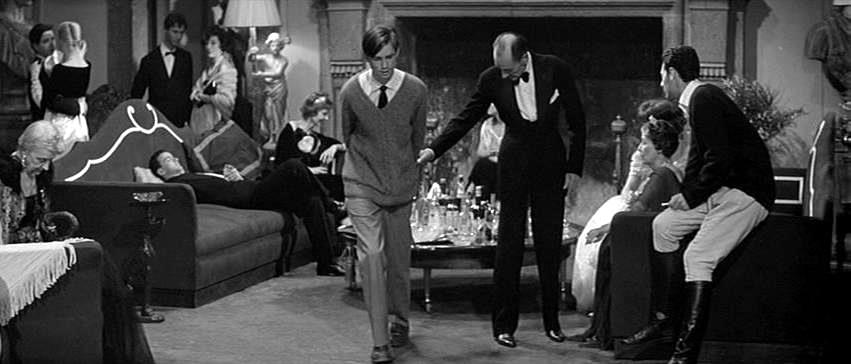
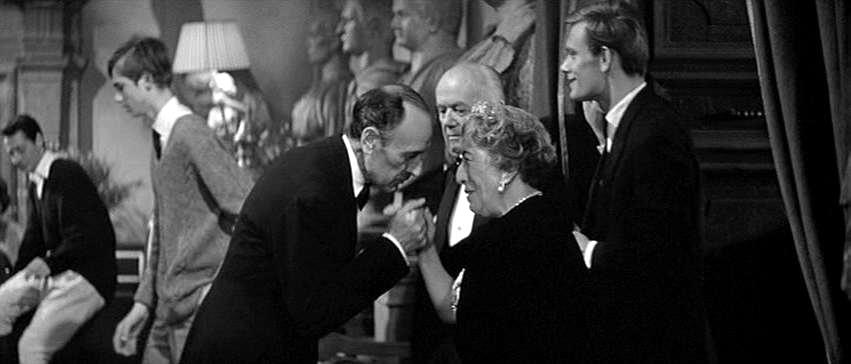
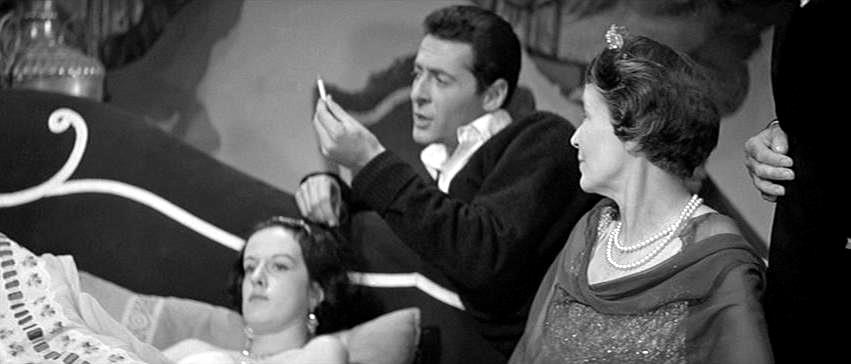
Have you heard the claims that Franco Rossellini played a character referred to as The Beautiful Horseman?
For the longest time I had trouble believing that, but lo and behold, there he was, and I had seen him along.
There he is, in riding gear, seated on the arm of the sofa.
And there he is again, out of focus in the background, on the very left. Isn’t this exciting?
Never able to stop smoking. Killed him in the end, you know.
Once upon a time I saw some clips from
the original Italian release, with the English sequences
subtitled into large bold Italian italics.
This was Fellini’s first widescreen
film, shot in the anamorphic process, 1:2.39. So when you
get a video that shows significantly less width, sue the
merchant who sold it to you.
The DVD
The poster
BOCCACCIO ’70
(1962)
This was the first example of
Fellini’s new dream-like style. Apparently he had just
read some Jung and found the experience liberating. So he
liberated his films. This was also his first film in color.
And this was also his comical response to the hostile
reactions to La dolce vita.
Until recently Boccaccio ’70
was quite rarely shown in the US. It was briefly available,
in the 1970s I think, on VHS on the Magnetic Video label,
in a full-screen crop. The few people who know of this film
know that it contained four episodes when it was shown in
Italy: one by Mario Monicelli, one by Fellini, one by
Luchino Visconti, and one by Vittorio de Sica, each
running slightly less than an hour. And as the few people
who know of this film know, Monicelli’s episode was
deleted for the export editions. But not many people
know that there were even more alterations. The
English-language releases had animated titles that were
quite obviously created in Joseph Levine’s studio, and
that obviously replaced more complete Italian title
sequences. The US version was dubbed into English, and I
don’t know if there was a subtitled version available.
But a viewing of the Italian print revealed even more: The
opening credits of each sequence were far more elaborate
than we could have imagined! And the music was predictably
different — and better. And there was an extra
scene in Fellini’s episode: After Mazuolo murders the
billboard, pallbearers carry up a gigantic casket and
celebrate the death! Why on earth was that
cut out?
But there was even more. The full
Italian version was just released on DVD by NoShame Films
in a beautiful transfer (but clutzy and incomplete
subtitles), and the program notes startlingly state that
Fellini’s original cut of his episode was over 80
minutes long! Where did that longer version go? (One of the
cuts is obvious in the film as it now stands. After the
giant Anita disappears we see the real-sized Anita’s
shadow start to come in around the corner. But then, partly
to shorten the film and partly to match the previous
disappearance, there is a jump cut so that she suddenly
reappears on the street. Watch closely!) What’s more,
when producer Carlo Ponti claimed he deleted
Monicelli’s episode because the film was too long,
Fellini, Visconti, and de Sica all offered to trim
their own episodes to make way for the restoration of
Monicelli’s!
Well, what are the other differences?
Anita Ekberg switched back and forth between English and
Italian, and in the Italian version that’s exactly
what happens, except that in the dubbing some of her
English lines were dubbed into Italian (and vice versa?). In
the English version she speaks English exclusively.
Interesting note: two of the boy scouts who get prizes are
named Rodolfo Sonego (a famous screenwriter) and Otello
Martelli (Fellini’s cinematographer). 1:1.85. Yes, the
DVD packaging insists that it’s 1:1.66, but I insist
that the packaging is dead wrong. The film was shot at
1:1.85 and the DVD retains that 1:1.85 image.
So there. If you switch to the English track,
you’ll see that it goes to Italian for the funeral
scene. The English track to that scene must
have been recorded. Where did it go?
The DVD
The poster
A documentary on the lost original ending (PAL system. Won’t play properly on most US equipment.)
8 ½
(1963)
This one drives me crazy. It’s one
of Fellini’s best, undeniably. It’s hilarious.
It’s dreamy. It’s dreamlike. It’s haunting.
But it’s not what audiences originally saw. Okay boys
and girls, raise your hands: How many of you had difficulty
determining where the fantasy began and the reality ended?
A ha. Almost everyone’s hand went up. (Mine
didn’t.) Well, that was the producer’s complaint.
He couldn’t tell which was which, and so he ordered a
clarification. (I once heard a performer refer to such
things as “Captioning for the f***ing stupid.”)
So Fellini once bemoaned:
...the rotten color in 8 ½
which — perhaps it’s not well
known — was stupidly decided by the
production unit against my will, with the
simple-minded idea of making it easier for the
audience to understand the film by distinguishing
dreams from reality (Giovanni Grazzini, ed,
Federico Fellini: Comments on Film, tr by
Joseph Henry. Fresno: The Press at the California
State University, 1988, p 222).
Did you see any color when you saw
8 ½? Neither did I. Neither did anyone I know,
in Italy or anywhere else. This is not the only interview in
which Fellini complained about the fantasies being shot in
color. Now, I knew about this claim from way back when, and
so when I first saw the film on the big screen I watched
carefully for any change in grain structure. There was none.
All the footage was shot in black and white. So if anything
actually was shot in color, what must have happened
is that Fellini went back to the studio to reshoot the fantasies.
And what must have happened is that subsequent releases,
only to save money, reverted to Fellini’s original version
which was entirely black and white. John Baxter, in his bio of
Fellini, published a different version of the events. He claims
that in the prints sent out to the Italian “provinces”
(i.e., any place away from the major cities) the fantasies were
merely tinted sepia. So what’s the truth?
Interestingly the film originally had a
different ending. It was almost silent, with merely the
sound of wind. On a train coach, Guido reconciles himself
with all the people he has alienated. Only a few production
stills survive. The footage is long gone, except for the
sound track of the wind, which sound mixer Fausto Ancillai
played for a recent documentary. Before the film was
released, Fellini had to create a preview. Instead of using
scenes he had already shot for the film, he brought back
his entire cast and had them dance in a circle as a band
played. Once he saw what he had created, he scrapped the
original train ending and used the preview footage instead.
You can see the production stills of the missing sequence
in a supplement to the Criterion DVD edition. (Baxter claims
that at the first public screening, both endings were shown
and the audience members voted on which they preferred.)
I don’t think anyone has pointed
this out before: For the first time in his directorial
career, Fellini used direct sound! But only in the audition
footage. Speaking of sound, it is with this film that
Fellini completely mastered the art of sound. No one could
ever approach Fellini in his use of sound. (It is absolutely
untrue that Fellini shot his films silent. He always miked
everything. But he used the direct sound only as a reference
for the revoicing sessions. In only three films did he actually
keep a little of the direct sound in the final edition.)
Believe it or not, there was an English dub. Ugh. Avoid it.
Yet a friend who knows much more than I do assures me that many of the actors actually spoke English on camera,
which makes the English version somewhat authentic.
Well, I guess I need to suffer through it now, don’t I?
Osiride
Pevarello was originally in this
film, but he must have ended up as the face on the
cutting-room floor. I’ve watched every character,
even all the multitudinous characters in the background,
hoping to catch a glimpse of him. No luck.
Once and for all, let’s settle the
meaning of the title. Someone on the set simply counted the
number of films Fellini had made. Luci del varietà
counted as a half-film, because Fellini
co-directed it. L’amore in città
was another half-film, since Fellini had directed only one
episode. Ditto for Boccaccio ’70. So that’s
only three half-films. Other than that, he directed six
films, for a total of seven and a half. So this was to be
his eighth-and-a-halfth film. Fellini thought that was
funny and used it as the title. The Criterion DVD contains
the entire 1:1.85 widescreen image. You won’t
understand Woody Allen’s What’s New,
Pussycat? unless you’ve first seen
8 ½.
The DVD
The poster
GIULIETTA DEGLI SPIRITI / JULIET OF THE SPIRITS
(1965)
Now who on earth would expect to see
Valeska Gert in a Fellini film? Fun movie. Lou Gilbert
(Professor Grandpa de Filippis) is a blast. Everyone
else is crazy, and not in a good way. But, almost
miraculously, this movie, though populated almost
exclusively by irritating characters, is not at all
irritating! This is when Fellini really learned how to use
color. And he was better at it than probably anyone else. I
couldn’t sit through the English dub, but I’d
love to find a copy just for reference purposes. The print
at the Eastman House is missing all the opening credits
(and they were such great credits!) as well as the
film’s only momentary flash of close-up
nudity (the torso in the window), which I’m sure
some projectionist decided to souvenir.
And here’s something that I
don’t think anyone’s pointed out before: The
opening of the film is done in the Tinto Brass style, with
agitated camera movements and editing that reveals only
enough of the action to give us an impression of
what’s going on, along with realistic lighting that
conceals more than it reveals. Fellini embellished that
style by adding mirrors. A few years later Tinto borrowed
that embellishment for his own films. Oh yes, and one of
the maids also plays the maid in Luis Buñuel’s Le
charme discret de la bourgeoisie. (Is her name Teresina
or Elisabetta? There was a goof in the recording of the
soundtrack, as the two maids kept switching names!)
The film was shot at 1:1.85. So the
videos that correctly claim to be “approximately
1:1.66” are not giving you the full width. And there
are apparently some older videos and 16mm prints that are
full screen and crop even more. The Criterion DVD, which is
beautiful in every other way, altered the
credits!!!!!!!!!!!!!!!!!!!!!! The credits were
white lettering on a bright blue background. Some doofus at
Criterion electronically changed the colors to yellow
lettering on a black background!
Why????????????????????????? Egad.
THE HUMBLE LECHER
(1968)
This is all I know:
Daily Variety vol. 139 no. 28, Friday, 12 April 1968, p. 3.
The Italian DVD (PAL system, which won’t play properly on most US equipment)
The French poster
The British VHS (PAL system, which won’t play at all on US equipment)
The US one-sheet poster
What on earth is this VHS release from the UK?
TRE PASSI NEL DELIRIO /
HISTOIRES EXTRAORDINAIRES /
SPIRITS OF THE
DEAD /
TALES OF
MYSTERY AND
IMAGINATION
(1968)
Oh is this fun!
I mean, oooohhhh is this fun!
When I was a younger cineaste, I heard several other young cineastes say that they absolutely hated Fellini,
but that they made an exception for Spirits of the Dead, which they loved.
Of course, when I pressed them, I learned that the only Fellini film they had ever seen was Spirits of the Dead.
So why, I asked, did they hate Fellini, if they only film of his they had seen they liked?
The response was the same: “He’s pretentious.” Oy vey.
Well, at least I made converts out of them. And quickly.
I’ve seen so many versions of this film.
It consists of three episodes, of which the first is by Roger Vadim.
It was shot at 1:2.35 anormorphic, but was cropped to 1:1.85 for the release prints.
There are two versions of this episode, sort of.
One version was filmed entirely in French.
Another version was basically the same, but some shots, where lip-reading was relatively easy, were re-done in English.
Jane Fonda’s voice is heard in both the English and French versions,
but Peter Fonda, who delivered his part in both French and English, was dubbed by a native actor for the French version.
Perhaps his accent wasn’t perfect?
I am convinced that the original French version had no narration.
The English version was narrated by an uncredited Donald Sutherland.
For the video versions, the video producer apparently hired some other English narrator to speak Sutherland’s lines in English over the French version,
but it wasn’s quite the same, as the English had been translated into something else and then back into English again, resulting in some odd anomalies.
For instance: “She ruled capriciously; day was night, or night day, according to her fancies.”
The meaning is lost in the prepared-for-laserdisc version:
“She ruled over it capriciously, both night and day, according to her whims.”
ORIGINAL DONALD SUTHERLAND VERSION:
INAUTHENTIC LASERDISC VERSION:
At 22 years of age, Frédérique, Countess of Metzengerstein, became heir to a vast family fortune.
Seldom had a noble of her country possessed an estate of such magnificence.
She ruled capriciously; day was night, or night day, according to her fancies.
That morning, haunted by the nightmare of the dawn, she decided to take her guests to the castle where she had spent her childhood.
At the age of 22, Frédérique, Countess of Metzengerstein, inherited the entire family fortune.
Rarely had a noble of this land come into such a legacy.
She ruled over it capriciously, both night and day, according to her whims.
That morning, still haunted by her dawn nightmares, she decided to take her guests to the castle where she had spent her childhood.
(By the way, don’t believe all the rumors about
Hanoi
Jane.
While some of the rumors are undoubtedly true,
the most horrific details and anecdotes, the ones that paint Jane Fonda as a war criminal,
are absolutely FALSE.
I breathed a great sigh of relief to learn this.)
The second episode, by Louis Malle, was also in French,
but in the US and England it was released in an unimpressive English dub that kills the whole flavor of the piece.
Fortunately, the laserdisc includes both soundtracks.
This episode was shot at 1:1.66, but you’ll never see it that way.
To fit with the other episodes, it is always cropped to 1:1.85,
but whether or not it’s actually cropped that way on the print, I don’t know.
The Fellini episode was designed to have two authentic original versions (indicated below by the use of bold).
• FIRST ITALIAN VERSION: Toby speaks English (without subtitles), pretty much everyone else speaks Italian.
Salvo Randone’s secretary hardly says anything.
• ITALIAN GENERAL-RELEASE VERSION: Same as above,
except that Toby’s English voice-over at the opening is replaced with the voice of an anonymous Italian.
• ENGLISH VERSION: A few of the Italians, here and there, are sometimes dubbed into English.
Salvo Randone’s secretary serves as the interpreter, and her translations are mixed over the Italians’ relentless jabber.
• US VERSION: Same as above, except that the Italian dialogue is subtitled, and a huge chunk of the awards ceremony is deleted.
• US TV VERSION: Same as the US version, except that nearly everyone is dubbed into English.
• US LASERDISC VERSION: The French dub is on the digital tracks, but the US half-English/half-Italian version is on the Analogue track.
The missing sequence is annoyingly filled in with the French dub,
which is a bit strange because the complete soundtrack for that sequence was easily available in both the UK and in Italy.
Incidentally, the woman who proposes marriage to Toby Dammit was obviously dubbed in the English versions.
Well, she’s obviously dubbed in the Italian version too.
The English version was clearly prepared first,
for in the Italian you can hear a distinct sound edit after her first line of English dialogue, when she switches to Italian.
This is especially noticeable because the actress who dubbed the English dialogue is not the same actress who dubbed the Italian dialogue!
Fellini apparently didn’t write any of her dialogue until shooting had finished,
and probably had her mutter random statements or sequences of numbers (as so often happens in his films).
I once had a miserably bad bootleg of the old US television version,
with almost all the Italian dialogue was dubbed into English.
I wish I had kept this, but it looked so bad that it was nearly unwatchable.
So I recorded Nothing Sacred over it.
I’d love to get another copy, but all copies seem to have vanished into thin air.
The English-language prints have a major blooper in the credits:
ITALIAN VERSION
FRENCH VERSION
ENGLISH VERSION
Illiterate oafs.
If the distributors had not translated word-for-word from the French,
but instead checked the original English source,
they would have had the credit correctly read
“freely adapted from Edgar Allen Poe’s story,
‘Never Bet the Devil Your Head.’”
The US laserdisc (and DVD too, I think),
solves this problem by using the French credit sequences.
The US print had an addition.
At the beginning, just before the opening credits, an uncredited Vincent Price spoke the first verse of Edgar Allen Poe’s
“Spirits of the Dead,”
and at the end came the final verse of that same poem.
This, of course, is included on the English tracks of the laserdisc.
As far as I can tell, this film was shot at 1:1.85,
though I can’t be absolutely certain because I’ve never had an opportunity to examine a print myself.
A DIRECTOR’S
NOTEBOOK /
BLOCK-NOTES DI UN REGISTA
(1969)
This was Fellini’s first television
film, commissioned by NBC-TV. Though funded by
the Americans, it was shot entirely in Italy. The few
subtitles are on large black placards that block out about
a quarter of the screen, which is a bit annoying, and some
Italian characters are obviously dubbed into English. Later
this film was released in Italian cinemas, but I’ve
never been able to find that version. I’m sure
it’s different. If you know where I can get a video
copy, please contact me.
The edition on Criterion DVD, issued as a supplement to
8 ½, looks miserable. Looks like it was from a
faded and slightly battered 16mm print that was not
carefully made to begin with. But I guess it’s better
than nothing.... Academy 1:1.375.
For the second time in his directorial
career, Fellini used direct sound! But only in a few
scenes, and not consistently.
Available on DVD as a supplement to
Criterion’s edition of 8 ½
The DVD
The poster
Dyslexia
FELLINI-SATYRICON / FELLINI-SATYRICON
(1969)
Here’s an early announcement of this movie, in a syndicated article from the North American Newspaper Alliance
as printed in the Watertown [NY] Daily Times:
If you’ve never seen a Fellini
movie, don’t start with this one.
Please. This is his most difficult and least accessible.
A first viewing can probably qualify as torture under
the Geneva Conventions. But after you’ve grown
accustomed to Fellini’s imagination, this is a
must-see. And a second viewing is
refreshing, delightful, funny, moving, cathartic.
You’ll even enjoy the dancing fish.
And here we go, The New York Times, Saturday, 10 August 1968, p. 17:
So there.
Though most of this movie was shot in
1969, the copyright date on the credits is wrongly given as
1968, which probably gave the producers and their staff
attorneys some real Excedrin headaches. The correct title
is simply Satyricon, but the correct title could
never be used as another Satyricon had begun
shooting just before Fellini entered production on his, and
copyright feuds were settled with this modified title.
(Hey. I just made the connection. Maybe that’s why the
copyright on the credits is 1968 — just to give
some teeth, or at least dentures, to the studio’s
pleadings in court. Hmmmm.) This was Fellini’s second
and last anamorphic film, 1:2.39. Oh please for the sake of
your sanity don’t even bother to look at the
pan-and-scan version that was once available in 16mm and
shown on cable TV. The visuals are busy, and in many
sequences two completely different things are happening on
each half of the screen. In the pan-and-scan version
you’ll see only one of those two things.
Not only are the visuals astounding; so
is the English dialogue. Yes, the English dialogue. Okay. I
know. The script was written in Italian, half of the actors
spoke Italian on camera, the original dubbing sessions were
in Italian, and the film premièred in the US at
Madison Square Garden in the Italian version with English
subtitles. But that’s not the whole story. Half of the
actors were Brits and Yanks who couldn’t speak
Italian, and so they were given English lines —
in blank verse! Their dialogue, and the dialogue for all
the English dubbing, was evidently written by a talented
English poet. I wish I knew for sure who. My guess that the
poet was dialogue coach Eugene Walter, who also invented
Hylette Adolphe’s nonexistent language and who did the
English dialogue for A Director’s Notebook, and
who appeared in 8 ½. For
years and years and years I found it so frustrating that I
could never get a good copy of the English version.
Finally, in desperation, I wrote a long long long letter,
with lengthy excerpts from the English dialogue, to a
well-known chap at MGM/UA, who brushed me off but then
immediately withdrew the subtitled version from the Swank
catalogue and replaced it with the English version, and who
then supplied Turner Classic Movies (or was it American
Movie Classics?) with the English version for a series of
Academy Award losers. (And then the station censored it!
Argh.) And then when it finally came out on DVD, guess
what? Option for the English track. Hooray! The English
track is most interesting. As with the Italian track, there
is nothing even vaguely resembling lip-sync. Often this
was achieved by Fellini giving the actors slightly
different dialogue in the dubbing studio. “At first
the boy wanted to refuse me his flower” became
“At first the boy would not have me pick his
flower.” And Greek and Latin became Italian: Encolpius
became Encolpio; Ascyltus became Ascilto. Of course,
actors, being actors, try to do their best and, against all
direction, dub their lines in sync. So Fellini simply
ordered the sound mixers to put the lines out of sync by
moving them ahead or behind by half a second or so. And
yes, Fellini really did direct the English dubbing. I read
that somewhere. Don’t remember where. He also directed
the dubbing for two other versions. Maybe the French and
the German? Don’t know. Wish I did. The end
credits misspell Joseph Wheeler as Joseph Weelher.
Oh well. And Donyale Luna was also in one of my
favorite films, Skidoo.
Well, turns out he supervised the French dub. Variety (weekly) 257 no 11, Wednesday, 28 January 1970, p. 25.
Fellini’s original ideas for the
film, which I don’t think he ever pursued seriously,
were to have it star Groucho Marx as a pimp and Mae West as
the emperor’s mother, along with Danny Kaye and Jimmy
Durante. Now that would have been one heck of a movie!
Especially since he originally wanted all his actors to
deliver their lines in Latin.
The out-of-print laserdisc from
Criterion has a nice extra: Ciao, Federico!, an
idolatrous behind-the-scenes docu by Gideon Bachmann. The
idolatry distressed Fellini terribly, and we can see why,
but it’s still such a great source of info that
it’s truly invaluable.
Fellini shot 262,480 feet for this film.
That’s 48 hours 36 minutes and 27 seconds. The version
we see now is about 2 hours and 9 minutes. It seems that
the world première (was it at Cannes?) was nine or ten
minutes longer, but I think it was Fellini who shortened
the film for general release, not some production ogre. At
least Osiride
Pevarello’s part remained intact. When
the soldiers assassinate the emperor, he’s the one who
shouts out in victory, “Il tiranno è morto!”
(“The tyrant is dead!”). How splendidly animated
he is delivering that one not-really-so-simple line! But,
of course, someone else dubbed his voice in the English
version. Drat.
Oh. It is available on DVD, but in PAL-system Region 2, which won’t play on American equipment. No English. French subtitles.
Oh. Even better news. As of March 2011 it’s available in the US with English subtitles, and it’s a beautiful transfer.
I CLOWNS /
THE
CLOWNS
(1970)
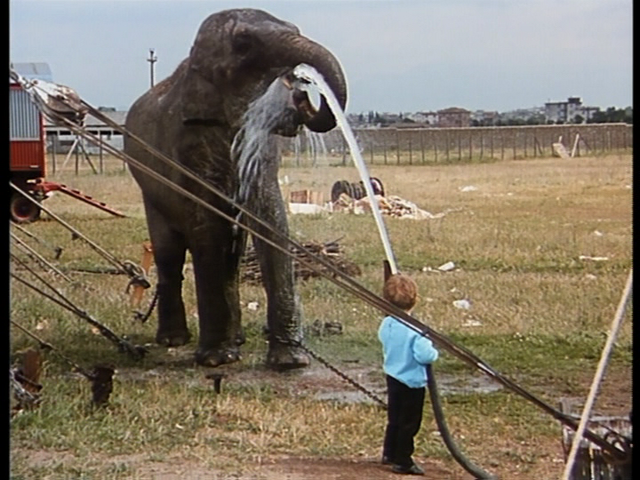
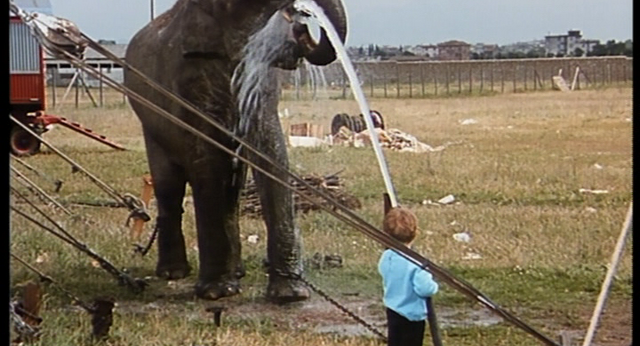
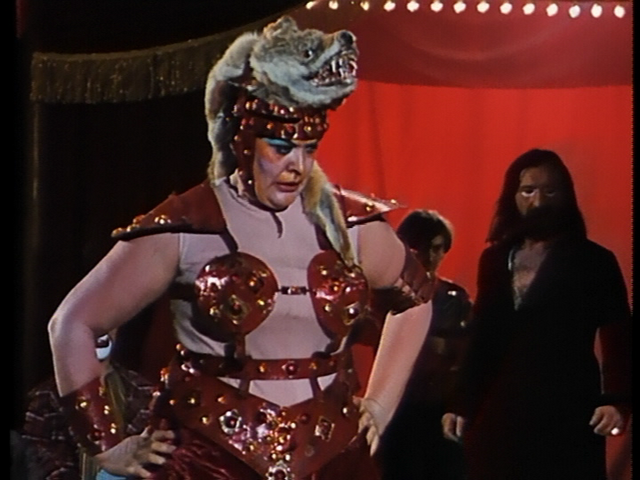
This is one of my all-time favorite movies.
I find it endlessly enchanting. Why?
Because Osiride Pevarello has a major part in it!
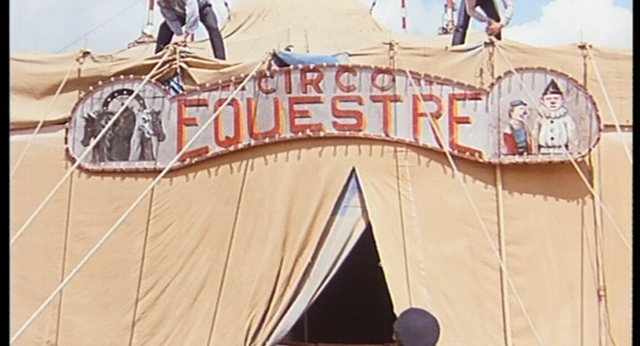
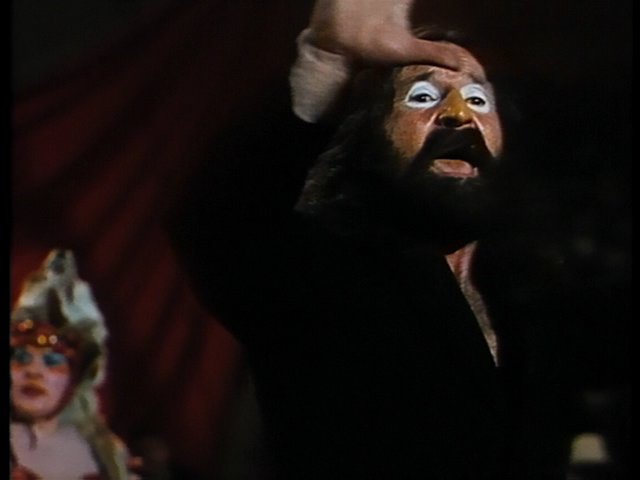
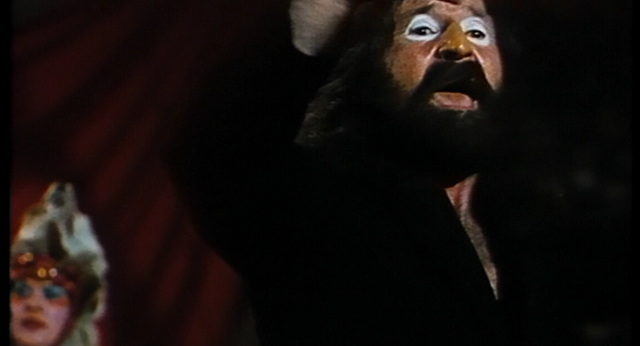
His is the first voice you hear heaving up a circus tent during the opening credits.
He is the talker (never call them barkers!!!!!) with the megaphone when the circus first opens.
He is the master of ceremonies for all the clown and spectacular acts under the big top.
And then he appears again at what I guess could be called the Funeral for the Unknown Clown at the end.
What could possibly be more satisfying than that?
(Answer: Having him in all the scenes.)
He’s credited at the end simply as Peverello.
For the third and final time in his directorial career, Fellini used direct sound!
But only a little bit.
Children, at least in the US, tend to find clowns off-putting, even frightening.
And when they grow up, they still find clowns off-putting and frightening.
That’s probably because they grew up watching Larry Harmon’s Bozo.
I have nothing against Larry Harmon or Bozo, but that’s not a real clown.
Or it could be that kids saw boring clowns at birthday parties or something.
Those aren’t true-blue clowns either.
The clowns we see now on TV kiddy shows or at birthday parties or at corporate luncheons
are de-fanged; they reinforce the status quo.
A bunch of business execs gather together in a dreary overhead-fluorescent-lit fake-wood-panel-walled
meeting room and have a clown perform a couple of magic tricks for their amusement,
and they all chuckle half-heartedly and somewhat derisively and thank him and dismiss him
and then get down to the real business on the agenda.
Yech!
Clowns, in the truest sense, are subversive, seditious.
They represent the worst in human nature — authoritarians and retarded maniacs —
and in that sense they are reflections of human society.
They emphasize all the ugliness and insanity at both the top and the bottom,
and they provide no assurance for those in the middle either.
How can one watch a clown and then take a politician seriously?
Fellini understood that.
A handful of Europeans seem to understand that.
Americans just don’t seem to get it at all.
So I’ve been looking through the online reviews of the new Raro DVD,
and they’re so sad,
because this movie didn’t resonate with the reviewers.
And I suspect it didn’t resonate simply because the reviewers still
consciously or unconsciously equate clowns with Bozo.
This is Fellini’s second made-for-TV movie.
As such, it was shot at Academy 1:1.375 (for TV purposes similar enough to video’s 1:1.33) and needs to be shown that way.
If you find that it’s shown widescreen anywhere, burn the cinema down.
Note to projectionists: Run it at 25 frames per second, not 24.
(Do your projectors have variable speed?
If not, you need to upgrade them.)
I read somewhere that the original television broadcast was black-and-white and shorter than the cinema release.
Not shorter merely because of the faster video frame rate, but physically abridged.
Could well be.
Oddly, though I clowns was made for television,
it was given its cinema première just two days later,
with Fellini and his wife Giulietta Masina treated as royalty in their box seats.
My friends Diane Christian and Bruce Jackson were there for the première.
Oh god am I jealous.
The DVD from Raro USA (the first Raro US release, item number RVDUSA001) is a beautiful presentation,
with nice extras and a beautiful booklet that includes an extensive cast list.
But it misidentifies Osiride Pevarello as the fire eater.
Osiride was not the fire eater. He was the “talker” and MC, and the booklet does not make any mention of the talker or MC.
I don’t know who the fire eater was.
The booklet also makes it clear that cinemas projected it at 1:1.85,
and strangely states that the 1:1.85 version was different from the 1:1.33 TV version. Huh?
That’s impossible.
Well, maybe not impossible, but highly improbable.
Yes, I can concede that the distributor may — may —
have printed some segments higher and some lower so that the more important action would kinda sorta fit on the widescreen.
That was done for Coming Apart and the first reel or so of The Rocky Horror Picture Show.
That was also done for this thing I ran once called Fievel Goes West
(reformatted at 1:1.85 hard matte)
as well as for the re-release of Disney’s Peter Pan (reformatted at 1:1.66 hard matte —
a rotten job, though, and heads and feet and action kept vanishing off the screen).
That was also done for the reissue of The Sorrow and the Pity (reformatted at 1:1.66 hard matte),
which I did not see, but which I am assured was unwatchable.
So yes, it is just barely conceivable that the distributor did that for I clowns.
But I really doubt it.
What must have happened is that cinemas, which were set up to show widescreen only,
simply cropped the living daylights out of the movie.
Okay, just out of curiosity, let’s try an experiment.
The Raro DVD includes significantly more image than the VHS releases,
and I’m pretty sure that what the DVD shows is pretty much all the image that was on the film.
For the sake of argument, let’s assume that I’m right, and that the DVD captured essentially all the image.
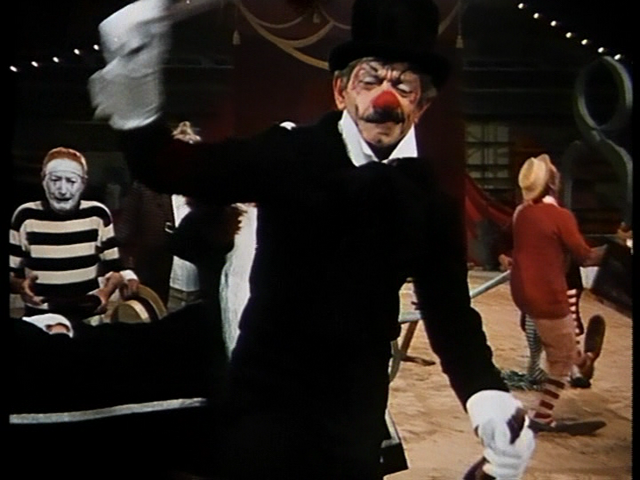
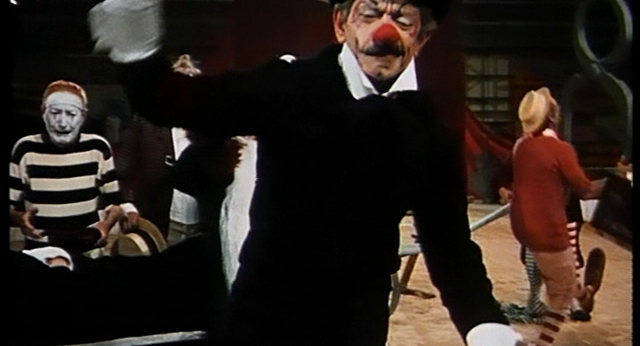
If that’s the case, the following examples will show approximately what happens when this movie is shown at 1:1.85 at a cinema.
1:1.33 as shown on TV, and as it appears on the Raro USA DVD
1:1.85 as shown at the cinema (a simulation)
Osiride Pevarello, or, as the credits simply state, “PEVERELLO.” There’s no set spelling of his surname.
See? If you show this in widescreen, you chop off Osiride’s head.
Yes, the action is all there, but the composition is completely ruined.
Marcello Di Falco,
who played the title rôle in Roberto Rossellini’s
L’età di Cosimo de’ Medici
and who also appeared briefly as Tiberius’ orgy master in
Caligula.
That’s
Jean-Baptiste Thiérrée.
According to the movie, he was a real-life shrink, but who knows?
If he was a shrink, we can thank heaven that he gave up shrinking to go full-time into the circus,
a much more honorable profession,
and a much more ameliorative and therapeutic one as well.
Why do I concentrate on him? Well, look who his partner is!
Victoria Chaplin!
The daughter of you-know-who.
Well, maybe not. As I’ve discovered over these past few decades,
she’s the daughter of you-don’t-know-who-you’ve-never-heard-of-him-and-you-don’t-care.
In any case, her dad wanted to star her in his next movie, The Freak,
about a child born with angel wings.
But she wrecked his preproduction by eloping with Jean-Baptiste.
Dad was planning another movie, too, about which I know nothing except what was reported in
the weekly edition of Variety on Wednesday, 27 September 1967, p 2:
The Doll and the Old Man from the Irish novel by
Alpha de Monté.
He must have read the novel in manuscript form, for it has yet to be published or even completed.
Fantastic, isn’t it?
That’s the only sort of life that’s worth living.
An enchanting smile. There’s no question of her paternity.
She looks strikingly like her mother too.
And to my eyes, her mother and her father looked strikingly like each other.
And that’s his wife, Annie Fratellini of the renowned circus family (and who was also in Zazie dans le métro, another one of my favorite movies that flops wherever it’s shown).
Can someone, anyone, please identify this actor?
We know that his first name was Roy, but that’s all we know.
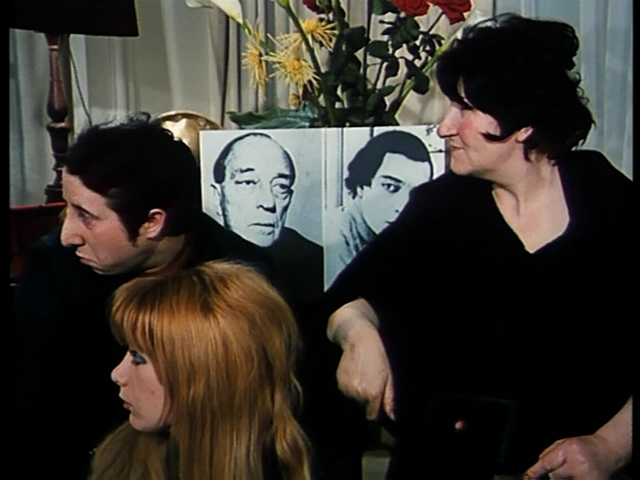
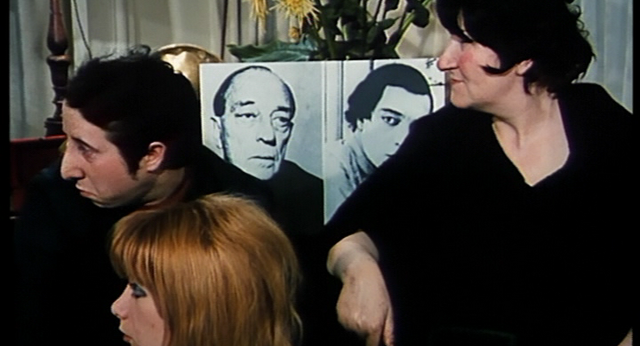
Gathered together in the Étaix apartment. Look at the photos on the table!
Did the world just get a tiny bit smaller again?
Remember, Buster was Fellini’s favorite of all, followed closely by Laurel & Hardy.
Most people I encounter have never heard of Buster or Laurel & Hardy either.
They give me blank stares when I mention the names.
Oh well, I give them blank stares when they talk about ball games and the latest celebrity gossip.
The Fratellinis performing at a looney bin.
The shrink on duty shows who’s boss.
Bario on the right, visited by you-don’t-know-who on the left.
You’ve never seen that photo published anywhere else, have you?
Osiride Pevarello and Alberto Sorrentino at Fischietto’s funeral.
Remember Alberto?
He was in Boccaccio ’70 and Tinto Brass’s underrated
Action, among other things.
Tino Scotti as the notary. He was a famous variety comic
and had appeared in Tinto Brass’s L’urlo
as the armed guard at the hotel who was eaten by The Greatest Philosopher (Osiride Pevarello) and family,
only to be resurrected as The Intellectual during the definitive war.
That was a fun movie too.
But like I clowns, it leaves most people cold for some reason.
But like I clowns, its fans are diehards.
“Italo TV Production for 1970,” Variety (weekly) 258 no 8,
Wednesday, 8 April 1970, p 74 col 3
The Italian DVD from Istituto Luce lists Alberto Sordi and Marcello Mastroianni on the front cover, but, alas, they are deleted, as this is the short version. Phooey! Italian audio only, with optional English subtitles. (Region 2 PAL system, which won’t play properly on most US/Canadian equipment)
The long-out-of-print Italian PAL VHS from Istituto Luce
ROMA
(1972)
Don’t believe the posters.
And don’t believe the reference books.
The title of this film is simply Roma.
That’s it. Nothing more.
It is not, was not, and I hope never will be called Fellini’s Roma.
It’s just Roma.
There have been multiple versions of this film.
I was so happy to win on eBay, a few months ago, an out-of-print Italian VHS of this film
that proudly announced on the cover A SORDI and M MASTROIANNI.
If you’ve seen the film, you’ll probably try to remember Alberto Sordi and Marcello Mastroianni being in it,
and you probably won’t be able to.
And if you watch it a second time, it’s clear that they’re not there.
Well, they were.
Once upon a time.
And I now have the video to prove it!
The PAL-speed running time is 2:02:31, which means that when shown at cinemas at the correct speed, it would run 2:07:37.
Check that against the DVD and VHS and laserdisc you have at home.
Your copies are, of course, a mere 1:59:26.
Well, don’t feel like you’re the only ones who’ve been swindled.
Even the print that Cinecittà circulates as part of its touring Fellini retro is the short version.
Marcello Mastroianni dines at the sidewalk café shortly before Gore Vidal’s scene.
And Alberto Sordi dines at a sidewalk café shortly after Gore Vidal’s scene.
The remaining difference of about five minutes consists of, well, something.
I need to put it side by side against one of the regular releases to figure out what else was chopped.
According to
Tempi Moderni,
the Italian DVD is indeed complete.
But Tempi Moderni is wrong!!!!!
Speaking of Gore Vidal, he once told a story to Hollis Alpert for the book Fellini: A Life:
Some months later I was summoned to a studio to dub my voice.
On a large screen there was my scene. Fred looked contented.
Since he had lost the soundtrack of the original scene, nothing but odd noises could be heard on the screen.
I asked, “Don’t you have a transcript of what was said?”
Fred winked.
“No, Gorino. We just make up something else.”
For two hours I sat trying to match words to my own lips on the screen.
Fred was quietly triumphant at this victory in his war against direct sound.
Finally I cobbled together three sets of words in English, French, and Italian.
Then we started to record.
There was a white ball that bounced along the top of the screen and when it stopped you stopped speaking,
your dialogue presumably in place.
I got through the French and the English easily,
but Italian is longer than English and after the ball had stopped I was still speaking — outside the scene.
There were long sentences, with complicated structures that I’m not used to speaking in the language.
I just couldn’t get them out in time for the synchronization.
Fred was gazing beatifically out the window as I struggled to keep up with the ball.
After the third ruined take, I said,
“Fred, you're supposed to be a great director — help me say the line so I get it out on time.”
“Oh, is there trouble?”
His eyes were wide with innocent concern.
“Oh, is so easy.
Before you talk, you take deep breath.”
I took a deep breath and it came out exactly right.
“See,” he said.
“I am a great director.”
There are other variations too.
The opening credits were entirely remade for the US release, and they were, of course in English.
A narrator, who pretends to be Fellini but whose voice is entirely different,
speaks English with an unconvincing Italian accent,
explaining that the film we are about to see is not a traditional narrative, but a series of impressions.
No such introductory narration appeared anywhere in the Italian version.
This same mysterious VO actor continued to deliver all of Fellini’s narration.
I didn’t understand why.
And then a few of the scenes were in English.
Not only Vidal’s, but also the tunnel excavation, Princess Domitilla, the Ecclesiastical Fashion Show.
They were all in English.
And the actors had delivered their lines in English. Obviously.
But Anna Magnani, who delivered her lines in Italian, dubbed her lines in English.
Finally, after years and years of waiting, I saw the Italian version on the big screen.
It was entirely in Italian.
Even Vidal’s scene.
Even the excavation. Even the Princess and the fashion show. Even Magnani.
But Fellini’s narration was still dubbed by someone else.
Most of the time.
You hear his own voice once or twice, briefly.
The VHS, issued in 1991, is the US release version.
The laserdisc, which came out in 1993 and has almost identical artwork, is the Italian version.
The DVD is also the Italian version.
The film was shot at 1:1.85, but whenever you look up the references, they insist that it was shot at 1:1.66.
Nope. Sorry guys. It was 1:1.85. Believe me.
Whoever mastered the DVD was apparently told to make it 1:1.66 to match the references.
And so it is.
And so the sides are lopped off.
The laserdisc is 1:1.78, but whether this is by revealing more of the width or less of the height
I have not yet had time to determine.
The British DVD apparently has numerous different dubs as options.
One of the options seemingly is for an all-English dub!
I must purchase it someday soon, before it goes out of print.
It has the same running time as the US DVD, and was probably just a video conversion from NTSC to PAL,
rather than a fresh transfer.
The DVD
The poster
AMARCORD / I
REMEMBER
(1973)
If you’ve never seen a Fellini
film, this is probably the one to start with.
Yes, we were all confused by the title.
Back in 1994 or thereabouts an Italian professor introduced
a showing of the film at the Eastman House and she
explained that it was in the Rimini dialect, and that it
was equivalent to “Mi ricordo.” There was a sigh
of relief and recognition (“Ahhhhhh!”) among the
several hundred people in the auditorium.
If you saw this film outside of the
Soviet Union, you probably saw the complete version.
It’s 1:1.85, and I absolutely hated the
cropped version that used to show on the cable stations,
because it completely killed the gag with the bouquet
toward the end of the film.
If you saw the English dub, don’t
worry. Fellini directed the English dubbing. That’s
why Gradisca became Si-vous-plait and
that’s why Volpina became Venus and that’s why
Biscein became Pinwheel. He needed to find
easy-to-understand English equivalents to the Italian names
that would sort of lip-sync. Fortunately the Criterion DVD
includes both soundtracks.
I hope someone preserved the outtakes.
Let Fellini tell his tale (Chandler,
I, Fellini, p 180):
Magali [Noël] was glad to be
working with me again. She is one of the most
coöperative actresses I have ever known. She
would do anything I asked. Anything. For a scene
that was later cut, I asked her to bare her
chest, which she did without
hesitation.
I had to cut her favorite scene as
Gradisca, and I’m not sure she has ever
forgiven me. I hope she has. The scene is in
front of the local cinema at night with the
camera moving in slowly until it reaches Gradisca
standing beside a poster of Gary Cooper. She is
gazing up worshipfully at her hero as she files
her nails. He was a man any woman would love. I
had to cut the scene. It would have made Gradisca
the central character, and this was not a picture
about Gradisca.
When I asked Magali if she liked the
picture, she bit her lip and bravely tried to
smile, but her eyes were still red from
crying.
A beautiful poster
An evocative poster
A boring poster
In 2003 or thereabouts it finally came to DVD! PAL system and Region 2, which won’t play on American equipment. It has both the English and Italian tracks, and optional English subtitles and Italian captions. 1:1.85.
FELLINI’S
CASANOVA / IL
CASANOVA DI
FEDERICO FELLINI
(1976)
I keep reading in the various books that
the correct title of this film is simply Casanova.
That’s probably right, but I’ve never seen a
print or poster that gave that title. Fellini’s name
is always incorporated.
The posters announced, not quite correctly, that this was Fellini’s first film in English.
But they neglected to mention that two of Willie Wonka’s Oompah-Loompahs are in it!
This is one of my favorite Fellini films,
but I can’t find too many people who agree with me.
Audiences walk out in droves, bored to numbness.
I don’t understand why.
Maybe they can’t relate to it because they don’t have dreams at night.
Incidentally, it was United Artists that imposed the condition that the actors speak English on camera.
So most of them did, most of the time.
But Bernardino Zapponi’s script, naturally, was in Italian.
Who could put it into English? Answer: Gore Vidal!
Vidal not only put it into English, he got Fellini’s approval to rewrite a few scenes.
In the end, though, Fellini kept only portions of Zapponi, deleted Vidal, and hired an uncredited Tonino Guerra for rewrites.
Anthony Burgess then put the result into English.
Burgess, of course, is not credited in the Italian version.
Here’s a little tidbit from John Baxter’s Fellini: The Biography
(New York: St Martin’s Press, 1993), p 313:
At three and a half hours, the film demanded severe editing.
Almost every supporting actor lost his or her major speech.
Those that remained were extensively rewritten for the English-language version by novelist Anthony Burgess.
Some sequences disappeared altogether, including Chesty Morgan’s entire rôle as the maid Barbarina,
and an Arabian Nights idyll in which Casanova is brought by gondola to a Venetian seraglio,
watched by adoring harem girls, then enjoys a homosexual dalliance with a beautiful black man.
Casanova admits to a few homosexual acts in the memoirs but Fellini, typically,
believed that the great lover’s compulsive womanising was, in part at least,
a flight from homosexuality.
‘You do not know women and you do not know yourself,’ Casanova is lectured in the original screenplay.
‘You do not pursue women; you flee them.
Loving that many means that what you are seeking is probably a man.’
The speech, like the homosexual encounter in the harem, was cut.
That’s terribly exaggerated.
Major speeches were not deleted.
I have read three drafts of the script, and yes, there were changes.
Voltaire was never shot, replaced by the scene with the worms.
The party scene was radically rewritten, and we can see the blond couple who were cast for the original script
became mere extras in the shooting.
The scene with Casanova’s daughter was never shot, but the woman cast for the part appears at a dinner scene.
Chesty Morgan was deleted in the editing,
the scene in which Casanova’s carriage nearly crashes into his brother is severely shortened,
and the black guy on the gondola was entirely deleted.
That was it.
It is reasonable to assume that the rough cut was indeed three and a half hours.
Considering that Chesty Morgan is prominently mentioned in the opening credits,
it is reasonable to assume that at an early time her scenes were included in a finished print of the film.
Interestingly, a documentary called I’m a Born Liar
includes an excerpt from an interview with Donald Sutherland,
who talks about one of the above-mentioned scenes from Casanova in which,
on a raft, Casanova makes love with a man. A clip is shown.
As for Chesty Morgan, a supplementary disc in the Italian Fellini DVD box set includes a mute clip from her scene.
I’m sure there’s plenty more buried in the studio vaults. We need to rescue this footage.
What can we learn from this?
Well, this is not a work print; this is printed from a negative that had been been cut preparatory to release.
Yet there is no work track or re-recorded track.
We can presume that these have been lost.
Charlotte Chandler, in her book I, Fellini,
states that the film is 2 hours and 50 minutes long.
Other sources state that the original Italian release was about 2 hours and 46 minutes long.
By the time the film got into general release it was merely 2 hours and 35 minutes long,
or 2 hours 28 minutes at video speed.
Baxter again:
Neither Grimaldi nor Universal was happy with the result.
Universal representatives flew to Rome from Hollywood in the hope of convincing Fellini to cut an hour.
The film was not erotic, they complained.
‘Casanova is life!’ one of them chided.
‘Is strength, courage, faith.
He is the joy of living. Understand, Fefé?
Why have you made him a zombie?’
Fellini had already cut a number of major scenes to get the Italian running time down to 165 minutes.
Now Ruggero Mastroianni and his team went through the Italian version
and removed another fifteen [sic] minutes for the French and English markets
without deleting a single scene.
Actually, when Universal first opened Casanova in Los Angeles, the film ran 166 minutes.
But a week or two later the original prints were pulled and replaced with the standard 155-minute version.
Fiddlesticks!
I visited a projectionist who was running this movie back in 1976 or 1977,
and I did a double-take when I saw that he was running it at 1:1.66 and was filling the screen at that ratio.
I had never before seen an Italian film that could be shown that way.
He led me over to the shipping bands, which, like the shipping bands of yore (circa 1950s), stated:
MINIMUM ASPECT RATIO 1:1.375
MAXIMUM ASPECT RATIO 1:2.00
PREFERRED ASPECT RATIO 1:1.85
And then he told me that after seeing the film, he would in the future run it at 1:1.85,
because a few shots revealed black bars at the top and bottom of the 1:1.66 screen.
(I have since seen two Italian films shot between the 1:1.85 years of 1962 and 1980 that were indeed shot at 1:1.66:
Rocco e i suoi fratelli and Il conformista.
I’m sure there are others too — probably 1900, but I’m not sure.
And the few Lina Wertmüller films I’ve seen were all shot, or at least cropped in the lab, at 1:1.75.
Just in case you wanted to know.)
When it showed on cable TV
(the foreign and older films were the only reason I subscribed to the Playboy Channel —
and when they quit showing them, I quit subscribing)
I understood why the opening credits were 1:1.85 and I understood why that dissolved to the first shot proper of the film,
which was full-screen 1:1.375.
But then I didn’t understand why the rest of the film was cropped.
I understood only when I saw another print, which had been cropped in the lab,
from beginning to end, at 1:1.85.
I was furious. Why can’t the labs just leave it alone?
Cinecittà includes in its Fellini retro a print of Casanova,
and I was so thrilled that I would finally see an extra 11 minutes or so. Nope.
It was the same 2-hour-35-minute print I had seen elsewhere.
But dubbed into Italian. Oh.
If you’re worried, like I was, that no one could possibly do justice to Donald Sutherland’s distinctive voice,
well, you’re right, but don’t worry.
In the Italian version he was dubbed by the great Luigi “Gigi” Proietti!
There are other differences.
The opening credits of the English version list Anita Sanders as Assistant Director.
The Italian credits don’t.
The Italian credits, of course, credit Gigi Proietti,
and the English credits, of course, don’t.
Did you notice that was Diane Kourys as the daughter Charpillon?
Neither did I. I need to look again. Wow.
The DVD
The poster
PROVA D’ORCHESTRA / ORCHESTRA REHEARSAL
(1979)
Fellini works for TV once again!
Rule # 1: No more than 80 minutes.
Rule # 2: Lots of close-ups.
But here’s what I don’t understand.
If it was shot for TV, why was it shot at 1:1.85?
Normally TV films are shot at the relatively large Academy 1:1.375 aperture.
If you want to release them theatrically later on,
you just make sure that nothing important happens at the top and bottom of the image,
because that’s what the cinema will crop off.
But this film was shot at the much smaller 1:1.85 aperture,
with nothing much important happening on the sides.
So if you crop off the sides and enlarge the middle to fill a TV screen, it will look just fine.
I don’t know if it was shot at 24fps or 25fps.
If you know, write to me. Thanks.
Surprisingly, a lot of people don’t like this movie.
Apparently they don’t see anything remarkable about it.
If you’re one of those people, here’s a helpful hint:
Take your eyes off the subtitles for a moment and look at the faces.
If a picture can speak a thousand words, a thousand pictures can speak a....
The DVD
The poster
LA CITTÀ DELLE DONNE / THE CITY OF WOMEN
(1980)
Franco Rossellini of Felix
Cinematografica and Bob Guccione of Penthouse
magazine produced this film. They signed a contract with
Fellini for four films: La città delle donne, an
untitled project, Il viaggio di G. Mastorna, and
something called Woman with a Hoop and Sword. Well,
we all know about ill-starred Mastorna, but what
were the other two projects?
Guccione kept pestering Fellini to add
more and more sex, more and more explicitly, to the film.
Fellini refused, and Guccione thought him a prude. When the
other Rossellini-Guccione film,
Caligula,
disintegrated into expensive and protracted legal suits,
they canceled the remaining three Fellini films. Finally
they canceled this one too, and turned it over to Franco
Rossellini’s cousin at Gaumont Italia, who saw the
film through to its completion.
This is one of Fellini’s greatest
films, but, like its two predecessors, it was a monumental
flop. Shot at 1:1.85.
More stuff that no one, but no one, has
commented on before: Back probably in the early 1970s
Robert Klein recorded a comic monologue concerning sexual
symbolism in TV commercials. One of his examples was an
advertisement that concluded with the boy and girl kissing
as a train entered a tunnel. “You don’t have to
be Fellini to understand that!” And so how did Fellini
begin this film? With a train entering a tunnel! But the
symbolism here is not sexual. Instead, it’s a descent
into the unconscious.
And something else that no one has
commented on: The character of Dott. Katzone (or Dr
Zübercock in the subtitles) is an obvious parody of
producer Bob Guccione, with his failed attempt at regained
youth, his shirt unbuttoned to the waist revealing his
barrel chest covered by gold necklaces and medallions, his
pack of vicious guard dogs, his celebration of his
ten-thousandth sexual conquest.
Shortly after the opening, Fellini himself cut two minutes.
Take a look:
The only other change I know of is in the opening credits:
Original version, as seen on the VHS from New Yorker Films
Revised version, as seen on the DVD from New Yorker Films
Should I wonder why?
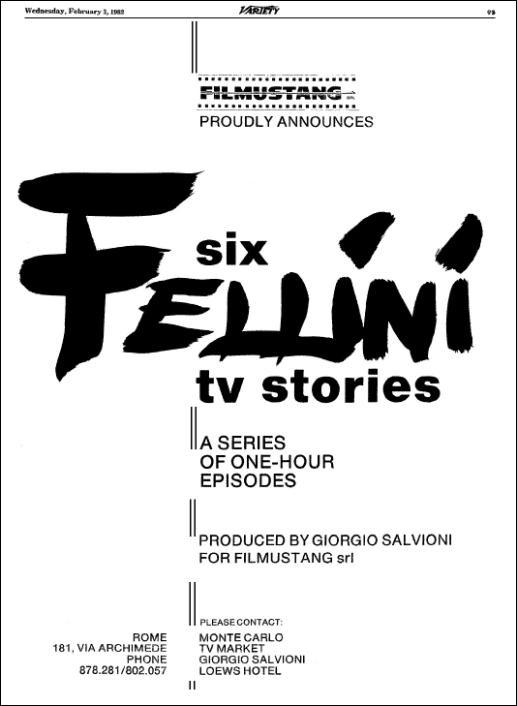
The ad from Variety (weekly) 306 no 1, 3 February 1982, p 95
This was a project long in the works.
Originally it was going to be four feature films produced by Franco Rossellini (Felix Cinematografica) and
Bob Guccione (Penthouse/Viva), but then things happened and later it would be a series of four TV movies.
And by this time apparently that had been upped to six.
What were these? Does anybody know? If you know, please let me know. Thanks!!!
The DVD
The poster
E LA NAVE VA /
AND THE SHIP
SAILS ON
(1983)
What a nice movie! Oh so nice! My only regret is that
Osiride
Pevarello was cut out of it. I hope
someone has his footage somewhere. This film, of course,
was in Italian. Even the Germans spoke Italian, despite not
being able to speak it. Except in the scene where they
couldn’t understand the Italian speaker Orlando. In
that scene they spoke German. But Orlando, played by
Freddie Jones who couldn’t speak Italian, spoke
English on camera. He was dubbed into Italian, and the
English subtitles are exact transcriptions of what his
mouth is really saying. But of course there was an English
version in which nearly everyone was dubbed into English,
including Freddie Jones. Like a total fool, I forgot to
record the English version when it was on cable TV, and now
it will probably never show up again. 1:1.85.
BITTER CAMPARI
(1984)
You’ve never heard of this one?
That’s because it’s one minute long and because
it was a TV commercial. It’s rarely shown anymore. I
have it on VHS in storage somewhere, recorded off a cable
show hosted by George Plimpton. It’s really nice. But
not as nice as Fellini’s later TV commercials.
The full-screen VHS
The needlessly “widescreen” DVD
The poster
GINGER E
FRED /
GINGER AND FRED
(1985)
Well, after making a TV commercial, why
not make a whole movie about TV commercials? I’m being
a bit unfair. It’s about more than TV commercials.
This is not a typical Fellini film (it’s really a
Giulietta Masina film, as it was her idea), and on my first
two viewings I wasn’t too impressed. But once I saw it
on the big screen... oh! It’s nice.
It’s one of Fellini’s most heartfelt, moving, and
bittersweet films ever. And those same two Oompah-Loompahs
are in it!
This is 1:1.375. Sort of. You can argue
that it’s 1:1.85. Both arguments are correct. The film
was composed for cropping at 1:1.85 for cinemas, but shot
with the taller 1:1.375 aperture so that it could be shown
on television. No big deal. That’s quite normal for
movies — even Italian movies shot in the 1980s
and later. But, again, it’s not that simple. For this
film Fellini shot a goodly number of fake TV commercials,
fake TV shows, fake TV talk shows, and fake TV music
videos. These were to be shown on TV monitors in the
background, and these, of course, were shot at 1:1.375
without any provision for cropping. Where it gets
complicated is where Fellini, in the editing suite, had
second thoughts and cut some of his commercials into the
film proper, filling the entire screen. So if we crop most
of the film properly at 1:1.85, we’ll totally ruin the
few TV commercials that fill the entire height of the
image. Solution: Run it at 1:1.375. It’s the only way
to do it properly. For Cinecittà’s subtitled
Fellini-retro prints, the lab wisely put the subtitles
right at the bottom of the frame so that no projectionist
in his right mind would even think of cropping it at
widescreen.
I’m not sure, but that might be
Osiride
Pevarello who hands the bouquet of flowers to the
transvestite. I’ve slowed the film down and watched
it frame by frame, but I can’t really be sure. His
face seems wider, but just before he disappears we get a
good look at his distinctive nose, and that looks like
Osiride’s nose.
It’s also
available, without English subtitles, on a properly full-screen DVD in Italy, as
part of the Fellini box set.
Now, Cinecittà’s Fellini retro
includes a film called La TV di Fellini, a
collection of the fake commercials and fake TV show
segments that Fellini shot but which were largely cut from
the final version of Ginger e Fred. These are
included as a supplement to Koch-Lorber’s DVD of La
dolce vita as well as on Istituto Luce’s
Ultima sequenza
DVD. On the tiny TV screen in your living room
they’re mildly amusing. But on the big screen
they’re screamingly funny. Why doesn’t the music
sync? Simply because it was never recorded. The folks who
found this footage and released it just put some of the
film’s other music over the mute music videos. In the
other sequences, listen carefully. What you sometimes hear
is not the final revoiced version, because there
wasn’t any, but the direct sound, with Fellini talking
in the background and even giving actors their lines!
Precious stuff!
ALTA SOCIETÀ
RIGATONI BARILLA
(1986)
Another minute-long TV commercial. I
think I saw this once, but I need to see it again. Does
anyone have this on video? If you do,
write to me. Thanks!
Like Ginger e Fred, this was
composed for cropping at the cinema at 1:1.85 but shot at
the much taller Academy 1:1.375 aperture. But it looks so
much better without the cropping. Realizing this, for the
touring retro prints, Cinecittà put the subtitles right at
the bottom of the frame again, forcing the few
projectionists who know the difference to run it with the
taller image. This, I think, is Fellini’s first stereo
film. But Fellini never needed stereo. His sound technique,
probably the best of any filmmaker’s, is perfect in
mono. Result: Though recorded in stereo, it sounds like
mono. I haven’t studied the sound on proper equipment,
but it wouldn’t surprise me if all the sound is on the
center channel.
The DVD available in the US is, sadly,
letterboxed. Sigh....
As a stand-alone title, this is out of print. PAL system. In other words, it won’t play properly on American equipment. No English subtitles.
But it’s still available as part of a box set.
LA VOCE DELLA LUNA / THE VOICE OF THE MOON
(1990)
This is my favorite Fellini film of all.
It is the most convincingly dreamlike, the most hallucinatory, the most magical of all his works.
I’ve seen it on the big screen three times, and audiences despise it.
The first two times I saw it, in Toronto, when the lights came up the folks in the audience were looking for blood.
Never have I heard so many people raging so angrily.
They took the film as a personal insult.
The third time I saw it I didn’t hear complaints; I just saw people walking out in droves.
So I prefer this one on video.
It wasn’t meant for the world.
It was meant for me and for the few people like me.
Too bad it’s never been released in the Americas.
1:1.85.
No. The reference books, and even Cinecittà’s program notes, are wrong wrong wrong wrong wrong wrong!!!!!
The title of the film is The Voice of the Moon, not Voices of the Moon.
Egad how can so many people get that wrong?
BANCA DI ROMA
(1992)
A series of three commercials, each running two minutes.
In each, Paolo Villaggio describes a nightmare to his shrink, portrayed by Fernando Rey,
who tells him that the only way to cure his psychological ills is to open an account at Banca di Roma.
These are the best commercials I’ve ever seen.
Oh how I’d love to get these on video.
If you’ve got copies, give me a holler.
Thanks!