BEFORE SCROLLING TO THE WEB PAGE BELOW ABOUT JORIS IVENS’S ITALY IS NOT A POOR COUNTRY, PLEASE TAKE A LOOK AT THESE NEWS ITEMS, WHICH ARE FAR MORE IMPORTANT THAN ANYTHING I’VE EVER HAD TO SAY:

AMY GOODMAN:     A little-noticed story surfaced a couple of weeks ago in the Army Times newspaper about the 3rd Infantry Division’s 1st Brigade Combat Team. “Beginning Oct. 1 for 12 months,” reported Army Times staff writer Gina Cavallaro, “the 1st BCT will be under the day-to-day control of U.S. Army North, the Army service component of Northern Command, as an on-call federal response force for natural or manmade emergencies and disasters, including terrorist attacks.” Disturbingly, she writes that “they may be called upon to help with civil unrest and crowd control” as well. The force will be called the chemical, biological, radiological, nuclear or high-yield explosive Consequence Management Response Force. Its acronym, CCMRF, is pronounced “sea-smurf.” These “sea-smurfs,” Cavallaro reports, have “spent 35 of the last 60 months in Iraq patrolling in full battle rattle,” in a combat zone, and now will spend their 20-month “dwell time” — time troops are required to spend to “reset and regenerate after a deployment” — armed and ready to hit the U.S. streets....

FOR THE FULL STORY, CLICK HERE.

It gets worse:

NAOMI WOLF:     On October 1, 2008, President Bush deployed a brigade — which means three to four thousand warriors — somewhere in America. We do not know where they are deployed though citizens have informally reported to me having seen military vehicles and troops in Georgia and Alabama. We do know that their official mandate according to the first report is “crowd control” as well as action in the event of a mass civilian catastrophe. Initial reports described their technology “module package” as involving Tasers and rubber bullets.... The First Brigade is Bush’s force: they are not answerable to Congress or to the Governors of states: they are answerable to the Commander in Chief. In an Alternet posting, I interviewed Air Force Colonel (retired) David Antoon who noted that the troops must obey the president, even if he asks them to arrest Congress or fire on civilians or attack media outlets. If they do not obey orders, he notes, they face five years in prison.... Antoon himself calls the deployment “ominous.” Troops on our streets makes us something less than a democracy: one definition of a police state is when a leader sends his own military units into civilian streets. Meanwhile the civilian policing of citizens is becoming more brutal. Hundreds of preemptive arrests took place in St Paul, dozens of journalists were arrested.... In St. Paul, funds were sent in advance to pay off the lawsuits against police forces that were guaranteed to arise from the planned abuse of citizens. This sort of thing is happening across the country. The tactic has established a closed circle that has turned citizens’ law enforcement agencies into contractors of a state that is directing acts of increasing severity against US citizens. Now a military brigade is being deployed....

FOR THE FULL STORY, CLICK HERE.

Click here to see an interview with Naomi Wolf conducted in early October 2008.

For the past five years or so I hve been hearing rumors that Halliburton has been building (and has now finished building) 800 prisons throughout the USA, not yet functioning, but just waiting for the right crisis. I have not found reliable evidence for the specific quantity, readiness, functionality, locations, or details, but you might be interested in taking a look at page 5 of this Halliburton press release dated 26 January 2006: KBR has been awarded a contract announced by the Department of Homeland Security’s United States Immigration and Customs Enforcement (ICE) component. The Indefinite Delivery/Indefinite Quantity contingency contract is to support ICE facilities and has a maximum total value of $385 million over a five-year term. The contract provides for establishing temporary detention and processing capabilities in the event of an emergency influx of immigrants into the United States, or to support the rapid development of new programs.... Now, really, what are the chances of “an emergency influx of immigrants into the United States”? And what are the “new programs” that could come under “rapid development”?

FOR THE FULL PRESS RELEASE, CLICK HERE.


NOW, BACK TO THE MAIN PART OF THE WEB PAGE:


Did you happen to record Monty Python’s Flying Circus when it was shown on PBS back in the 1970s?
Do you still have the tapes?
Is there a TIME-LIFE logo at the end?
If so, please write to me. Thank you!


THE WORKS OF TINTO BRASS
Apprenticeship—Continued


This page was previously at http://www.geocities.com/busterktn/tinto1a.html (and http://www.geocities.com/busterktn/1960a-it.html), but Yahoo/Geocities deleted it without warning or explanation. Since Yahoo also deleted my entire email collection, if you once wrote to me at busterktn@yahoo.com, please write to me again by clicking here. Thanks!


L’Italia non è un Paese povero

(Italy Is Not a Poor Country, 1959–1960)

Joris Ivens, the famous experimental Dutch filmmaker, spent his life traveling the world making documentaries. All are rare, and this is one of the rarest. I have seen only two Ivens films, The Bridge and Rain, both silent experimental shorts, and there is no question to my mind that Ivens’s impressionistic editing left a mark on Brass. According to Carlos Böker’s thesis, Joris Ivens, Film-Maker: Facing Reality (“Studies in Photography and Cinematography, No. 1,” UMI Research Press, 1978):

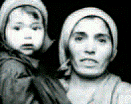
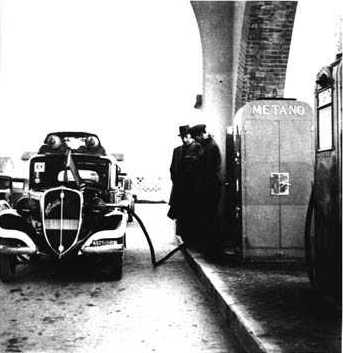
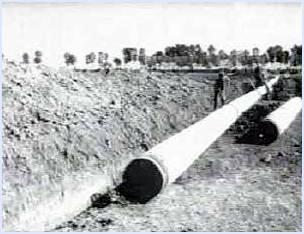
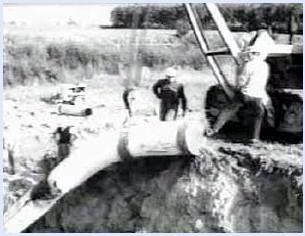
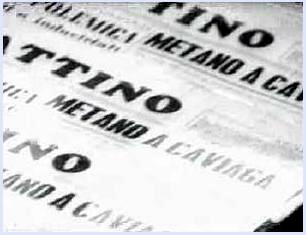
... Ivens was approached by Enrico Mattei, head of ENI, the Italian State Natural Gas Monopoly. Mattei, who died mysteriously in an air crash in 1962, and was the subject of a later film by Francesco Rosi (Il caso Mattei, The Mattei Affair, 1972), had been put in charge of ENI on the understanding that he would wind it up. However, he expanded its activities and investment programme against much internal political opposition and external opposition from the US-controlled multinational oil firms. Ivens’s films, collectively entitled Italia non è un Paese povero, were to be shown on television. The first part, Fuochi della Val Padana (Fire in the Po Valley), deals with the extraction and distribution of methane in the Po Valley. The second part is divided in two: Due città (Two Cities), devoted to Venice (Porto Maghera) and Ravenna, is a treatment of the production of agipgaz and its by-products; and La storia di due alberi (The Story of Two Trees), set in Lucania, which contrasts the impoverishment of peasant life in a southern village, where seven families are dependent on one olive tree, with the future benefits to come through the newly exploited natural resource (mechanisms for controlling the gas outlets, lit up at night, are called “Christmas trees”).
The third part, Appuntamento a Gela (An Appointment in Gela), is set in Sicily, and revolves around the marriage of a Sicilian, daughter of a fisherman, to a North Italian worker on an oil rig offshore. By the time the film was finished, Mattei was in a weak political position, and RAI-TV refused to show the films as they were, taking particular exception to the representation of peasant life in Lucania as being irrelevant to the main subject. From being three programmes each 45 minutes long, the film was cut down [by 25 minutes] and was shown, at Ivens’s insistence, under the general description “Fragments of a film by Joris Ivens.” He left the country secretly taking a complete copy with him, and this original version had its first showing at an Ivens retrospective in Modena in 1979.

(Actually, he left the country without taking a complete copy with him. But once he realized what was happening to his film, he telephoned Tinto Brass and told him where he could steal the original version, and asked him to smuggle it out of Italy. Brass did, but no one said a word about this until long past the expiration of the statute of limitations. This story demonstrates, once again, that it is to thieves that we owe so much of the preservation of our history. SIDENOTE/CONFESSION: I, too, have rescued historical artifacts from certain destruction — though once I was outwitted by a vandal who tossed a major collection of vast historical importance onto the curb for garbage collection the next day. I had rescued it and had been trying to find an archive for its preservation, but as soon as I found one, it was too late. I am still not over the trauma. Oh gawd did I learn my lesson.)

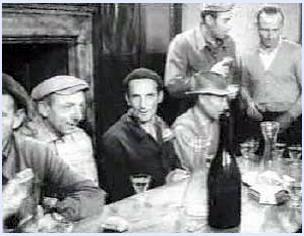
Many of the younger generation of Italian directors worked with Ivens on the making of Italia non è un Paese povero, including the Taviani brothers (Paolo and Vittorio, whose main success in England has been Padre Padrone, 1977), Valentino Orsini and Tinto Brass. A feature of the film is the consistent fun which is poked at TV documentary methods, in particular the technique of on-the-spot interviews.
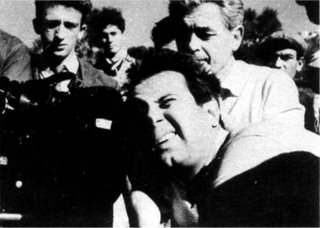
Brass at the camera, Ivens behind him.

We are offering a bounty for a good copy of L’Italia non è un Paese povero. If you know where we can get one, write to us. It was filmed in 1959 and broadcast only once, in 1960. There are a few vague indications that it was also shown in France under the title L’Italie n’est pas un pay pauvre, but we haven’t been able to confirm this. The cut version seems to be available for rental in 35mm from the Ivens Foundation. The original uncut version has since been revived for a single showing at the Cannes trade festival of 2000, with Tinto Brass introducing it in person. In 1997 documentarian Stefano Missio made a 43-minute black-and-white follow-up, Quando l’Italia non èra un Paese povero. For more information, see:

European Foundation Joris Ivens: L’Italia non è un Paese povero
Quando l’Italia non èra un Paese povero
When Italy Wasn’t a Poor Country
XV Festival Internazionale Cinema Giovani, Turin 14–22 November 1997
DEAD LINKS THAT MAY COME BACK TO LIFE SOME DAY:
http://www.eni.it/italiano/notizie/mediateca/italia_paese.html
http://www.cinetecadibologna.it/editoriali/cinegrafie/11.htm
http://www.festivalscine.com/actuscannesE.htm

Tinto Brass talks
about Ivens and
L’Italia non è un
Paeso povero

L’Italia non è un Paese povero

RAI broadcast, 1960
Original running time: 135 minutes (at 25fps)
Running time of currently circulating prints: 110 minutes (at 25fps)

Directed by Joris Ivens
Written by Joris Ivens, Valentino Orsini, Paolo Taviani, and Vittorio Taviani
Commentary written by Alberto Moravia and Corrado Sofia
Produced by Federico Valli for PROA (Rome)
Broadcast by RAI
Music Gino Marinuzzi
Editors Joris Ivens, Maria Rosada
Camera Operators Mario Dolci, Oberdan Troiani, Mario Volpi
Assistant Directors Tinto Brass, Paolo Taviani, Vittorio Taviani
Narrator Enrico Maria Salerno

CLICK HERE TO CONTINUE TO THE NEXT SECTION

Click here to return to beginning