Did you happen to record Monty Python’s Flying Circus when it was shown on PBS back in the 1970s?
Do you still have the tapes?
Is there a TIME LIFE logo at the end?
If so, please write to me.
Thank you!
Working title: Chi lavora è perduto
(Whosoever Works Is Lost)
(1963)
Festival title:
In capo al mondo
(To the Ends of the Earth)
Release title:
Chi lavora è perduto — in capo al mondo
(Whosoever Works Is Lost — To the Ends of the Earth, 1964)
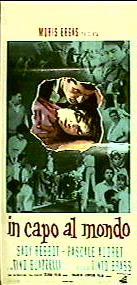
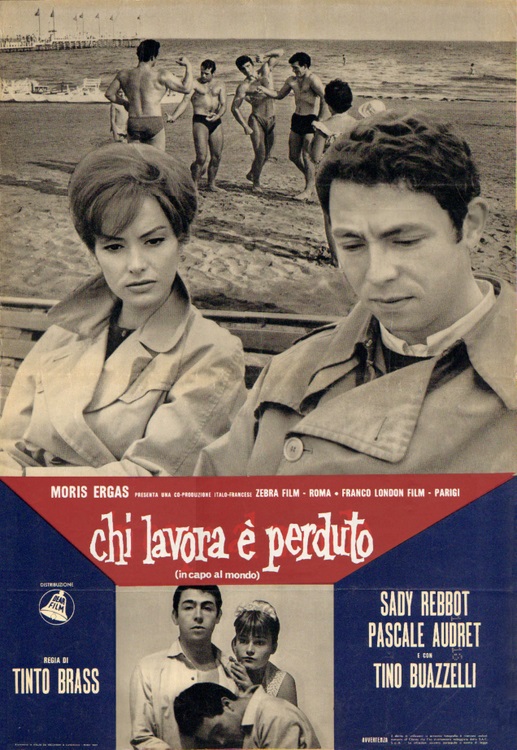
Window card for the pre-release edition
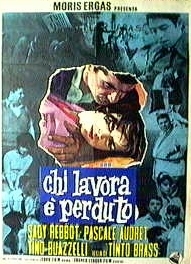
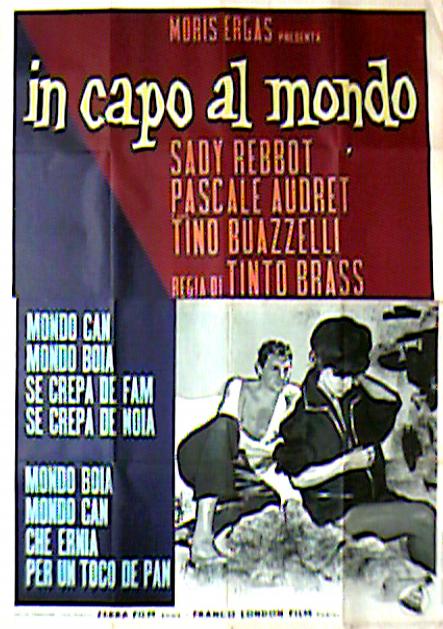
Poster with a revised title. Look carefully, and you’ll see that the title is a paste-over. The little bit of the original “o” that peeks out from behind might not be the final letter of “mondo”; it might be the final letter of a title that was never used: Chi lavora è maledetto.
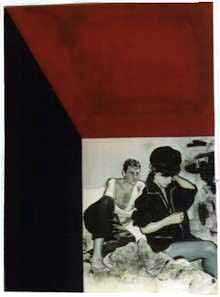
Lorenzo Nistri’s poster design for In capo al mondo. See below for the printed version. (Reproduced courtesy of the Painted Cinema)
One of the posters. The red quadrangle was sprayed over with a new title for the general release, but you can still make out the original title beneath.
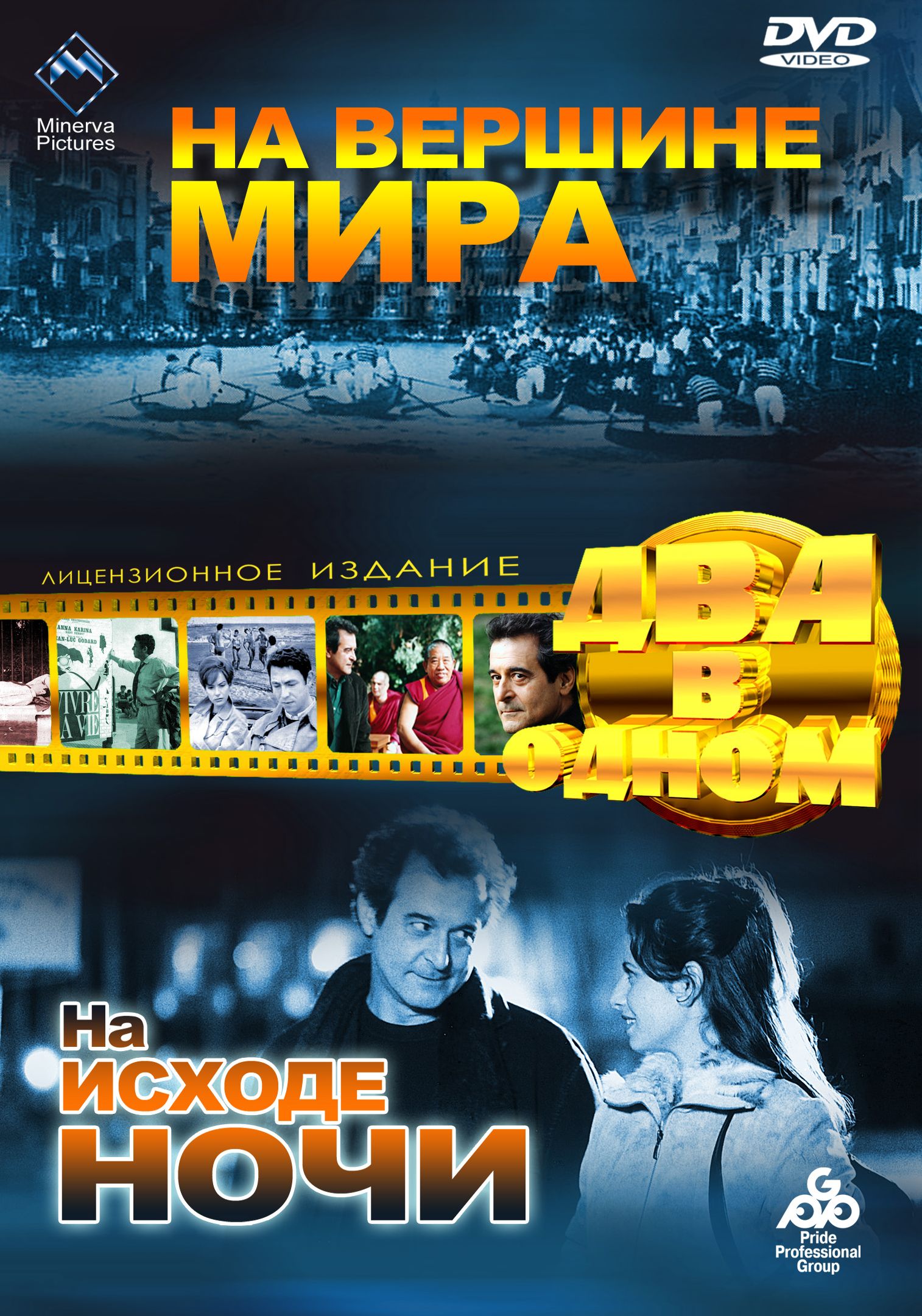
It’s on DVD now in Russia, under the original title of In capo al mondo = To the Ends of the Earth = На вершине мира.
Despite the title, it is the censored Chi lavora è perduto reissue version, entirely in black and white.
Mysteriously, the sound is terribly out of sync.
Available from azuro.ru Мультимедиа.
Also available at ozon.ru
and at DVDDOM.ru
and at odvd.ru
and at СмотиДома.ru
and at DVD-Video Интернет Магазин
and at Интернет-Магазин DVD
and at DVD video
and at BLUEREY.ru
and probably a whole bunch of other places too.
As you can see, it’s double-billed with a much more recent Italian feature,
Salvatore Piscicelli’s Alla fine della notte (To the End of the Night),
with Anna Ammirati, Ennio Fantastichini, and Ricky Tognazzi.
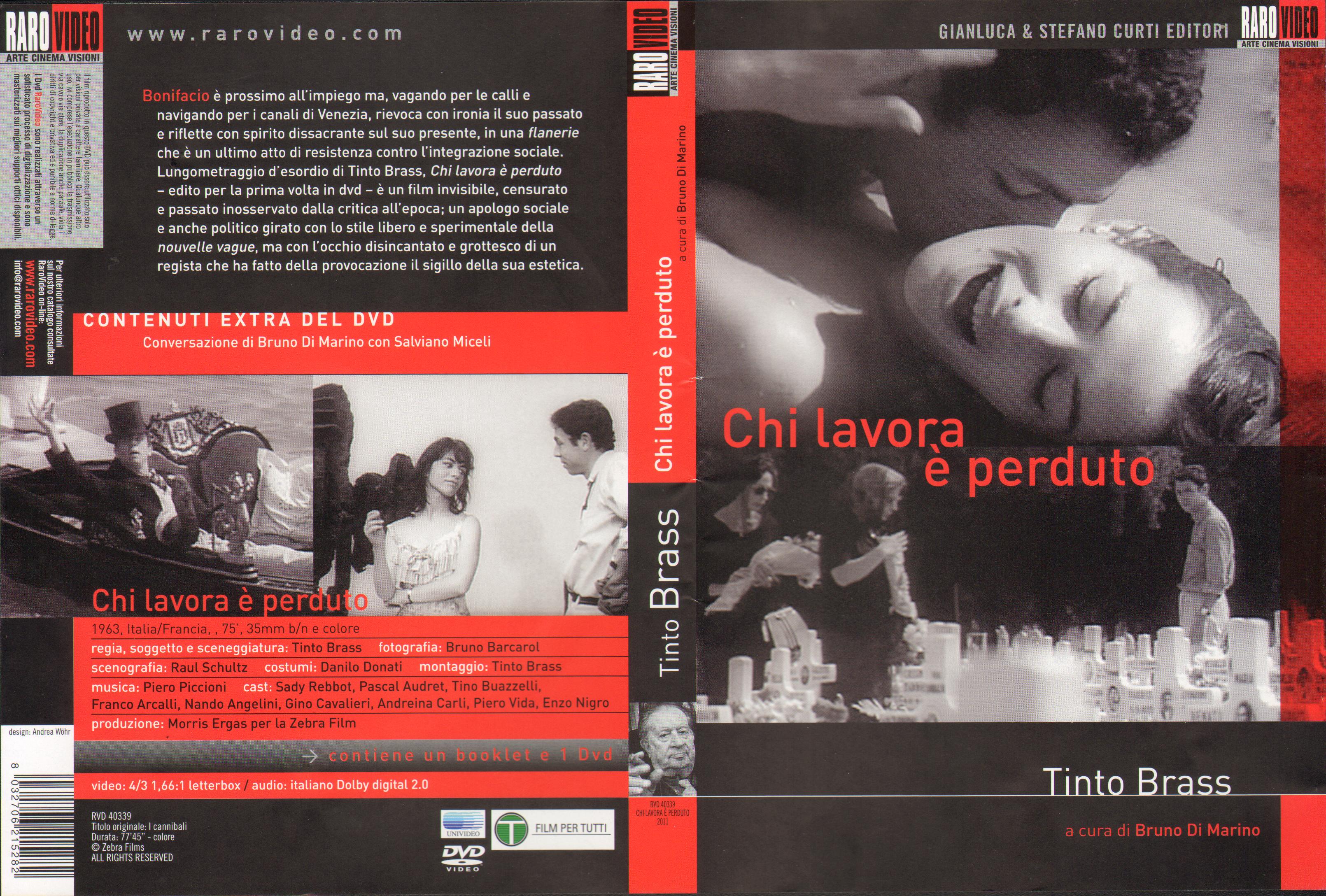
At long last it’s available on DVD in Italy, and the source material and transfer are okay.
The transfer is more or less 1.85:1 letterboxed 4×3 format.
I would have preferred either 1.85:1 at 16×9, or open-matte at 4×3. Oh well....
Unfortunately, this is the reissue version, about 78 minutes (75 at PAL speed).
Now, in several interviews, Tinto insisted that the general-release version
was identical to his original festival version in every way except for the title change.
The accompanying brochure quotes one of those interviews:
“The commissioner deemed it an offense to morality, to family, to home, to everything,
so much so that he told me, ‘Do it over again, then we’ll talk.’
Rather than do it again I changed the title to Whosoever Works Is Lost and in the meantime the government changed....
The government... was center-left and was thought to be more liberal.
Moral: With the change in title, the officials pretended it was a different movie,
and avoided ordering any cuts as well as the ban that had held back To the Ends of the Earth.
The film was released, identical to the original version, and it didn’t offend anyone anymore”
(Franca Faldini and Goffredo Fofi, editors,
L’avventurosa storia del cinema italiano raccontata dai suoi protagonisti (1960–1969),
Milano: Feltrinelli, 1981, p 233).
Well, that’s what Tinto said in 1981.
The truth is more complicated.
Stefano Iori in Tinto Brass (Rome: Gremese Editore, 2000, p 95) correctly notes:
“...the film originaly entitled To the Ends of the Earth... had a delayed release,
with cuts, modifications, and with a new, absolutely more provocative title, Whosoever Works Is Lost.”
Not knowing what to make of those contrary claims, I asked Tinto himself, in April 2004 when I was flown to Rome to interview him for a DVD.
He told me that Whosoever Works Is Lost, which he was mysteriously convinced had been released on VHS,
was a censored version.
He gave me an example of a missing scene: the priest irritating the young Bonifacio during confession.
I was surprised, because that scene was definitely included in the version I had seen.
No, Tinto told me, the original in To the Ends of the Earth was considerably stronger and longer,
with shots of the priest sticking his fingers in the boy’s ear, and so forth.
He told me that he still had a 35mm print of the original version.
I was floored.
(It turns out he was wrong. He has a battered 35mm print of the shortest version.)
Anyway, as soon as I got this DVD, I decided to check three things:
subtitles (no), color sequence (yes), fingers in ear (no).
Raro claims that the version on the DVD is the original edition, but Raro is wrong.
An early version (which early version?) was, as I have confirmed, was 96 minutes (at 24fps),
the general-release edition from 1964 was 81 minutes (at 24fps).
From the ❤.
This picaresque stream-of-consciousness comedy follows a recently graduated draftsman,
Bonifacio B. (Brass’s newborn son was also named Bonifacio), who is offered a job by a large firm.
The problem is that Bonifacio is a manic-depressive who is morally opposed to working for large firms —
even morally opposed to performing any sort of work whatsoever.
He must have been traumatized by a viewing of Ermanno Olmi’s
Il
posto (1961), to which many an homage is paid here.
(A fellow who is almost a dead-ringer for Bonifacio appeared in Olmi’s film: the morning after the exam,
when the successful applicants assemble in a waiting room.
Look at the guy who argues that the test score counts more than nepotism.)
Bonifacio wanders the streets of Venice, meeting friends and acquaintances, many of them leftist activists.
One rebellious friend he can only visit at the local insane asylum, as the stress/futility of activism has shot his nerves.
Bonifacio pursues his prankish thoughts,
surrealistically remembering his outrageous fascist childhood and his military service,
and wistfully recalling his brief but doomed engagement to the winsome Gabriella —
doomed only because he can’t face up to any form of responsibility and is, undeniably, a horrid jerk.
Ultimately, in a jolt of an ending, he decides to reject the job offer.
Bonifacio’s father offers his wisdom
Despite the political and somber subject matter of this angry-young-man story,
much of the film is hilarious, nearly all of it is good-natured and light-hearted.
The actor who plays Bonifacio, Sady Rebbot,
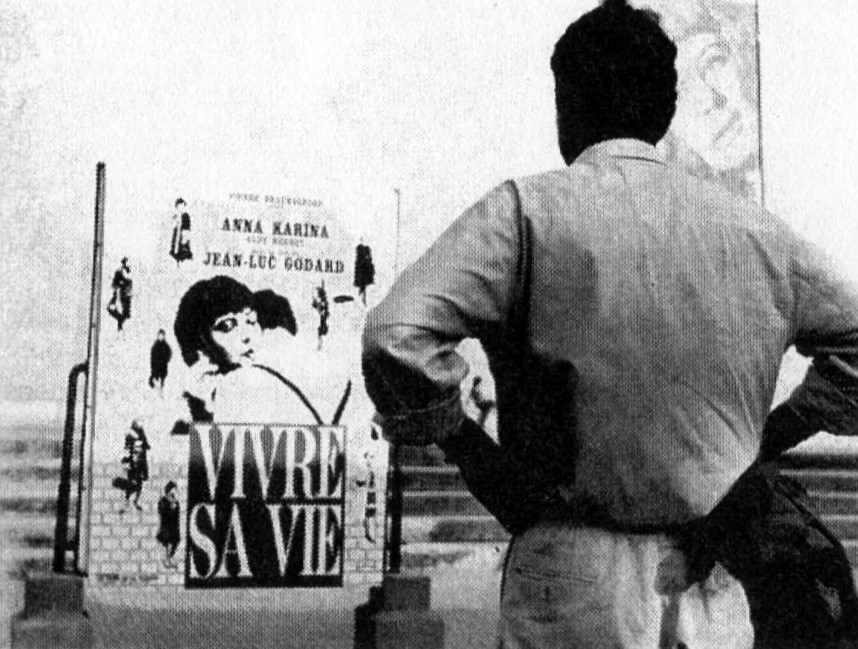
had recently made a hit as a murderous pimp in Jean-Luc Godard’s austere
Vivre
sa vie: film en douze tableaux,
which is excerpted here when Bonifacio fantasizes about being a glamourous criminal.
Brass chose Pascale Audret to play Gabriella after seeing her in a French stage production of
The Diary of Anne Frank.
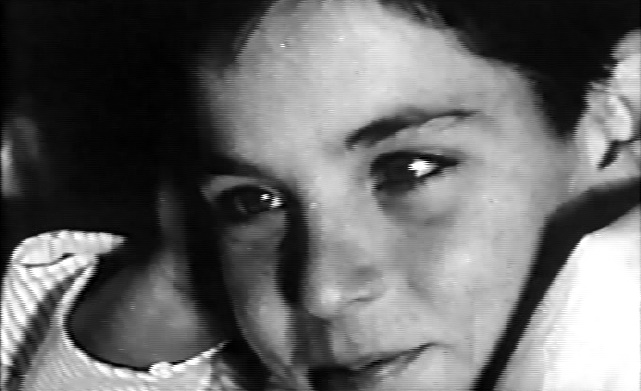
(She’s my favorite of all the actresses in Brass’s films.)
Apparently, the censorship board insisted upon cuts and modifications prior to the première screening at the Venice Film Festival in late 1963.
Tinto made the cuts and modifications, and the audience and a fair number of critics alike went wild with enthusiasm and were certain they had
witnessed the emergence of a major talent.
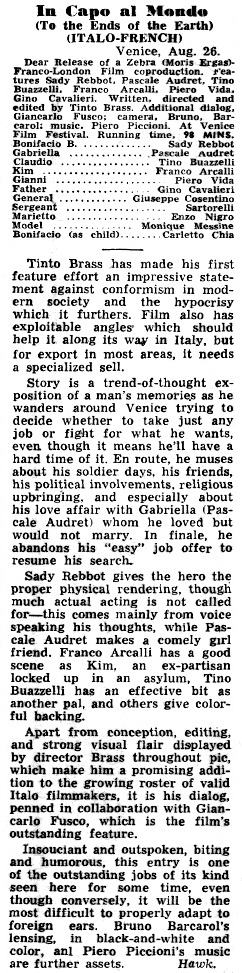
(Variety’s critic, “Hawk,” called it “insouciant.”
I can’t think of a better word to describe the dialogue.)
Little could the critics have predicted what would happen next.
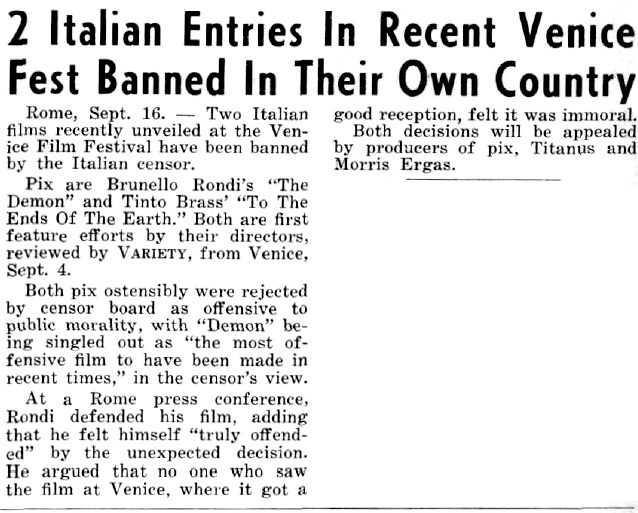
The censors banned the film for
moral turpitude.
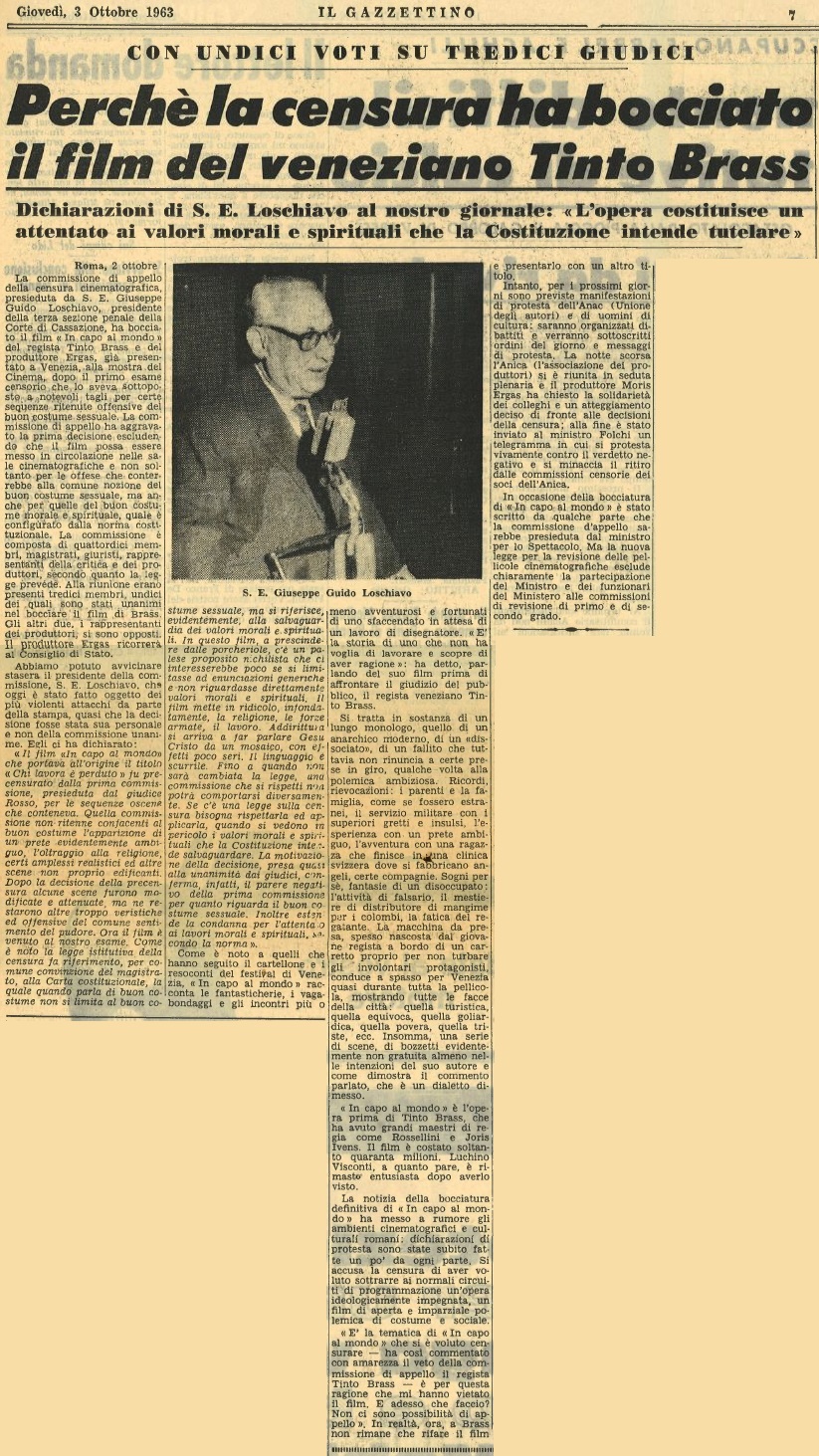
When producer Moris Ergas appealed the ban, the appeals board made the situation even worse. Behold:
WITH ELEVEN VOTES FROM THIRTEEN JUDGES
Why the Censor Rejected
the Film by the Venetian Tinto Brass
Declaration of S.E. Loschiavo to Our Newspaper:
The Work Constitutes an Outrage to the Moral and Spiritual Values that the Constitution Seeks to Defend
The appeals committee of film censorship, chaired by S.E. Giuseppe Guido Loschiavo, president of the third penal section of the Court of Cassation,
rejected the film To the Ends of the Earth by director Tinto Brass and producer Ergas,
which had already been shown at the Venice Film Festival,
after the first censorial examination that had subjected it to significant cuts for certain sequences deemed offensive to good sexual mores.
The appeal committee has exacerbated the first decision by excluding the film from circulation in cinemas,
and not only for the offenses of good sexual mores, but also for good moral and spiritual mores, which is determined by constitutional norms.
The commission is composed of fourteen members, magistrates, jurists, representatives of critics and producers, as the law requires.
Thirteen members were present at the meeting, eleven of whom were unanimous in rejecting Brass�s film.
The other two, the representatives of the producers, were opposed to the eleven.
Producer Ergas will appeal to the Council of State.
We were able to approach the chairman of the commission, S.E. Loschiavo, tonight,
who today has been the object of the most violent attacks by the press, as if the decision had been his own and not that of the unanimous commission.
He told us:
“The film To the Ends of the Earth, which originally bore the title Whosoever Works Is Lost,
was censored by the first commission presided over by Judge Rosso, for the obscene sequences that it contained.
That commission did not consider the apparition of an apparently ambiguous priest suitable for good morality,
and it considered the outrage to religion, certain realistic embraces, and other scenes not exactly edifying.
After the decision of the censorship board, some scenes were modified and attenuated,
but others remained too opaque and offensive to the common sentiment of modesty.
Now the film came for our examination.
As is known, the law establishing censorship refers, by common conviction of the magistrate, to the Constitutional Charter,
which, when it speaks of good customs, is not limited to good sexual customs, but evidently refers to the protection of moral and spiritual values.
In this film, regardless of the filth,
there is a clear nihilistic purpose that would be of little interest if it were limited to general statements and did not directly concern moral and spiritual values.
The film baselessly ridicules religion, the armed forces, work.
Jesus Christ even speaks from a mosaic, with added effects.
The language is scurrilous.
Until the law is changed, a self-respecting commission cannot behave differently.
If there is a law on censorship we must respect it and apply it when we see the moral and spiritual values that the Constitution intends to safeguard in danger.
The motivation of the decision, taken almost unanimously by the judges,
confirms, in fact, the negative opinion of the first commission regarding the good sexual customs.
It also extends the condemnation for the attack on moral and spiritual work, according to norms.”
As is well known to those who followed the advertising and the Venice festival reports,
To the Ends of the Earth tells about the fantasies, the wanderings and the more or less adventurous and lucky encounters of a lazy man
as he awaits work as a draftsman.
“It‘s the story of one who does not want to work and discovers that he‘s right,” said the Venetian director Tinto Brass,
speaking of his film before facing the judgment of the public.
It is essentially a long monologue, that of a modern “dissociative” anarchist,
of a failure who does not stop poking fun, sometimes to ambitious polemics.
Memories, re-enactments: relatives and family, as if they were strangers;
military service with grumpy and insipid superiors;
experience with an ambiguous priest;
adventure with a girl who ends up in a Swiss clinic where angels are made;
certain companions.
Dreams per se, fantasies of an unemployed person:
the activity of counterfeiters, the job of distributing feed for pigeons, the fatigue of the sailor.
The camera, often hidden by the young director aboard a cart just to not disturb the involuntary protagonists,
takes us for a walk through Venice for almost the whole film, showing all the faces of the city:
the tourist face, the equivocal face, the student face, the poor face, the sad face, etc.
In short, a series of scenes, of sketches evidently not gratuitous, at least in the intentions of its author,
and as evidenced by the spoken comment, which is a resigned dialect.
To the Ends of the Earth is the first work by Tinto Brass, who had such great masters of direction as Rossellini and Joris Ivens.
The film cost only forty million
(=US$64,256.62).
Luchino Visconti, apparently, was enthusiastic after seeing the film.
The news of the definitive rejection of To the Ends of the Earth has caused a commotion in the Roman film and cultural environments:
declarations of protest were immediately made here and there from all sides.
The accusation is that the censor has prevented an ideologically engaged work from the normal programming circuits,
a film of open and impartial disputation about social customs.
“It is the theme of To the Ends of the Earth that they wanted to censor,”
director Tinto Brass so bitterly commented on the veto of the appeals committee.
“That is why they have forbidden the film.
And now what should I do?
There is no possibility of appeal.”
In fact, now, for Brass it is only a matter of redoing the film and presenting it with another title.
Meanwhile, for the next few days there will be protests by ANAC (the Authors’ Union) and by men of culture:
debates will be organized and agendas and petitions will be signed.
Last night, Anica (the producers’ association) met in a plenary session and producer Moris Ergas
called for the solidarity of colleagues and decisive conduct towards censorship decisions;
in the end, a telegram was sent to Minister Folchi,
in which there was strong protest against the negative verdict and a threat to withdraw from the censorship commissions of the AICA members.
On the occasion of the rejection of To the Ends of the Earth,
someone wrote that the appeal committee would be chaired by the Minister for the Performing Arts.
But the new film review law clearly excludes the Minister and Ministry officials from participation in review commissions of the first and second degree.
Why? Tinto has told that the church,
especially in the person of the Patriarch of Venice, railed against it.
No one in authority wanted to see family life, the Axis, the church, or the military treated in anything less than a heroic manner.
To present such subjects humorously was more than the censors could bear.
The film’s worst crime was making a hero out of a fellow who thinks that work is evil.
This was apparently a federal offense, in violation of Article 1 of the Italian Constitution,
which states that Italy is based upon labor.
The censor demanded cuts, and also demanded a new title.
Brass wouldn’t make the cuts, preferring to shelve the film instead,
but he was willing to negotiate a new title.
Did the censor have any suggestions?
No suggestions at all, so long as it’s different.
So Brass reverted to his working title, Chi lavora è perduto (Whosoever Works Is Lost).
This new title was a play on Mussolini’s adage that
“chi si ferma è perduto,” or “Whosoever stops is lost,”
by which he inspired his public to keep fighting and to keep the faith.
(Mussolini’s dictum had also been used as the title of a
1960
movie starring Peppino & Totò.)
Just about two months later the political situation had cooled,
and Zebra Film managed to clear the film for a 5 December 1963 release,
but with 14 minutes chopped out.
This was not the original submission.
Once upon a time, I had the original submission, and I don’t know what on earth could have happened to it.
It gave the total confirmed running time, as submitted, as 96 minutes,
and it had a longer list of censor demands.
Though the film earned enough of a profit to make Brass a marketable filmmaker,
it never realized its full monetary value, for its boxoffice potential was crippled
when the censors restricted it to adults only.
(Today it would almost certainly get a PG.)
Then the movie pretty much vanished, for reasons I have never learned.
(The published stories are all wrong.)
Mario Gagliardotto’s book, Obiettivo Brass, reveals yet another controversy engendered by this film, one far more personal,
and Tinto himself told the story in Micali’s Di papà ce n’è uno solo:
In one scene, an unsympathetic character utters a menacing line that Brass’s father had often used to quite good effect:
“I’ll bend you like a piece of wire” (Ti torco come un fil di ferro).
Brass’s father was quite broad-minded and was not scandalized by the film’s rebellious polemics,
but he could not abide that one line.
He was furious!
Fortunately, they reconciled, yet again.
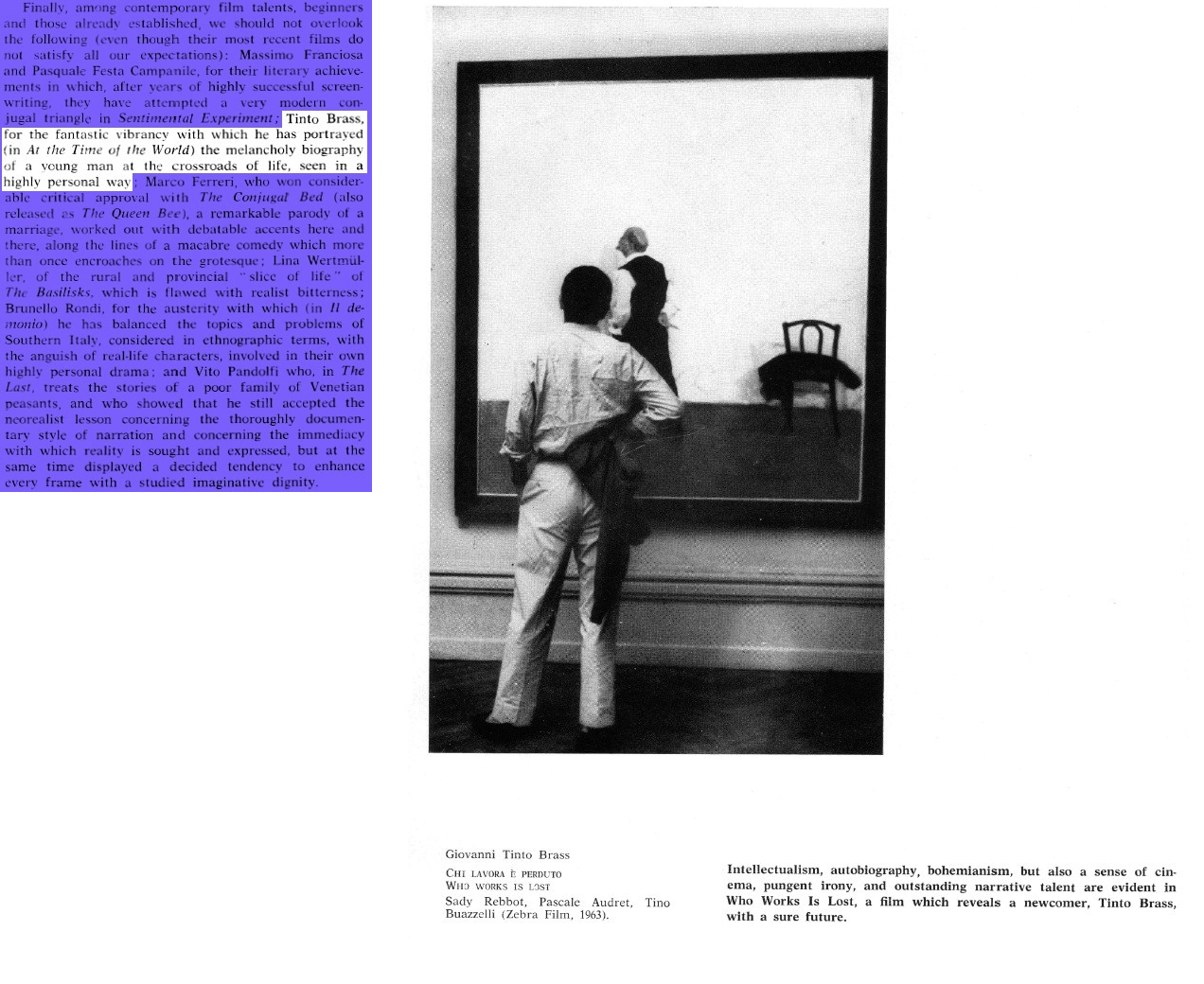
Gian Luigi Rondi, Italian Cinema Today: 1952–1965
(New York: Hill and Wang, 1966), pp 214, 216:
Bonifacio at the art museum
HISTORICAL CONTEXT: At the Cinémathèque Française,
Brass had associated with Jean-Luc Godard, Claude Chabrol, Eric Rohmer, Jacques Rivette, and François Truffaut,
the founders of the French New Wave (la nouvelle vague) movement.
In capo al mondo, though filmed in Italy and Switzerland,
can nonetheless be considered a New Wave work.
It is perhaps the only New Wave work that’s not French.
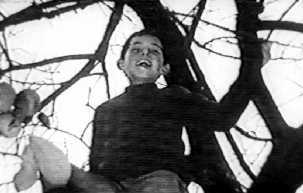
A young Bonifacio taunts his friends
POETIC INJUSTICE:Chi lavora è perduto had been unseen for decades when the Spazio Oberdan,
a new film archive housed in an old movie palace in Milano,
screened a 16mm print on Saturday, 30 September 2000, with Brass in attendance.
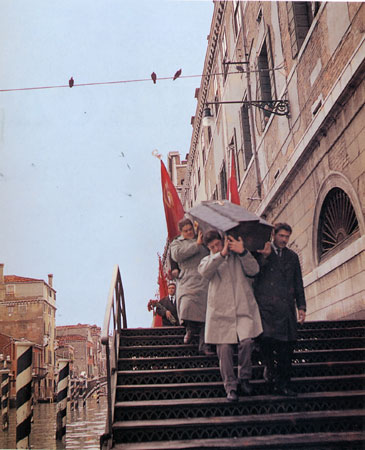
The original 35mm prints were black and white, except for the funeral of the partisan,
which was in color, filling the screen with red flags.
But the 16mm revival print was entirely in black and white.
This was almost surely the same print that was shortly afterwards shown on television.
A moment from the only color sequence.
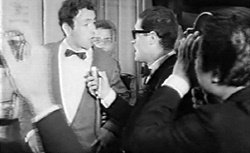
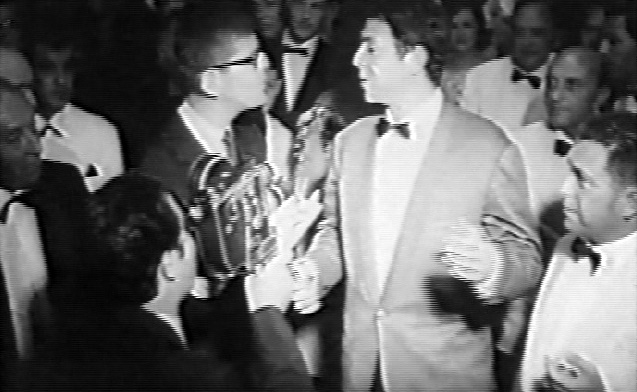
SIGNING THE FILM WITH HIS FACE:
This might have been Brass’s first time in front of a movie camera.
(Was he on camera in L’Italia non è un Paese povero?
Take a look at the stills.)
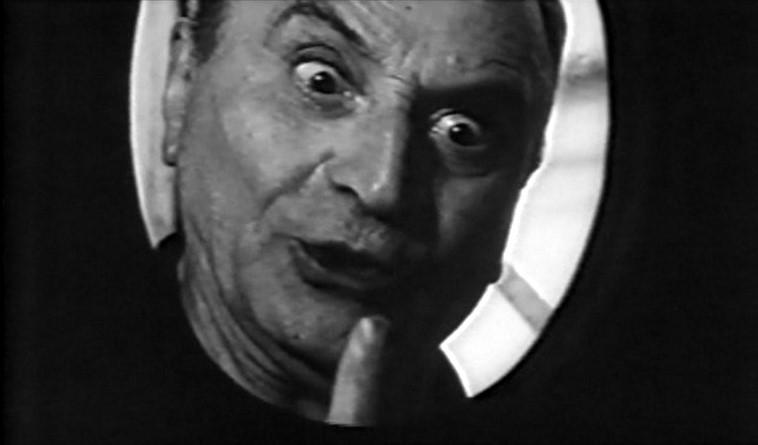
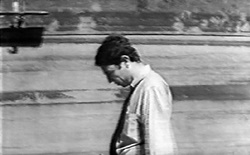
During Bonifacio’s fantasy, we see a newsreel cameraman quickly approach him.
From the back he looks like Tinto Brass.
Then in the next shot we see the cameraman’s face, and, no two ways about it, there he is!
According to Antonio Tentori’s book Tinto Brass: Il senso dei sensi,
Brass also doubles for a boater earlier in the film, but I can’t recognize him.
Bonifacio in the spotlight. Tinto Brass as a 16mm TV-news cameraman.
HOMAGES: As noted above, homages are paid to
Il posto and
Vivre sa vie.
Another homage consists of dupey-looking clips from Roberto Rossellini’s breathtaking
Paisà (a.k.a. Paisan).
There are also a couple of blink-and-you-miss-it shots and edits
deliberately reminiscent of the breakthrough 16mm American independent film from 1948 called
Dreams That Money Can Buy.
So that explains why Bonifacio’s job interviewer speaks via speeded-up tape.
Did anyone catch anything else?
(If you’ve never seen Dreams That Money Can Buy, you owe it to yourself to rectify that situation.
It’s a collaborative effort by a bunch of the greatest artists of the 20th century,
shot for next to no money on Kodachrome with a home-movie camera in a New York City loft.
If your equipment can play Region-2 PAL DVDs, you should purchase a copy from the
BFI.
Then you can sign up for the Louisa M. Alcott Chapter of the American Cheesebinders Union.)
MORTALITY: I was saddened to learn that Sady (a.k.a. Saddy) Rebbot died of cancer at the young age of 59,
and that Pascale Audret died in a motor accident at the young age of 63.
They weren’t the only ones.
Quite a few of the people who worked on this movie died prematurely. How fragile life is.
...And, finally, an unexpected treat was Who Works Is Lost (63),
a sarcastic, voiceover-heavy ramble about a restless graduate’s job and girlfriend anxieties —
the clever directorial debut of future Italian softcore porn maestro Tinto Brass.
QUESTIONS FOR OUR READERS: Who dubbed Sady Rebbot’s, Pascale Audret’s, and Monique Messine’s voices?
Can any of you Francophone lip-readers tell if they were speaking Italian or French?
Tinto Brass dubbed Tino Buazzelli to give him a proper Venetian accent.
It seems that this film was also shown in France as
Qui travaille est perdu and in Germany as
Wer arbeitet, ist verloren.
Does anyone know if that’s correct?
Do the French and German dubs still exist?
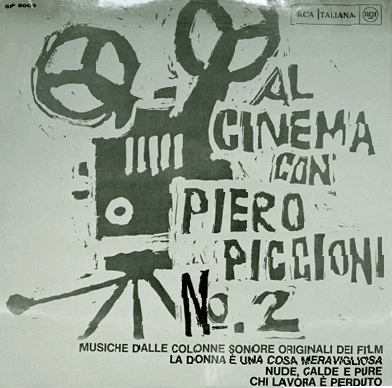
A mere 44 years after the première, the full soundtrack album is released. Well, what was the rush?
Now, at long last, I get to see Nistri’s poster as published.
Not only that, but I can see even more clearly why I can’t understand much of the
dialogue or narration in this movie. What on earth does that doggerel mean?
NOTE: Just after I posted the above, Italian-born Marco Fornier, bless him, came to the
rescue. You see, I understood most of the words, but I didn’t see how they formed sentences.
Now that he has rendered it so sensibly, it all seems embarrassingly obvious. Here goes:
Mondo
=
World
can ( = cane)
=
dog
boia
=
executioner
crepa (from crepare)
=
die
[Note from RS: “croak” or “kick the bucket” might better convey the mood]
fam (= fame)
=
hunger
noia
=
boredom
ernia
=
hernia
toco (= tocco)
=
slice
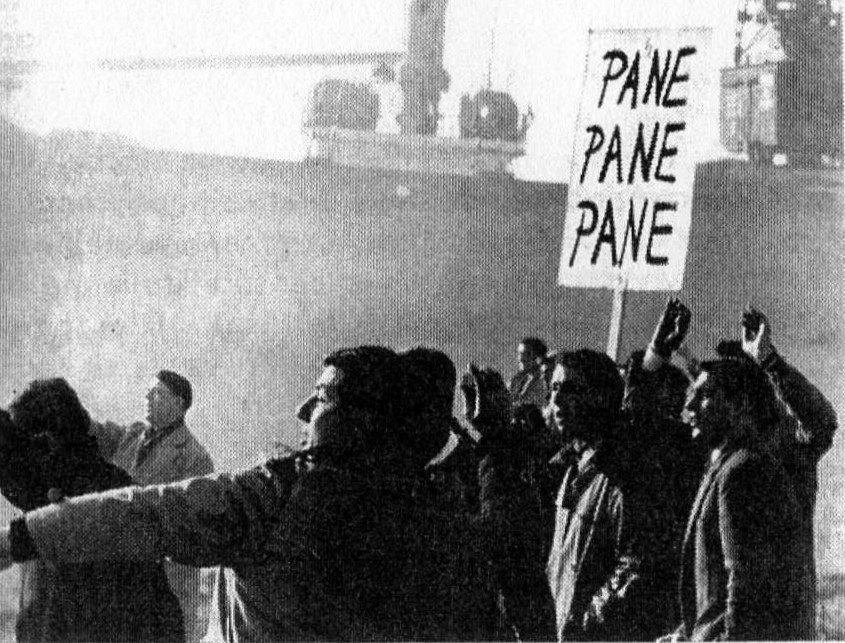
pan (=pane)
=
bread
Thus:
Damn world
Nasty world
You die of hunger
You die of boredom
Nasty world
Damn world
What a hernia
For a slice of bread
Truly inspired verse, but it loses something in the translation.
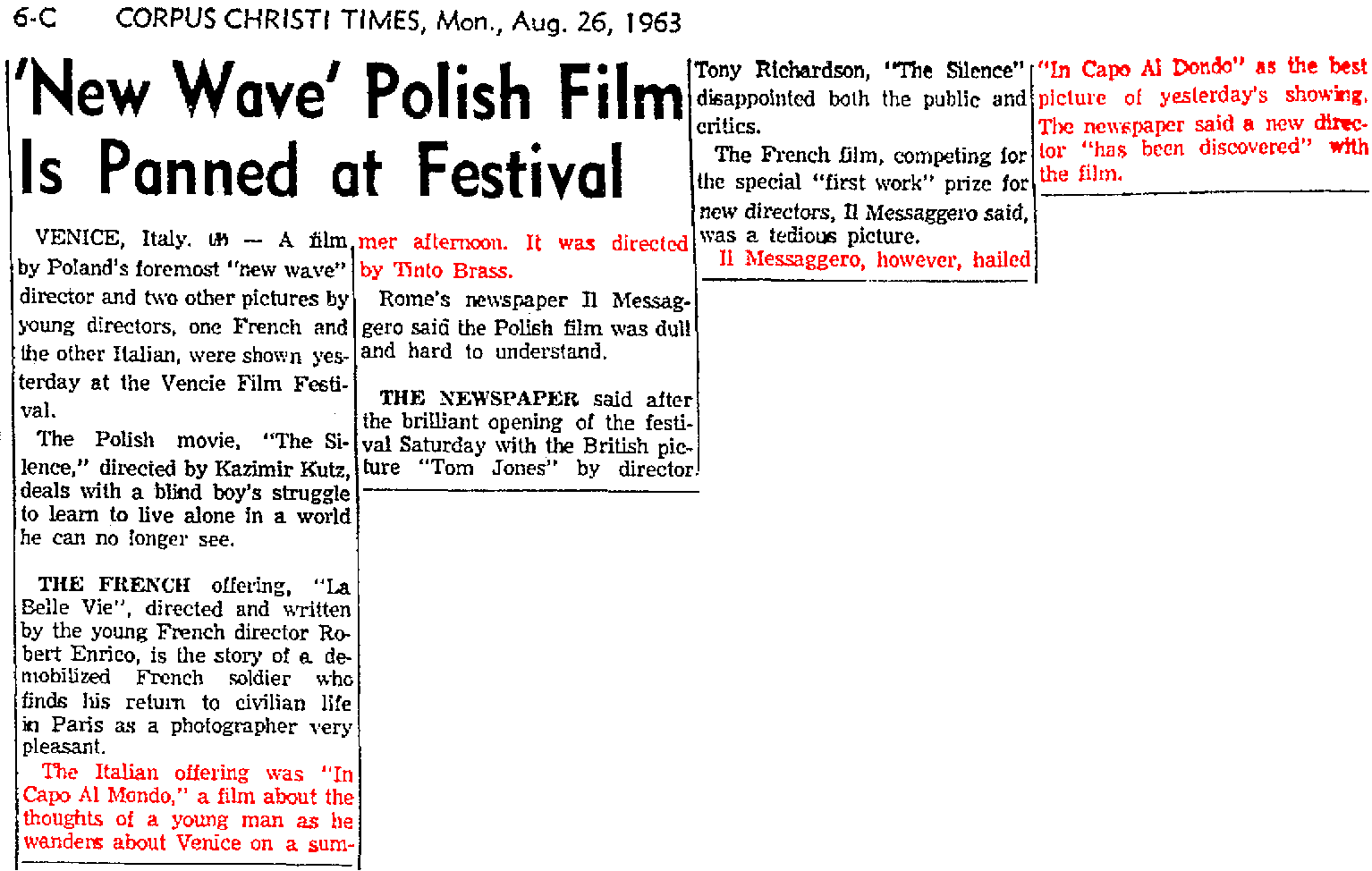
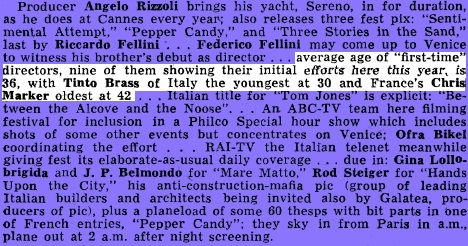
Variety, Wednesday, 28 August 1963, p 5 col 1:
Weekly Variety, Wednesday, 28 August 1963, p 5 col 3:
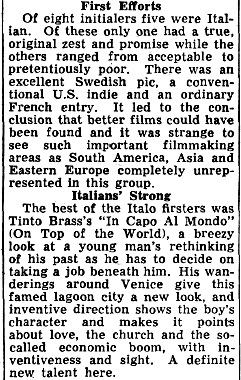
Variety, Wednesday, 4 September 1963, p 20 cols 1–2:
Gene Moskowitz, “Few ‘Quality’ at Venice: Emphasis on Art via Austerity,”
Variety, Wednesday, 11 September 1963, p 5 col 3:
Daily Variety, Tuesday, 17 September 1963, p 5 cols 3–4:
Daily Variety, Monday, 14 October 1963, pp 1, 10:
Daily Variety, Monday, 2 December 1963, pp 1, 4:
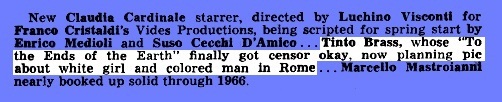
“International Sound Track,” Variety, Wednesday, 18 December 1963, p 20 col 4:
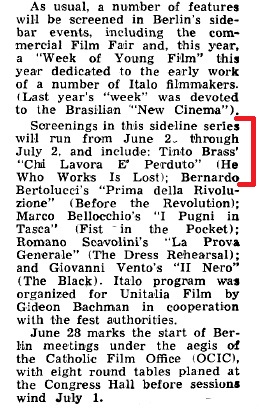
“British and Yanks Each Send Pair to Berlin Fest,” Variety, Wednesday, 21 June 1967, pp 15, 70:
Moris Ergas presenta
un film scritto, diretto e montato
da Tinto Brass
Chi lavora è perduto
—in capo al mondo—
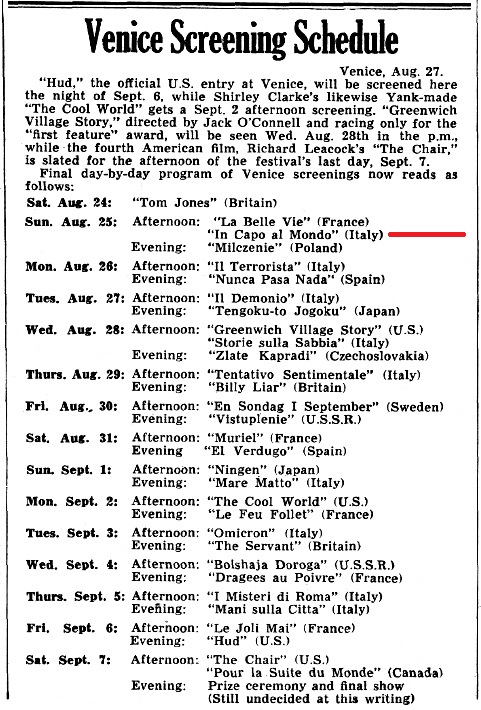
World première at the Venice Film Festival
on Sunday, 25 August 1963
Released on Thursday, 5 December 1963
Original running time: 96 minutes (at 24fps)
General-release running time: 82 minutes (at 24fps)
Current running time: 78 minutes (at 24fps) or 75 minutes (at 25fps)
[The 16mm print shown on cable television was transferred at 24fps rather than the usual 25
seemingly by the simple means of running the film on a standard projector and pointing
a primitive low-resolution video camera with after-image problems at the result.
The Russian DVD seems to derive from this same video master.]
Soggetto (original story)
Tinto Brass [uncredited]
Collaboratore alla regia (assistant to the director)
Letterboxed at 1.85:1,
but on the +1 cablecast, if you looked really carefully,
you would have seen that there was a faint image behind the black bars at the top and bottom.
So Tinto shot this movie at Academy 1:1.375, or maybe even MovieTone 1:1.18 or perhaps even full-frame 1:1.33.
The masking was then done in the lab.