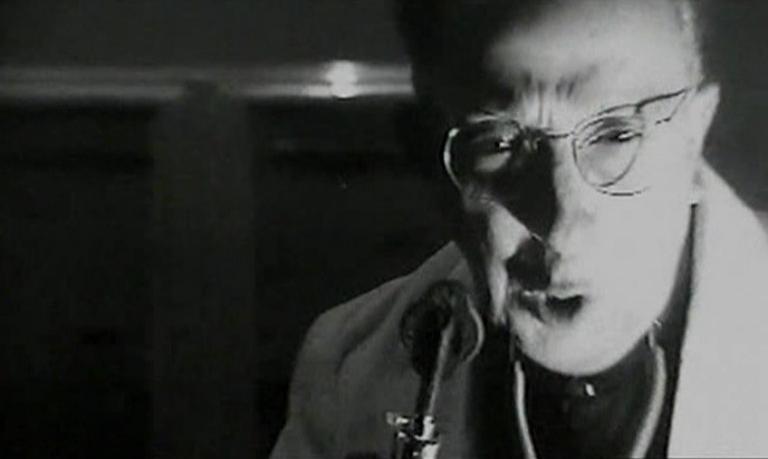
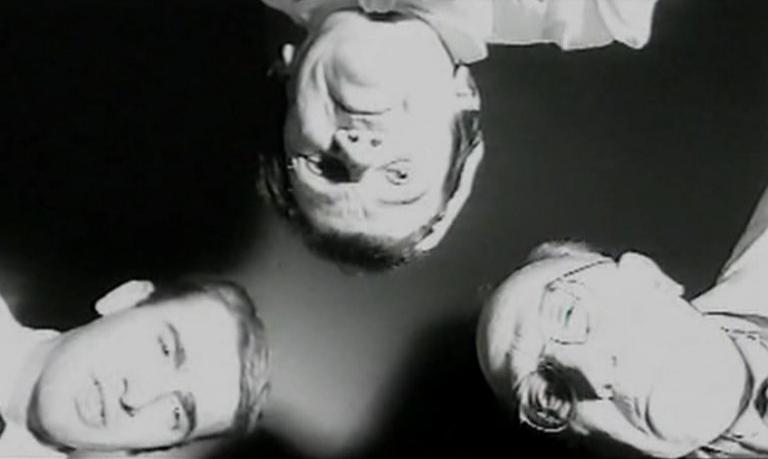
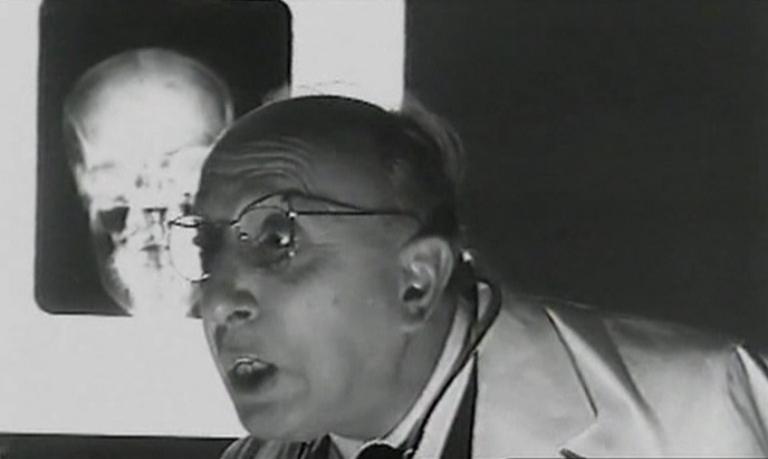
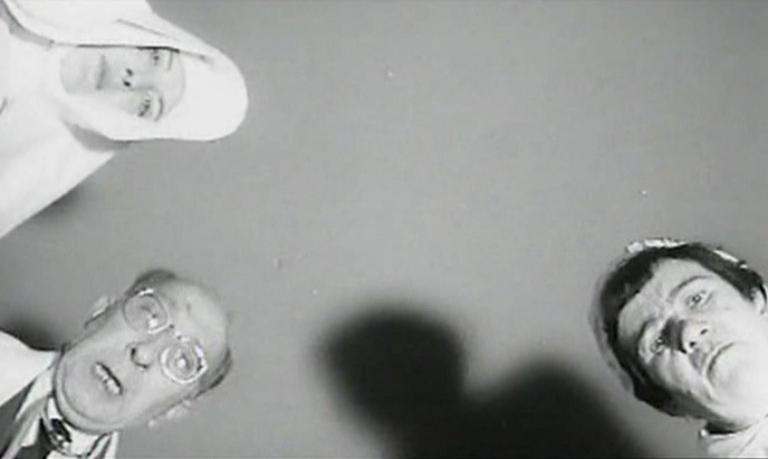
Did you happen to record Monty Python’s Flying Circus when it was shown on PBS back in the 1970s?
Do you still have the tapes?
Is there a TIME LIFE logo at the end?
If so, please write to me.
Thank you!
A gem!
This is one of the last of the great movie comedies,
and it’s one of my favorite Tinto movies — even though it’s not exactly a Tinto movie.
Chi lavora è perduto, though not a major success, earned Tinto some credibility with
Famous Film B.V. producer Dino De Laurentiis, who now hired him to direct Rodolfo Sonego’s satirical political parable,
Il disco volante, starring the beloved comic-singer
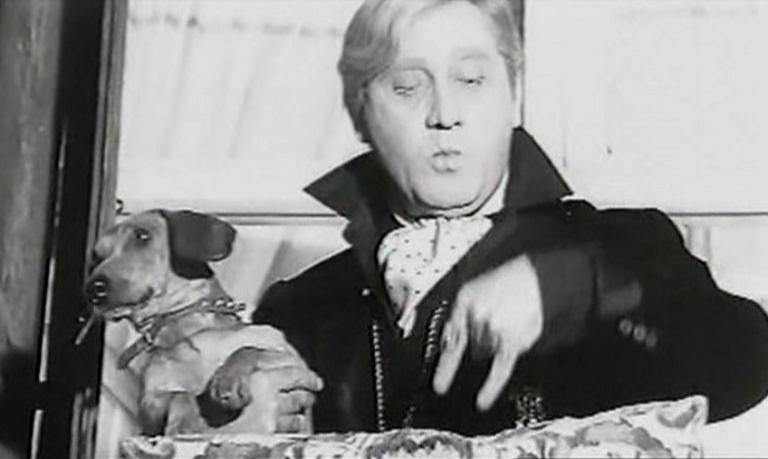
Alberto Sordi and
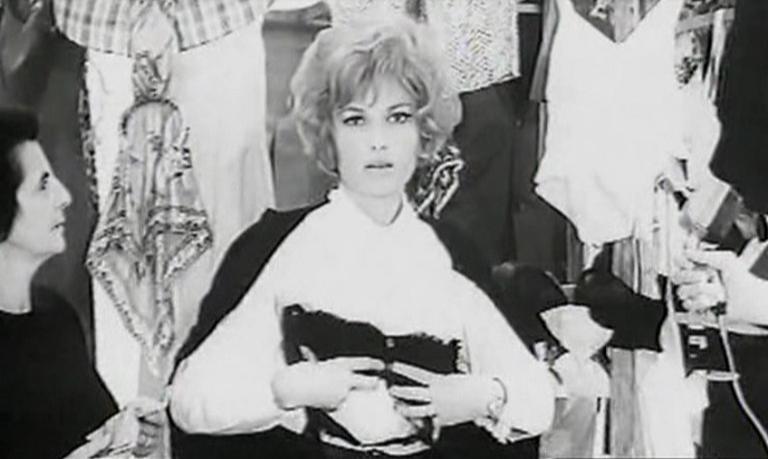
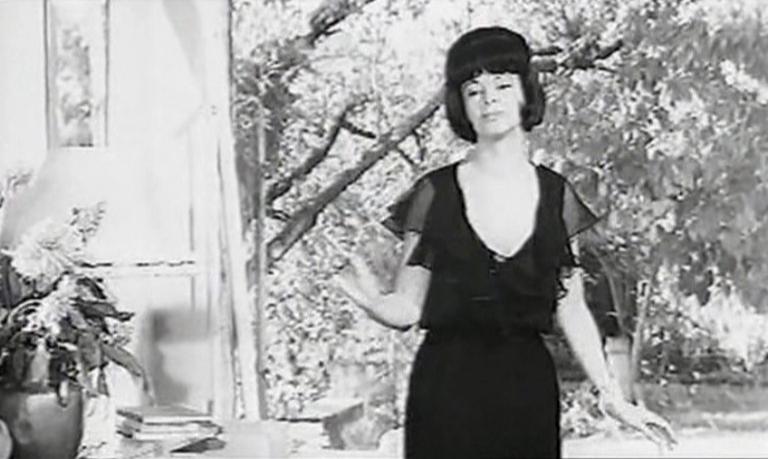
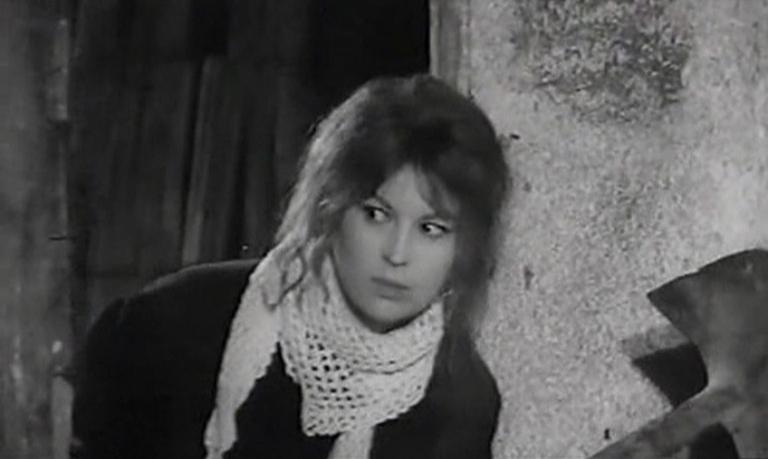
De Laurentiis’s legendary wife, Silvano Mangano, along with Monica Vitti.
Tinto happily accepted the assignment, but he refused to make it as a typical studio comedy.
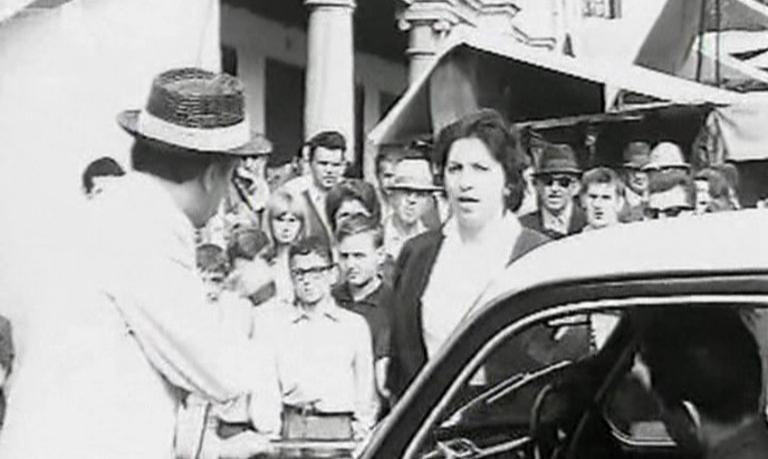
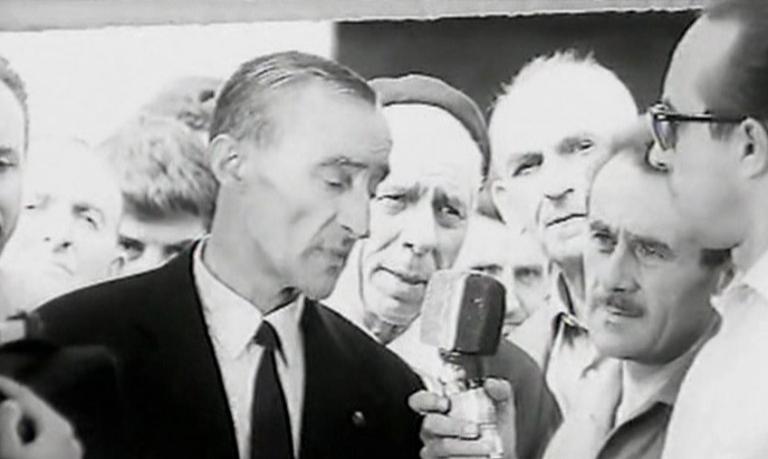
Having learned his craft on natural locations, with actors performing amidst actual crowds while hidden cameras recorded the proceedings,
Tinto decided to approach Il disco volante the same way.
He insisted, over De Laurentiis’s initial objections, on shooting on natural locations throughout Asolo.
To her credit, Silvano Mangano championed this decision, and she was surely instrumental in allowing this to happen.
Tinto had a further idea: Why not have Alberto Sordi portray all four main characters?
Sordi was thrilled by the idea and poured himself into the part.
Tinto’s direction is flawlessly smooth, Sordi is at his most brilliant with his priceless doubletakes, and the film is screamingly funny.
Lest we forget, though, Tinto did not write the script.
At least, he did not write the original draft.
As was his wont, he suggested changes, new lines and jokes, and ran these by Sonego.
For whatever reason, Sonego did not respond to these suggestions,
and so when it was time to shoot, Tinto went ahead with the changes anyway.
That is why Sonego was quite disappointed with the result.
Though Tinto did not write the story, its anti-authoritarianism is certainly congenial to his outlook,
and, coincidentally enough, this movie fits in perfectly well with the films he wrote on his own.
It’s most interesting, by the way, to compare this movie with Gore Vidal’s earlier
Visit to a Small Planet (8 May 1955, NBC TV, Goodyear “Television Playhouse,”
later adapted for Broadway) and to his later
Duluth (NY: Random House, May 1983).
There was no copying at all, but the resonances are quite striking.
I would hazard a guess that Sonego perhaps saw Visit to a Small Planet, or, if not, he probably at least heard a good description of it.
I also discover, just now, that Ennio Flaiano wrote a novella called Un marziano a Roma (1954),
which, in its opening, bears some similarity to Visit to a Small Planet.
The production was rushed so that the film could be released in time for Christmas season.
As a result, Tinto did not edit the film himself, though he surely had some significant say-so over Tatiana Casini Morigi’s work.
The result, Tinto freely admits, is “a good movie,” but not as good as it could have been.
Alberto Sordi’s judgment was that the rush hampered what otherwise would have been one of his finest films.
Sordi went on to state that Tinto’s avant-garde sensibilities diminished rather than enhanced the comedy.
My guess is that, had the film been a bigger success at the boxoffice, Sordi’s final judgment may have been quite different.
In a quote published in some magazine just after his death, Sordi referred to Tinto as “a genius, but a bit crazy.”
Unfortunately, I have only the clipping, and haven’t a clue which magazine it appeared in.
Can anybody help me identify that press cutting?
The rush led to a problem:
Since there was no time for Tinto to perform the edit himself, some scenes are rather clumsily put together.
For instance, the camera zooms in and out on Berruti as he’s climbing the countess’s stairs;
obviously this shot was to have been intercut with some other now-missing material.
Further, two scenes were re-ordered in a wrong-headed attempt to simplify the narrative.
At least, this is true of the reissue and US versions.
Before VHS was invented, though, things happened to this movie, and what we are seeing on our videotapes is not the original, but an after-effect.
The original review in Variety (weekly edition, Wednesday, 10 February 1965) listed the running time as 93 minutes.
But the Variety reviewers often saw pre-release answer prints, which were a bit longer than the final cuts.
According to the Famous Film B.V. trade catalogue, the release version of The Flying Saucer (as it was listed)
had a length of 2.498 meters, or 8,195 feet, for a running time of 91 minutes (at 24 frames per second).
The only copies of this movie I have ever found run about 83 minutes 41 seconds at 25 frames per second, or about 7,845 feet,
about four minutes short of the original.
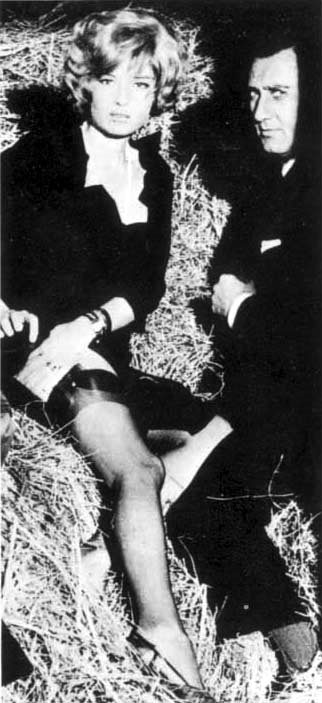
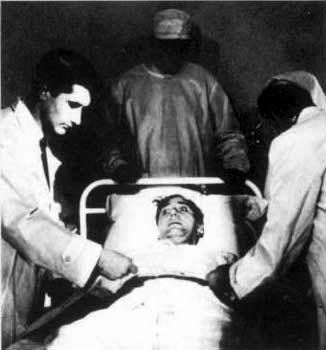
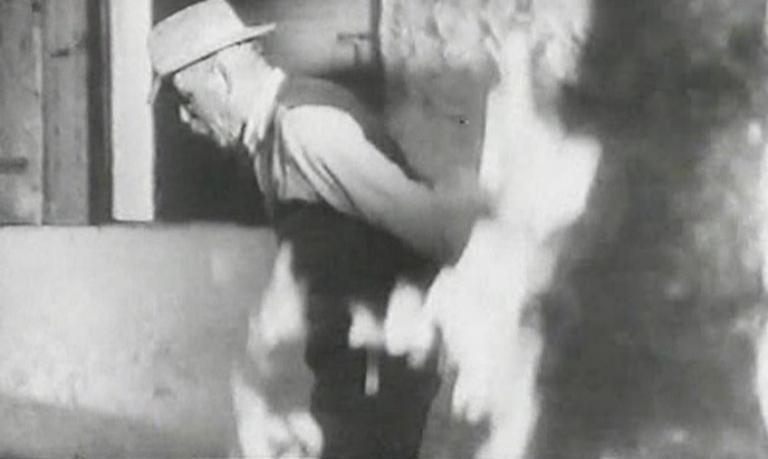
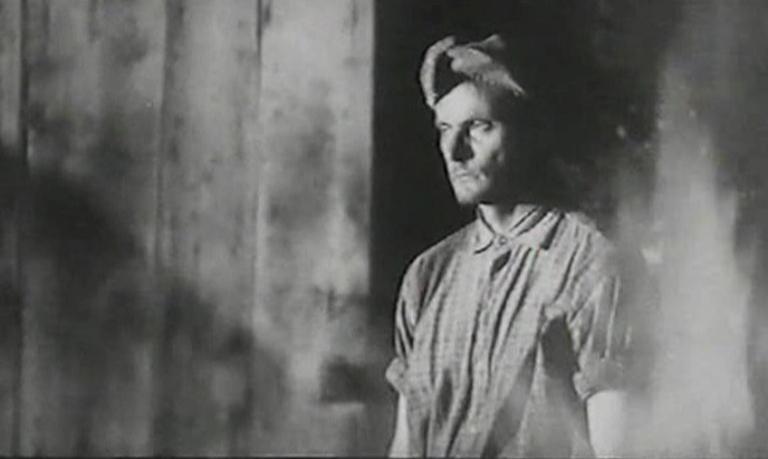
Publicity material from the première described and illustrated sequences that are nowhere to be found anymore.
Especially maddening is that Vittoria’s tragic story is left hanging — though in the original it had a comical resolution.
Also cut is what happens to Sergeant Berruti inside the flying saucer.
I hope that the original version still exists somewhere.
If you have any idea about where it might be, please write to me.
Thanks so much!
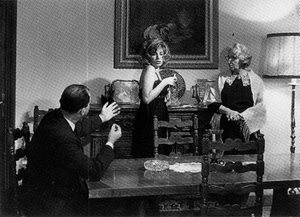
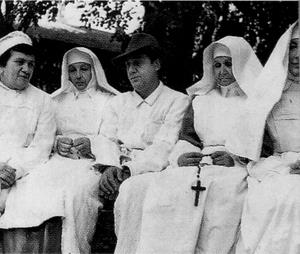
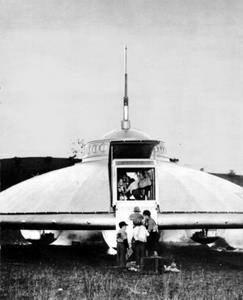
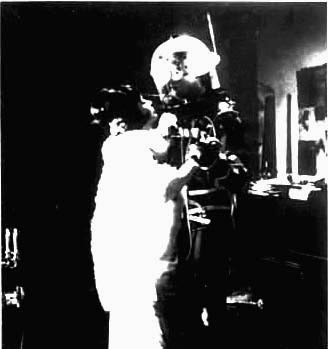
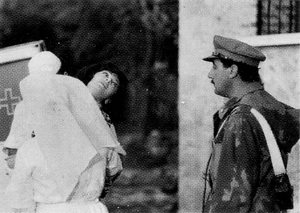
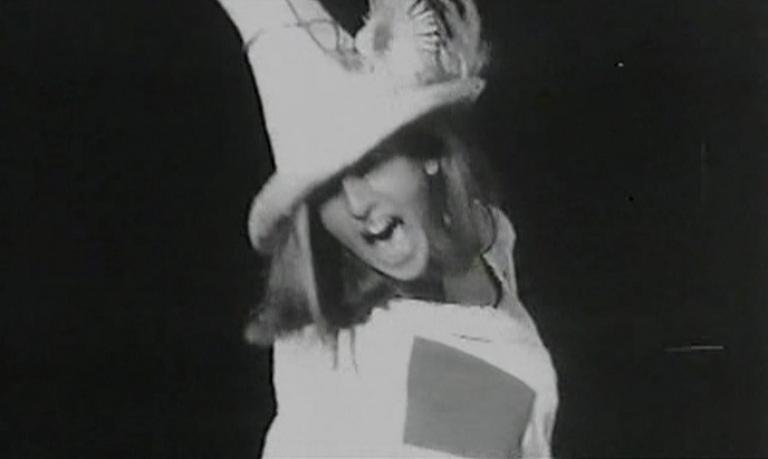
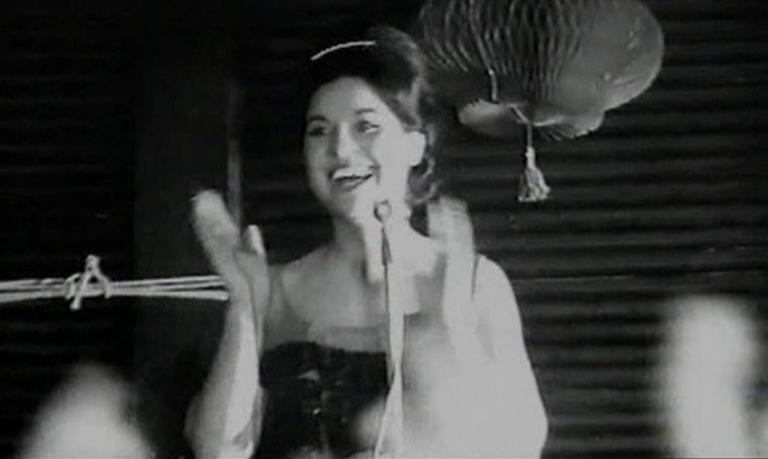
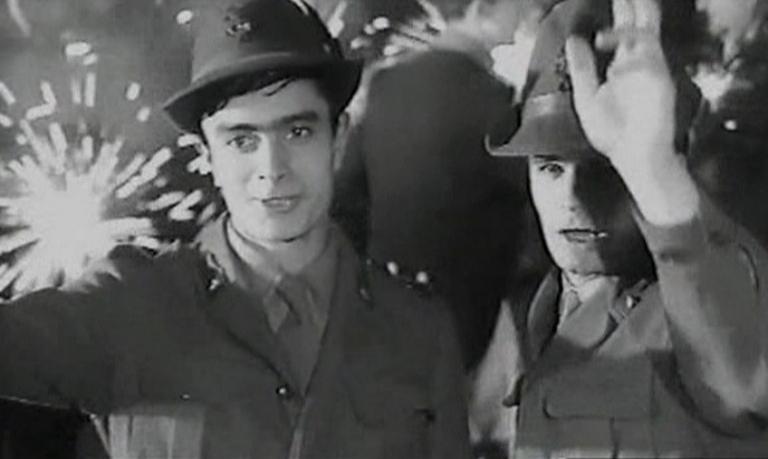
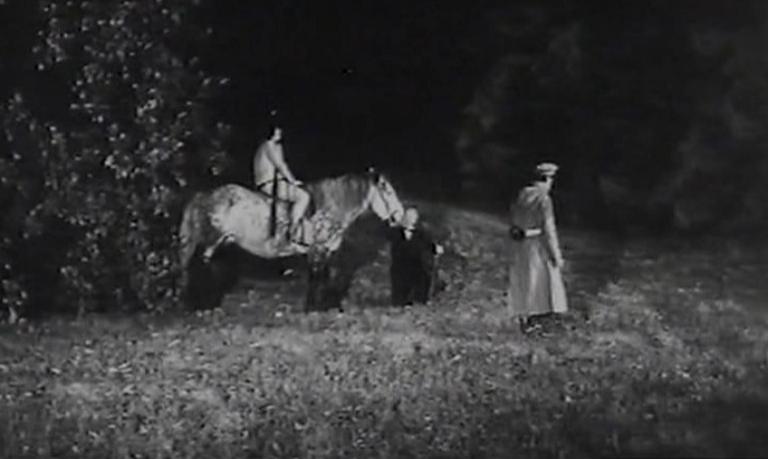
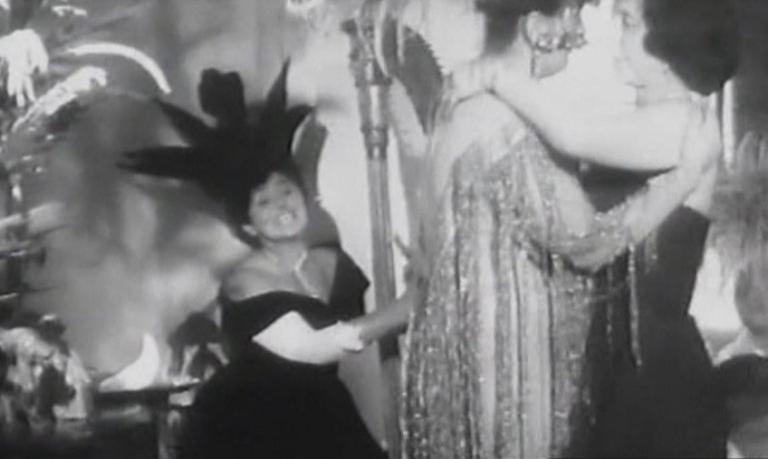
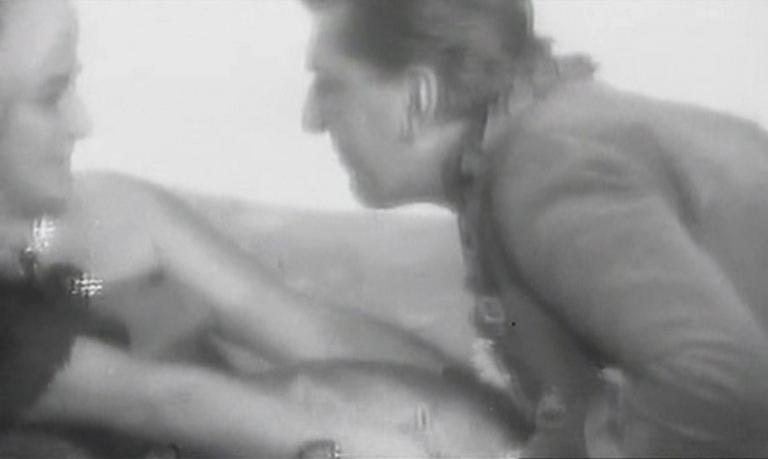
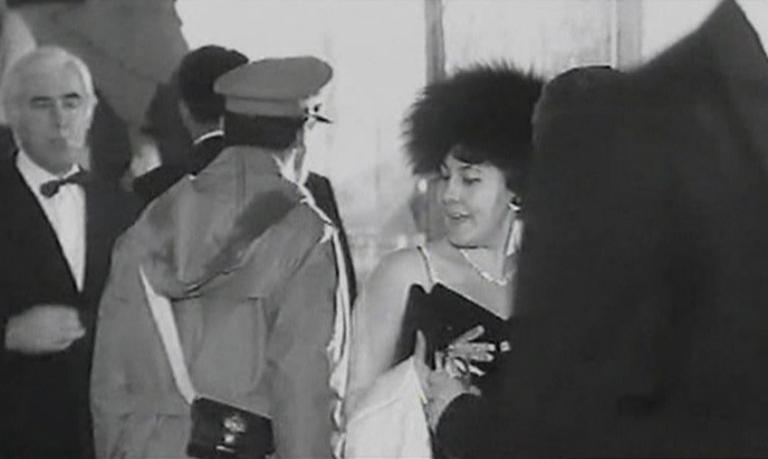
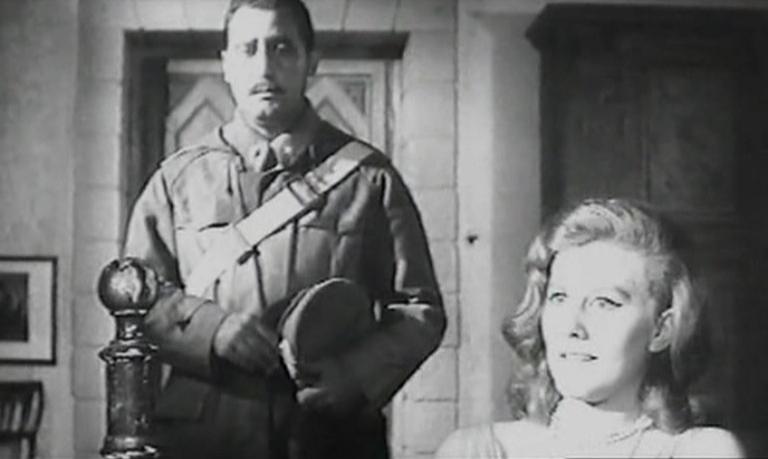
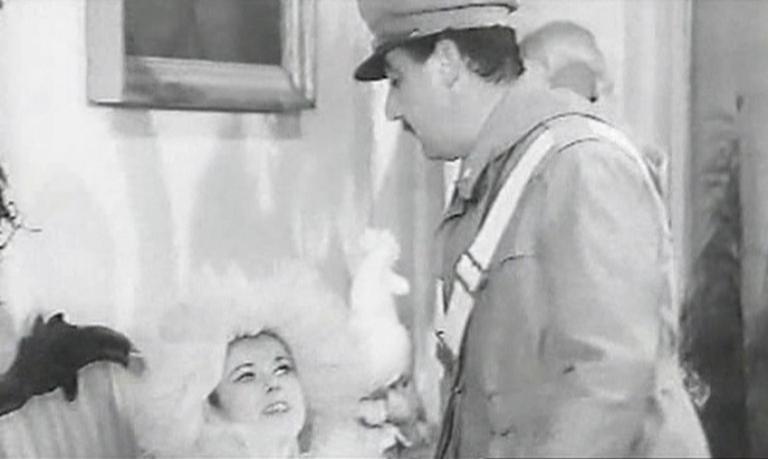
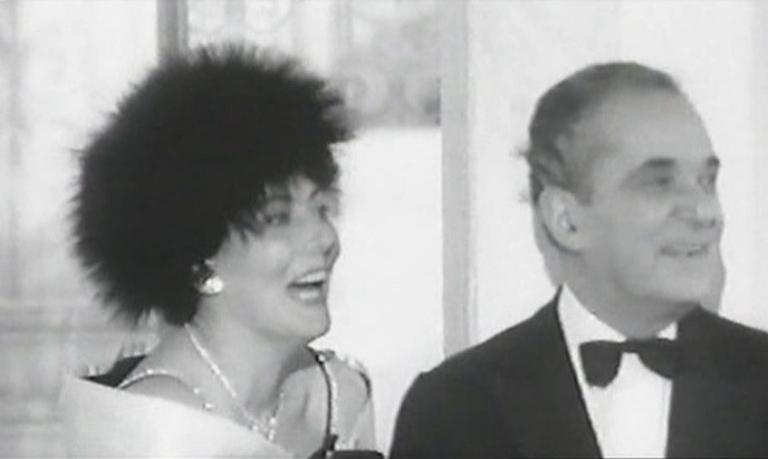
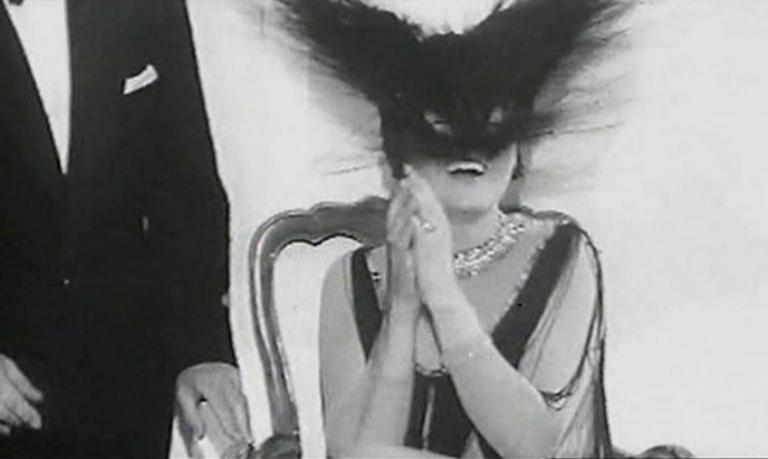
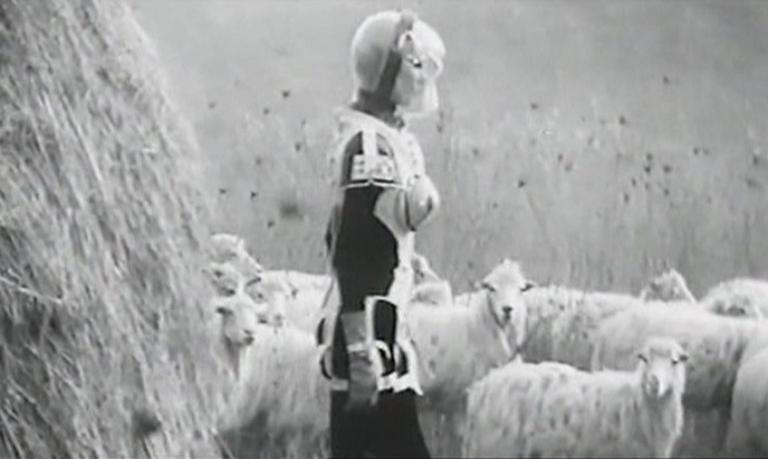
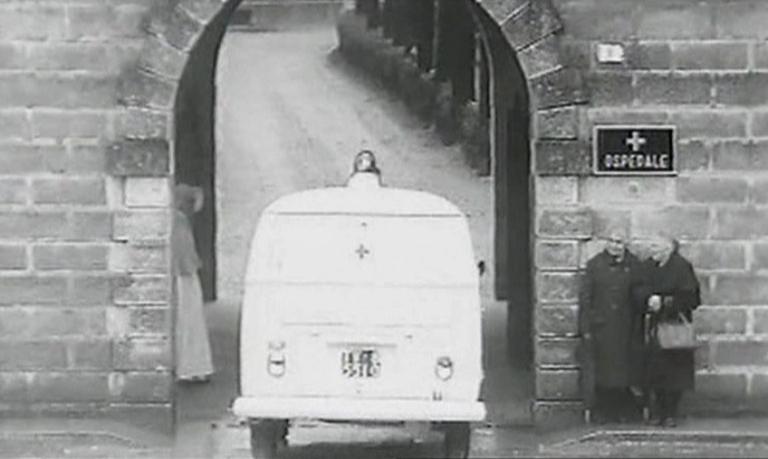
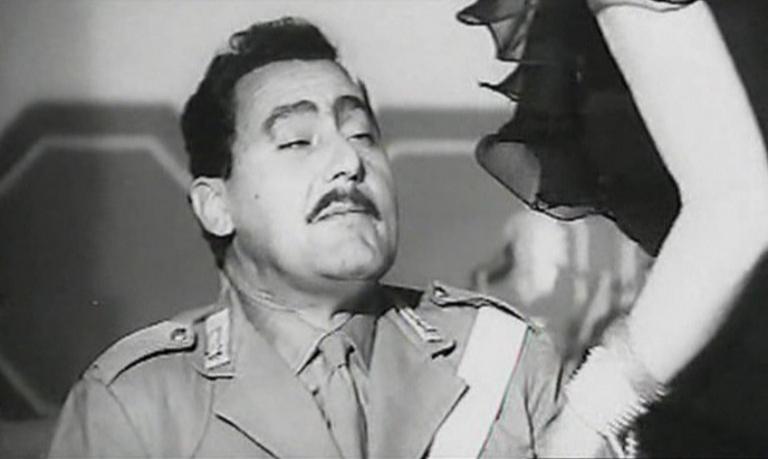
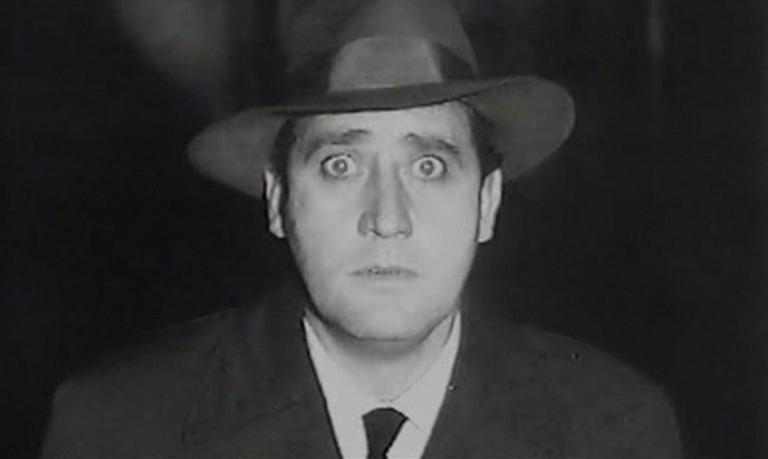
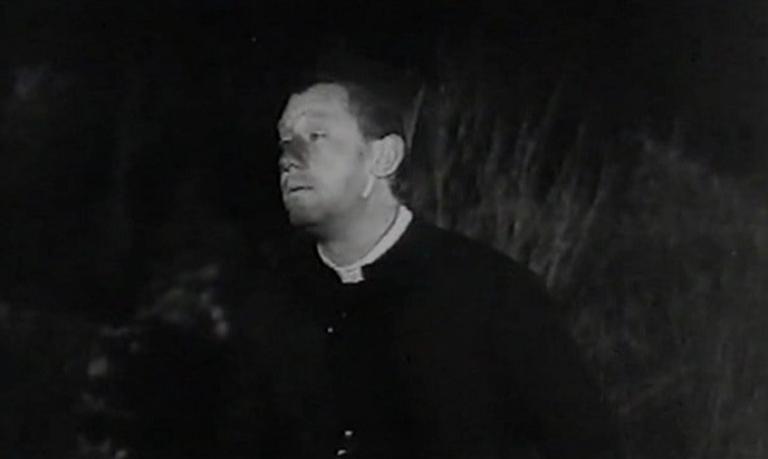
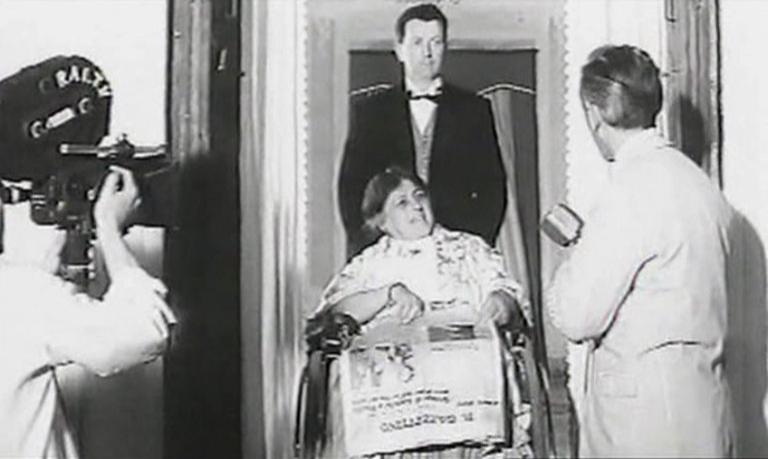
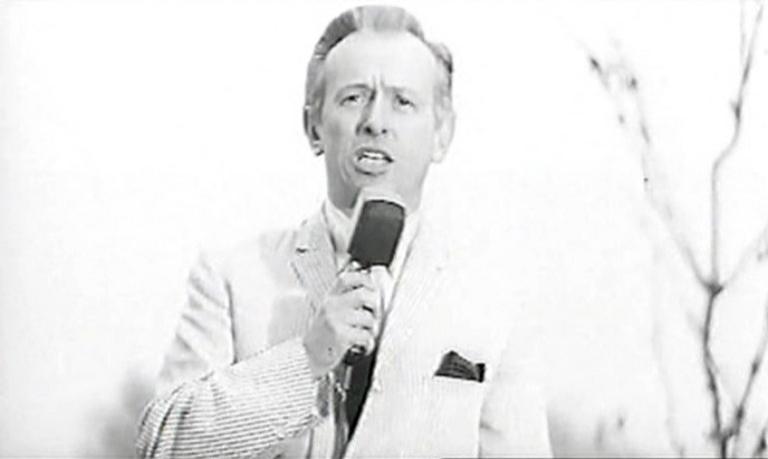
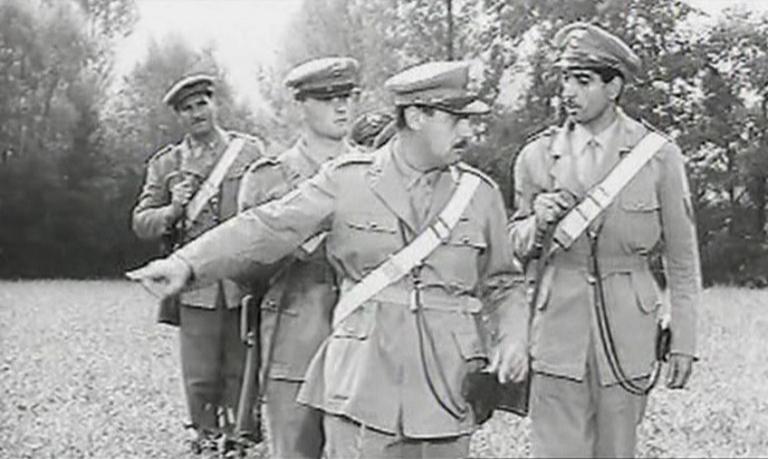
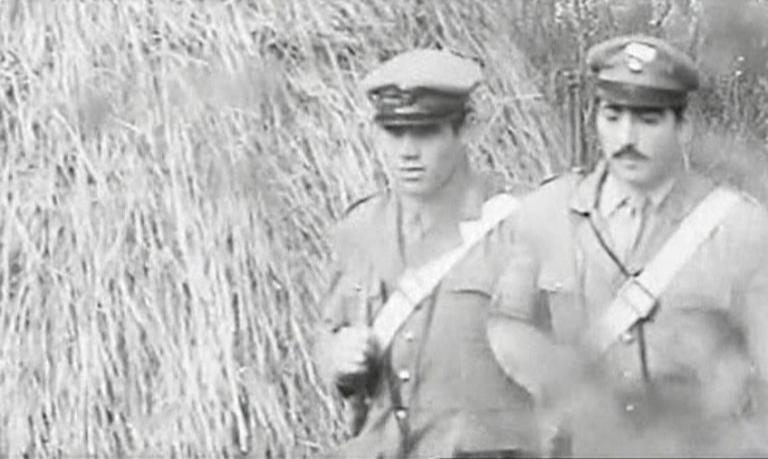
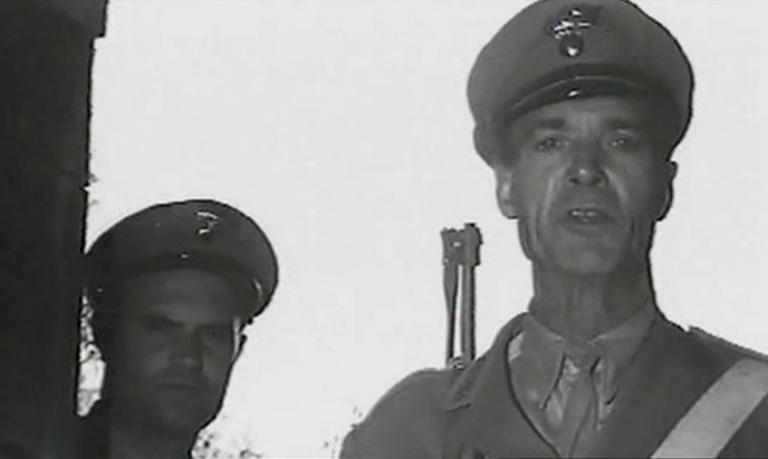
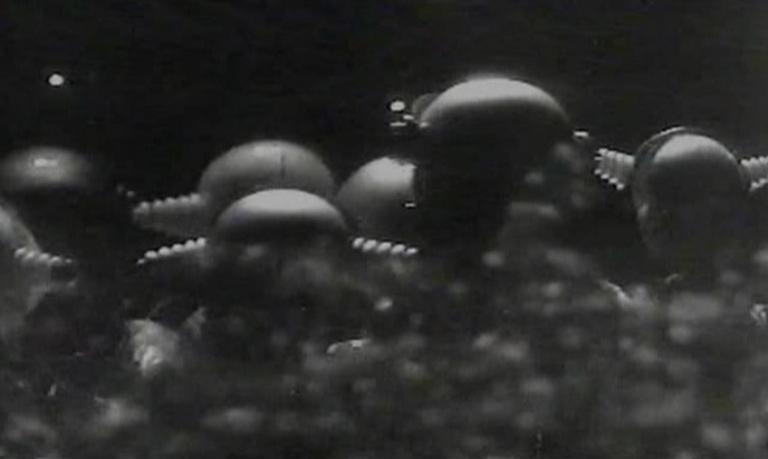
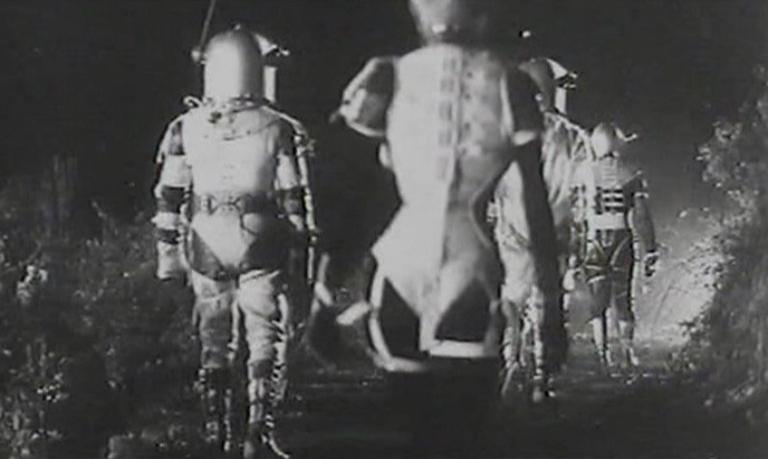
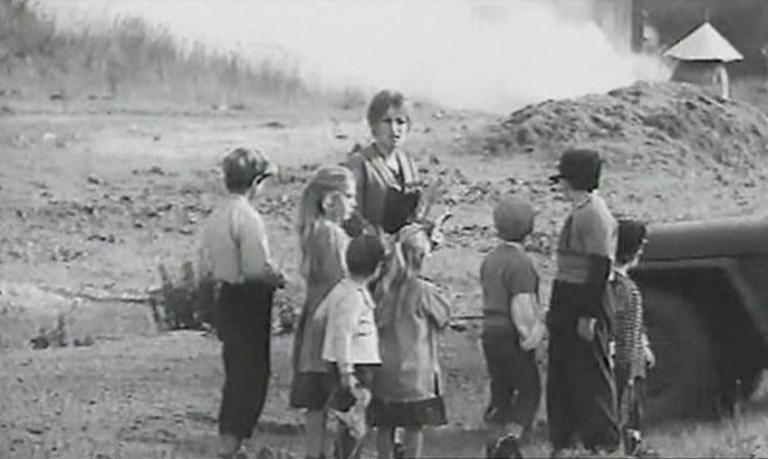
The above six images are from scenes missing from the currently available prints and videos of this movie
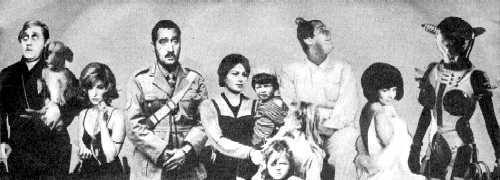
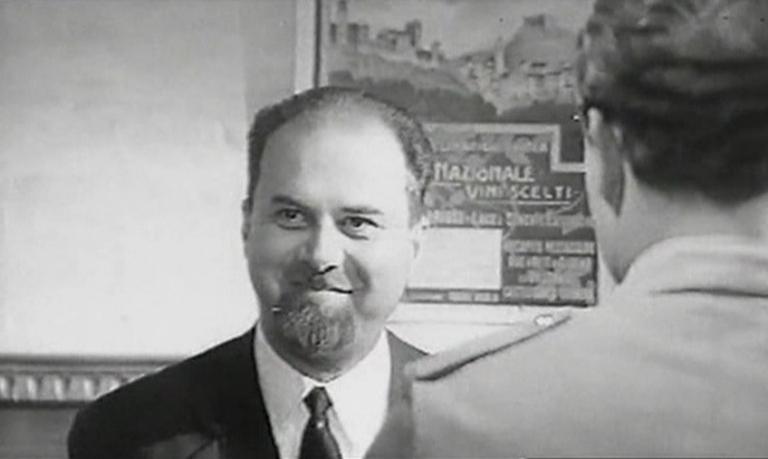
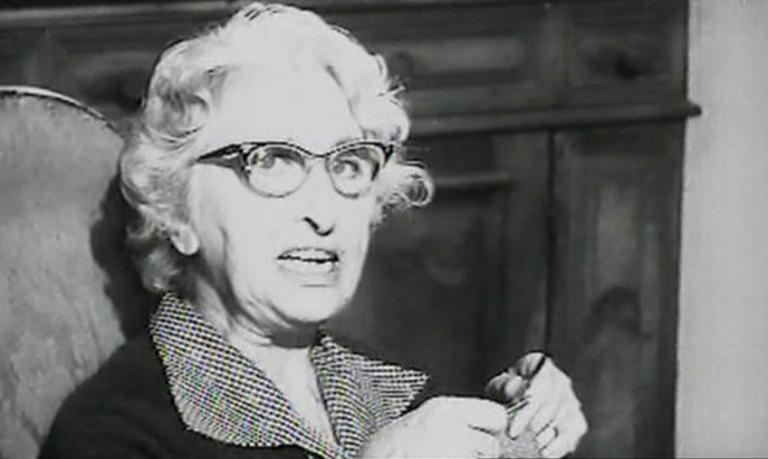
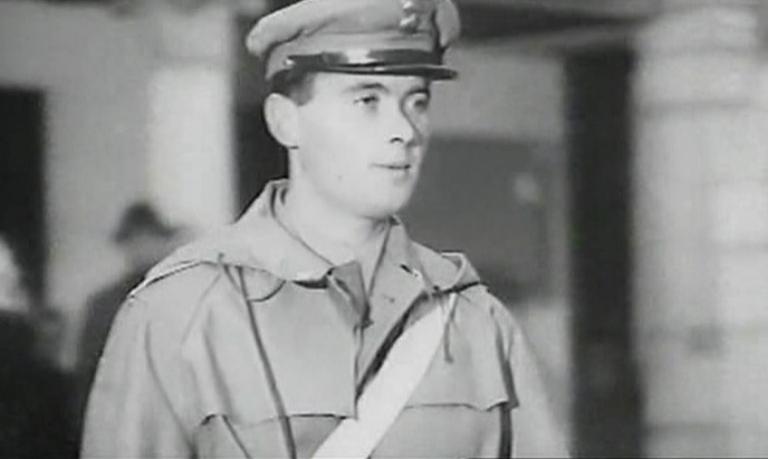
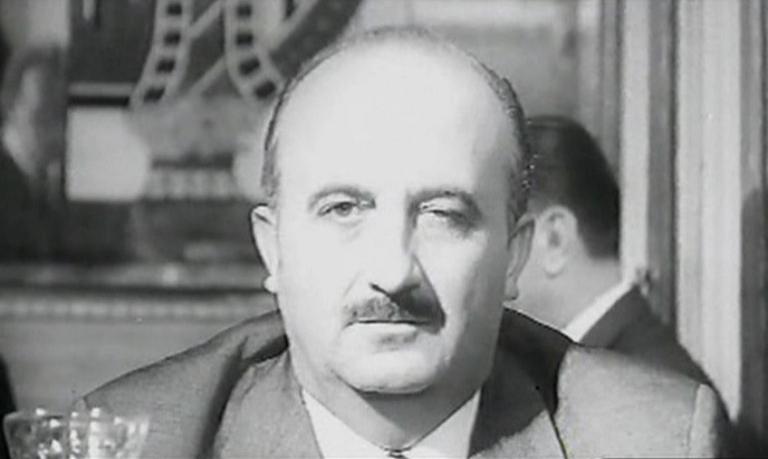
The cast of characters.
We now know more or less what was in the three-and-a-quarter minute preview of coming attractions.
DINO DE LAURENTIIS CINEMATOGRAFICA S.p.A. declares to this Honorable Ministry that it has had the Italian negatives and sound mix altered in the film:
“THE FLYING SAUCER”
the scenes or the dialogue of the sequences:
1) Partially reduced the dialogue of the scene in the barn.
2) Reduced the scene and the corresponding dialogue of the sequence between the actor Alberto Sordi and the actress Monica Vitti inside the car.
3) Reduced the sequence of the party in the villa, eliminating: the dance between the lesbians, the Martian carrying the actor Sordi (in the role of the invert) in his arms, and the passage of a female posterior in the foreground in front of the actor Sordi (in the role of the brigadier) while lying on the dancer.
4) Eliminated the close-up of the Martian’s naked breasts in the jeep.
The international title was originally
supposed to be The Martians, but wiser heads
prevailed in time for the English dub to be entitled
The Flying Saucer.
Back in the 1970’s there was a book that consisted of a listing of sci-fi films released in the US.
Sorry, I can’t be more specific, because I’m relying on a four-decade-old memory of a book I only glanced at.
If memory serves, it was printed from a typescript, and the only text consisted of title, director, principal stars, year of release, and distributor.
This book contained a reference to The Flying Saucer having been released in the US in 1967 by Avco Embassy.
That was right — but it was missing a nuance.
Some accidental detective work revealed the background.
It was Avco-Embassy’s predecessor,
Joseph E. Levine’s
Embassy Pictures,
that released this film to television in the US, presumably in September 1967, and the prints do indeed bear a 1967 copyright date.
Shortly after The Flying Saucer was released,
Levine sold Embassy to the
Avco Corporation, which specialized in aerospace, weapons manufacture, and farm equipment.
Embassy then became the Avco Embassy Company,
which continued to distribute The Flying Saucer.
No trade annual or other mainstream reference work that I have ever run across makes a mention of this,
for the simple reason that The Flying Saucer was not released to cinemas.
It was released only to television — and not to network television, but only to local stations, for use as a filler,
and it was issued surely in 16mm only, never 35mm.
Indeed, the background images during opening credits were cropped to 1.33×1, and the text was reset to fit within that narrower parameter.
The Italian trade materials made it clear that no foreign-language dubs had been prepared,
and that only the original Italian track was available for export.
So it was almost certainly Embassy that commissioned its own English track.
There was little concern over lip-synch in the English dub, and little concern over precise translation.
Whoever wrote the dubbing script added jokes and asides not in the original, and they don’t help.
Yes, the result is still funny, but subtitles would have been much better.
QUESTION: One of the doctors in the
lunatic asylum sure looks like Alberto Sorrentino. Is it?
PERSONAL COMMENT: Like I say, I have memories of 1964, when I was all of four years old.
Here’s another maddening memory.
As soon as Brigadiere Berruti approaches the countess’s mansion,
we hear the haunting strains of
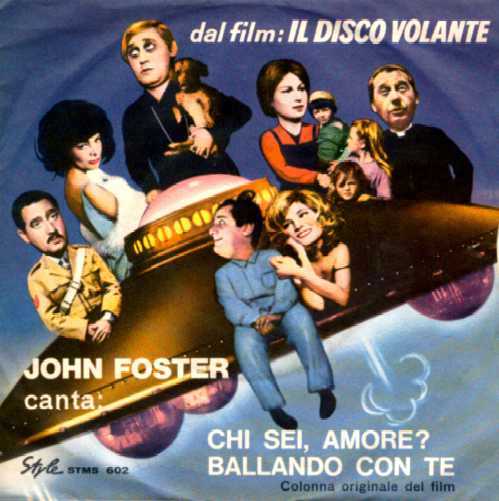
John Foster singing Ballando con te.
I recognized it instantly, but I couldn’t place it.
Maybe it played on the easy-listening stations when I was four?
Can anyone help me figure out where I heard it?
I heard it more than once, and I surely heard it many, many times.
There’s no other way I would have recognized it so instantly.
What’s memory for if you can’t use it?
Ballando con te
Comincio a sognar
E senza parlar
Ti parlo di me
E mentre la mia mano
Carezza la tua mano,
L’ orchestra sta suonando un blues
La sera tu sei
Più bella che mai,
Ballando con te
Ho il mondo con me,
Con gli occhi ci baciamo
E mentre ci guardiamo,
L’ orchestra sta suonando un blues
La gente che abbiamo intorno
Non la vediamo più,
La notte diventa giorno
E il Sole mio sei tu
Ed eccolo il mar
A un passo da noi,
Cammino con te,
Felice con me,
Ma dopo ci fermiamo
E mentre ci baciamo,
L’ orchestra sta suonando un blues
La gente che abbiamo intorno
Non la vediamo più,
La notte diventa giorno
E il Sole mio sei tu
Ed eccolo il mar
A un passo da noi,
Cammino con te,
Felice con me,
Ma dopo ci fermiamo
E mentre ci baciamo,
L’ orchestra sta suonando un blues
L’ orchestra suona ancora un blues,
L’ orchestra suona ancora un blues,
L’ orchestra suona ancora un blues
This next song was in the original version of the movie, but it’s missing from current copies:
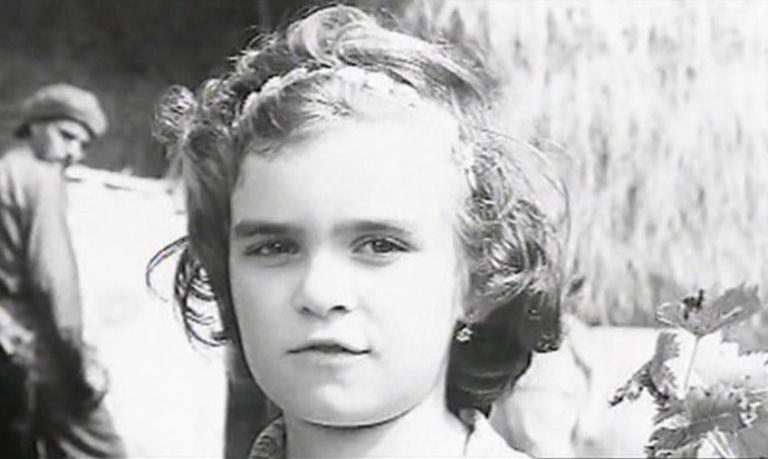
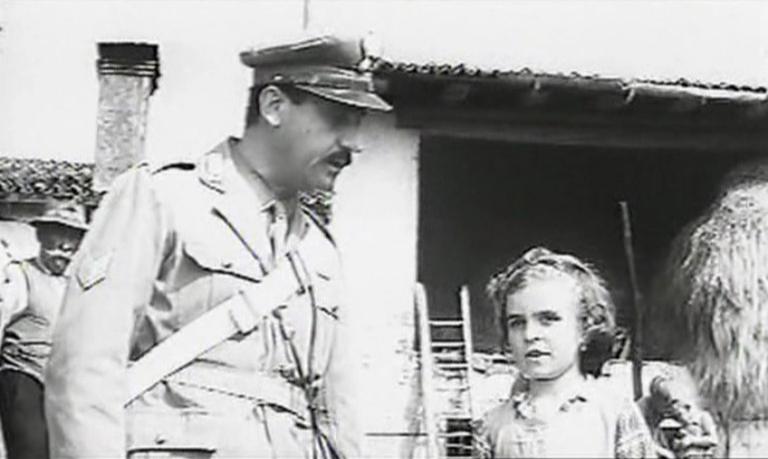
If you need actors who look like farm villagers, hire them from a farm village.
If you need a newsreel look, with locals in the background,
shoot your movie as though it were a newsreel in the midst of crowds of locals.
If you need to characters in the distant background to be conscious of the presence of a stranger,
hire locals who will be conscious of the camera.
If your comedy needs some dramatic relief, play it like a drama.
These shrinks offer almost as much comfort as US law enforcement would.
(Is the elderly chief doctor Alberto Sorrentino?)
If the screenwriter had a scene take place during a carnival, shoot the scene during a carnival.
If it would be funnier to have the Martian woman look ridiculously phony,
have a guy play the part while wearing a rubber mask and rubber appendages.
And if the locals at the carnival find this amusing and if they laugh and smile at the camera,
all the better.
If you need people to wear local costumes, hire locals who normally wear local costumes.
If you need to establish decadence without being decadent, take a break from the naturalism and be absurd.
How to diminish an authority figure with an even larger authority figure.
If you need debonair party-goers at a rural mansion, throw a debonair party at a rural mansion.
If you need a young American woman to be nervous about an arranged marriage
to someone she doesn’t know, like, or trust,
hire an Italian actress who can barely speak English and then wrongly revoice her part.
Upper-class mirth brought about by the destruction of a working-class policeman’s credibility.
If Jerry Lewis would play it like a low comedy, go in the opposite direction and play it like a contemplative drama, and choreograph it as though it were a ballet, and light it and frame it as though it were a mystical painting from long, long ago. It will be funnier that way.
And if the impossible schedule doesn’t allow you to edit your own movie which has to come out in time for the Christmas season,
and if your footage gets turned over to a staff editor daily during the shoot,
and if the staff editor uses your rejected takes to create a prologue,
oh well, don’t worry about it, because it’s still a good movie anyway.
These Italian-language PAL VHS editions (no English subtitles) still pop up on the used market. Try your luck. (PAL VHS will not play on US equipment.)
Una produzione Dino
De Laurentiis Cinematografica S.p.A.
Il disco volante
Originally released on
Wednesday, 23 December 1964
Regia di (directed by)
Tinto Brass
Prodotto da (produced by)
Dino De Laurentiis
Soggetto e sceneggiatura di (original story and screenplay)
Rodolfo Sonego
Produzione organizzata e diretta da
Giorgio Adriani a.d.c.
Scenografia e arredamento (art direction and set décor)
Elio Costanzi
Il “Disco Volante” e i costumi dei Marziani sono stati ideati da (the “Flying Saucer” and Martian costumes created by)
Gianni Polidori
Direttore della fotografia (director of photography)
Bruno Barcarol
Aiuti registi (assistant directors)
Gianni Nerattini, Carla Cipriani
Operatore alla macc. (camera operator)
Alvaro Lanzoni
Operatore ai fuochi (focus puller)
Giorgio Regis
Assistente operatore (assistant camera operator)
Giulio Spadini c.s.c.
Segr. di edizione (continuity)
Silvana Sonego
Truccatore (make-up)
Amato Garsini
Parrucchiera (hair dresser)
Gabriella Scazelli
Tecnico del suono (sound technician)
Bruno Brunacci
Consulenza esterni
Raoul Schoultz
Ispett. di produzione (unit manager)
Claudio Agostinelli
Segr. di produzione (continuity)
Antonio Guadagnino
Segr. amministratore (secr. to accountant)
Fernando Caputo
Aiuto montaggio (assistant editor)
Paola Tassi
Capo macchinista (key grip)
Tarcasio Giamanti
Capo elettricista (gaffer)
Nunzio Colucci
Montaggio di (editing by)
Tatiana Casini [Morigi]
Musica di (music by)
Piero Piccioni
Edizioni musicali (music publishers)
“DINO” Roma
Il film e stato girato nel
Centro di Produzione della Dino De Laurentiis Cinematografica S.p.A.
Upon hearing from one of the rare people who became a fan of this movie by watching it on late-night-filler programming,
I got curious and decided to see what I could learn. Behold.
And now you can understand why it never found its audience.
Our brief email correspondence also got me to thinking.
I found the English edition on eBay.
It was a 16mm print that instigated a bidding war between myself and a rival.
After I won the thing for $150, I contacted the losing bidder and asked what her interest was.
That led to an email friendship.
She was an elderly lady named Joyce Elliott, and she was a huge fan of Silvana Mangano.
I also contacted the eBay vendor, who told me that this print was originally owned by a Chicago TV station.
That’s all he knew of the provenance.
When the 16mm print arrived, it was in a thousand pieces.
Sprocket holes were shredded, glue splices had peeled apart, and tape splices were stretching and going bad.
I spent the better part of a day on a rewind bench in a projection booth repairing the thing with a Ciro splicer.
Fortunately, I didn’t need to chop anything out. I was able to rescue every surviving frame.
In addition to being damaged, with noticeable jump cuts all over the place, the print had also been censored,
with every hint of fake nudity deleted, as well as the finale of the friskiness between Don Mariscano and Dolores in the car,
resulting in the deletion of the final line, “What gams!” (“Che gambone!”). Sheerest idiocy.
There was no need to cut any of that. Nobody would have taken offense.
Eventually I got a friend to run off an SVHS transfer, and with pathetic editing equipment at the office where I worked
I was able to stitch it together with a horrid bootleg of the Italian version.
The result was a total calamity. Unwatchable. But Joyce wanted to see it, and so I sent it to her.
She was thrilled.
I now discover that two Chicago TV stations ran the film.
WMAQ 5 and WSNS 44 were sister stations that shared the print, and they seemed to have purchased or licensed it.
So my print came from those two stations.
Anyway, the recent email correspondence got me to thinking again.
More often than not, a license is good for seven years, after which the materials must be returned to the rights holder.
So why was this print left behind after the license expired?
Should it not have been returned to Famous Films B.V. or its successor?
Yes, it should have, except....
You see, the station surely sent a message to Famous Films stating that the print was so badly damaged that it was being discarded.
Someone then saw a pile of prints on a junk heap ready for pick up by the trash collector
and decided he could probably make away with them and get a few bucks for each
from collectors dumb enough not to demand a quality check prior to purchase.
And that’s how I got my print. Fascinating, isn’t it?
With various licenses and assignments and transfers, the current licensor is StudioCanal+ in Paris.
My damaged 16mm print is probably the only English-language print that is not in StudioCanal+’s possession.
Ah! Oh! Oops! I was wrong. Totally, definitively wrong.
My print was most certainly not the only English-language print outside of StudioCanal+’s possession.
How do I know that?
Easy!
I purchased a second print.
No time to watch it yet, but I did inspect it on a friend’s hand rewinder.
The print confuses me terribly.
Like my other print, it is three reels.
All leaders and tails had been removed and tape spliced back on,
as this print was obviously assembled onto a 5,000' or 6,000' reel for at least one showing.
How could that be?
Only cinema projectors could hold 5,000' or 6,000 reels, yes?
No!
I just discovered that some 16mm telecines could also hold such large reels.
Here is kinemaman’s eBay listing 284378181783 for an Eastman 285 16mm telecine:
This can hold 5,000' reels, and it’s too bad that no reels are on the machine in this photo.
It is clear that other footage, perhaps previews or other announcements, had been spliced to the beginning and end.
A small remnant of a foil cue indicates that the print was shown by an automated dual-machine operation at least once.
Reel 1: A number of frames at the opening are melted.
There are 4 tape splices during the action, 3 of them exactly between shots.
No footage appears to be missing.
Reel 2: There are 2 tape splices during the action.
Only a few frames appear to be missing.
There is also a tape patch to cover some sprocket damage, without the removal of any frames.
A remnant of a foil cue survives underneath a piece of splicing tape, indicating that this print was run on automated equipment at one time.
Reel 3: There are 8 tape splices during the action, as well as 2 cement splices.
It seems that several frames are missing.
There are also 3 tape patches to cover some sprocket damage, without the removal of any frames.
There are no visual cue marks anywhere.
There are occasional remnants of red grease pencil, indicating that there were once some temporary cue marks, which have largely been cleaned off.
The melted frames, along with some other slight damage, make it appear that it had been run by nonprofessionals, perhaps at a library or at a school.
The total missing footage might be less than 1 second, tops, and so this print appears never to have been censored.
Several sprocket holes are split, but will still run.
A number of sprocket holes are notched and will run without a problem.
The notches are probably the work of the TV station’s projectionist.
There are several instances of edge damage, but not enough to interfere with a projection.
Glue from some of the tape splices has oozed out and spread onto adjacent layers.
What threw me, more than anything else, was the complete absence of visual cue marks.
TV stations filled their prints with cue marks, scratched in with cue-marking tools,
and those cues filled the screen for the half-minute prior to every commercial break and every station break and every reel change.
I’m ever so glad that this print has no cue marks, but that’s what confused me.
Whichever station ran this print was kind enough not to scratch cues all over it.
Blessed relief.
It was surely the TV station that added the foil cue and then later assembled the film onto a 5,000' or 6,000' reel.
Apparently, the TV station got superior equipment between its first and last broadcast of this film.
Splices occurring exactly between shots indicate that commercials or station breaks were spliced in at those moments.
Those particular splices were made with a 16mm Ciro guillotine and are quite nicely done.
Some of those splices are quite close together, and this indicates that different broadcasts inserted commercials at different places.
Other splices are considerably shoddy in comparison, and this tells us that this print was used not only for broadcast,
but was handed over to other parties who had inferior equipment and little or no training.
What also threw me were the melted frames.
TV stations do not melt frames.
Only goofy high-school kids melt frames.
Was this print loaned out to or given to a high school or a library?
It seems to have been.
Zo, let me think this through.
The print was purchased likely in 1967.
The TV station had a policy about not using cue-marking tools to scratch cues onto film.
Instead, the projectionists used red grease pencils to make the cues.
Also, instead of having commercials and station ID’s and other announcements on separate reels,
with operators cuing back and forth among machines, this TV station simply spliced an entire program together, and did so quite neatly.
Later, the TV station purchased an automation system, and so added foil cues to make the change-overs from one machine to the next.
This allowed the projectionist to wipe off the old grease-pencil cues for a cleaner presentation.
Later still, the TV station purchased a newer telecine that held 5,000' or 6,000' reels, and, for the last broadcast of this film,
ran the entire program at a single go, on a single machine.
By the time of this last broadcast, several sprocket holes had split, and the projectionist notched them to prevent breaks.
The TV station then gave up the print, and it went to a library or to a high school,
where some students ran it, battered it, and attemped to repair their damage with rather junky splicers.
Once VHS and then DVD ate up the market,
schools and libraries sold off their 16mm collections for pennies on the dollar, and that is how this print ended up with an eBay vendor in Tampa,
who auctioned it to me for $250.
See?
Every film print has a biography.
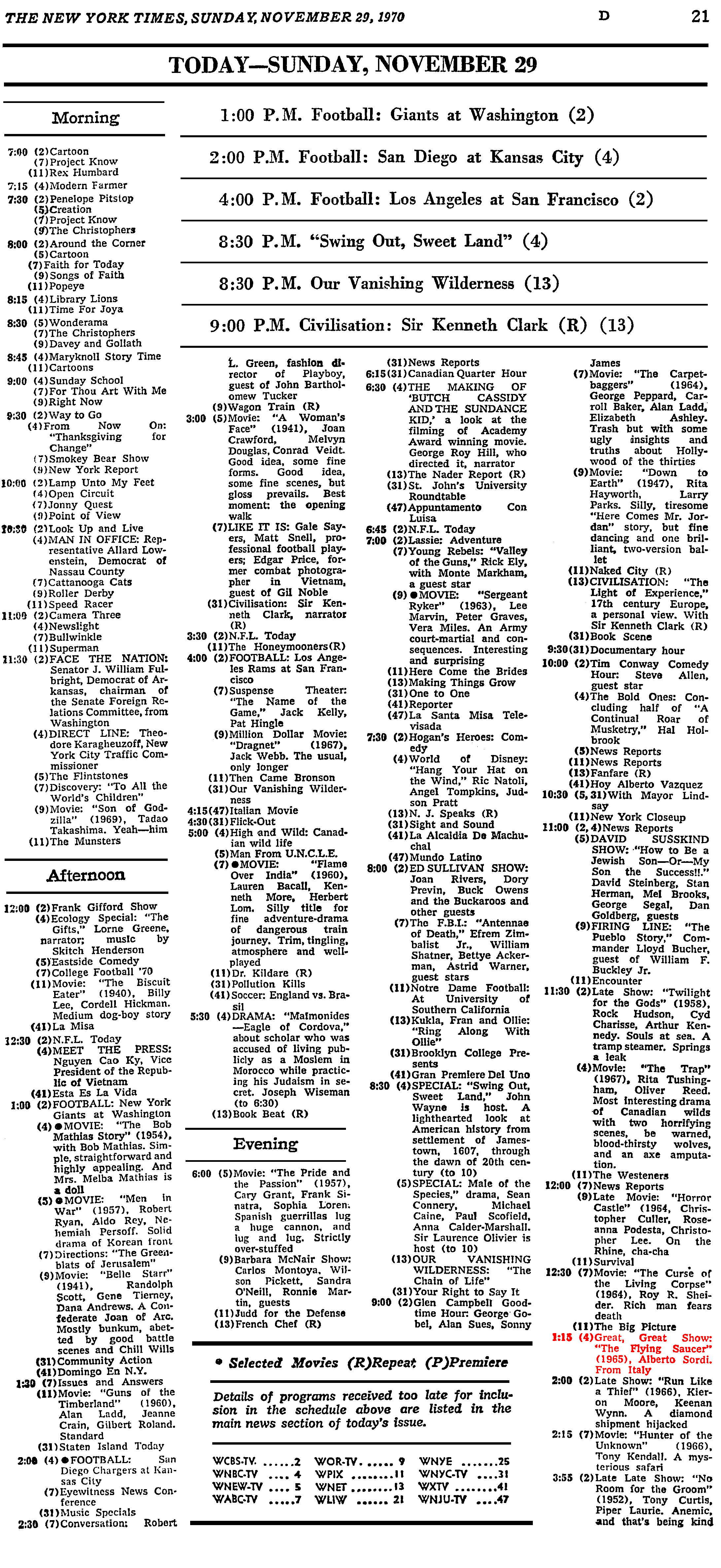
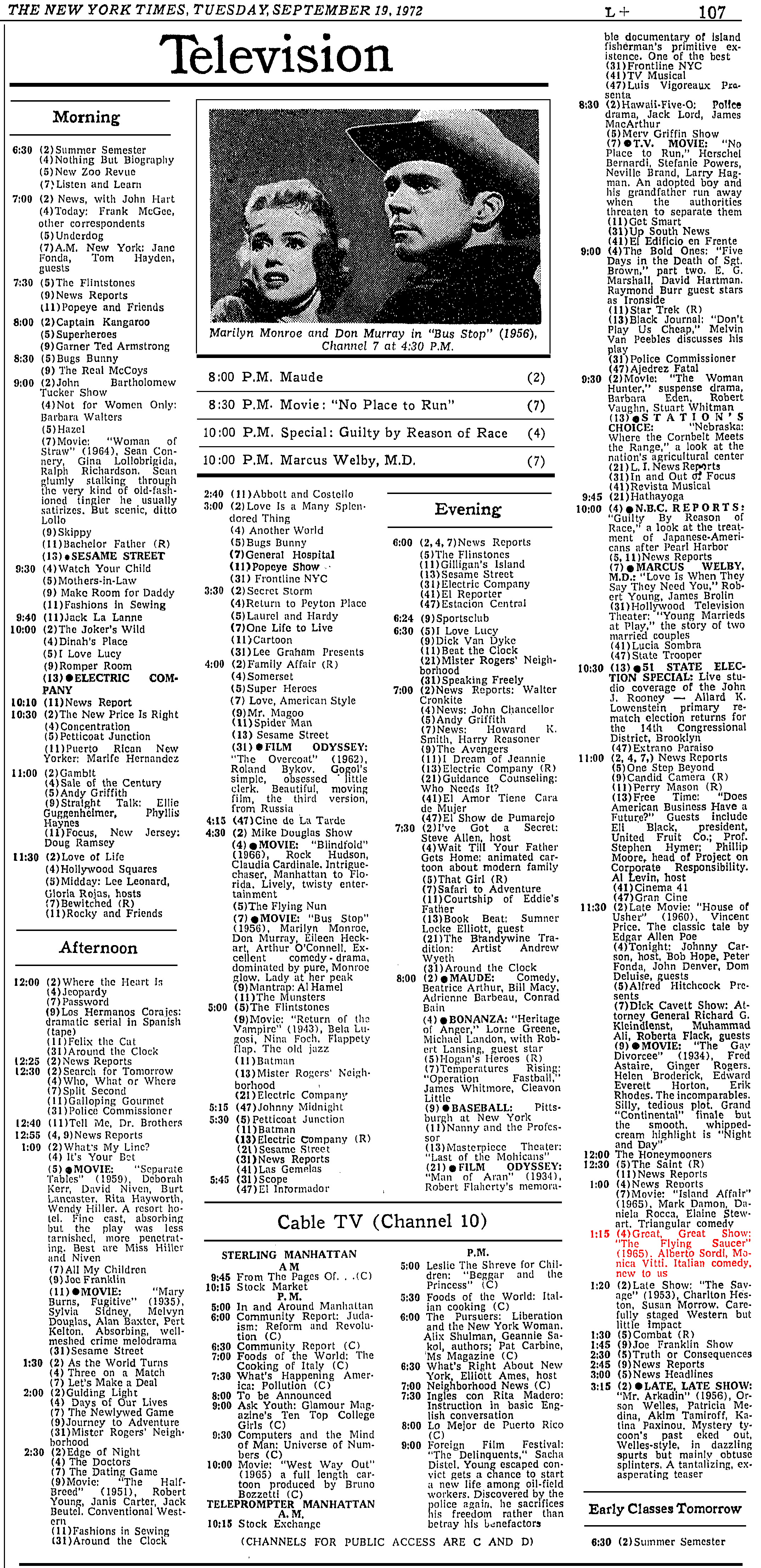
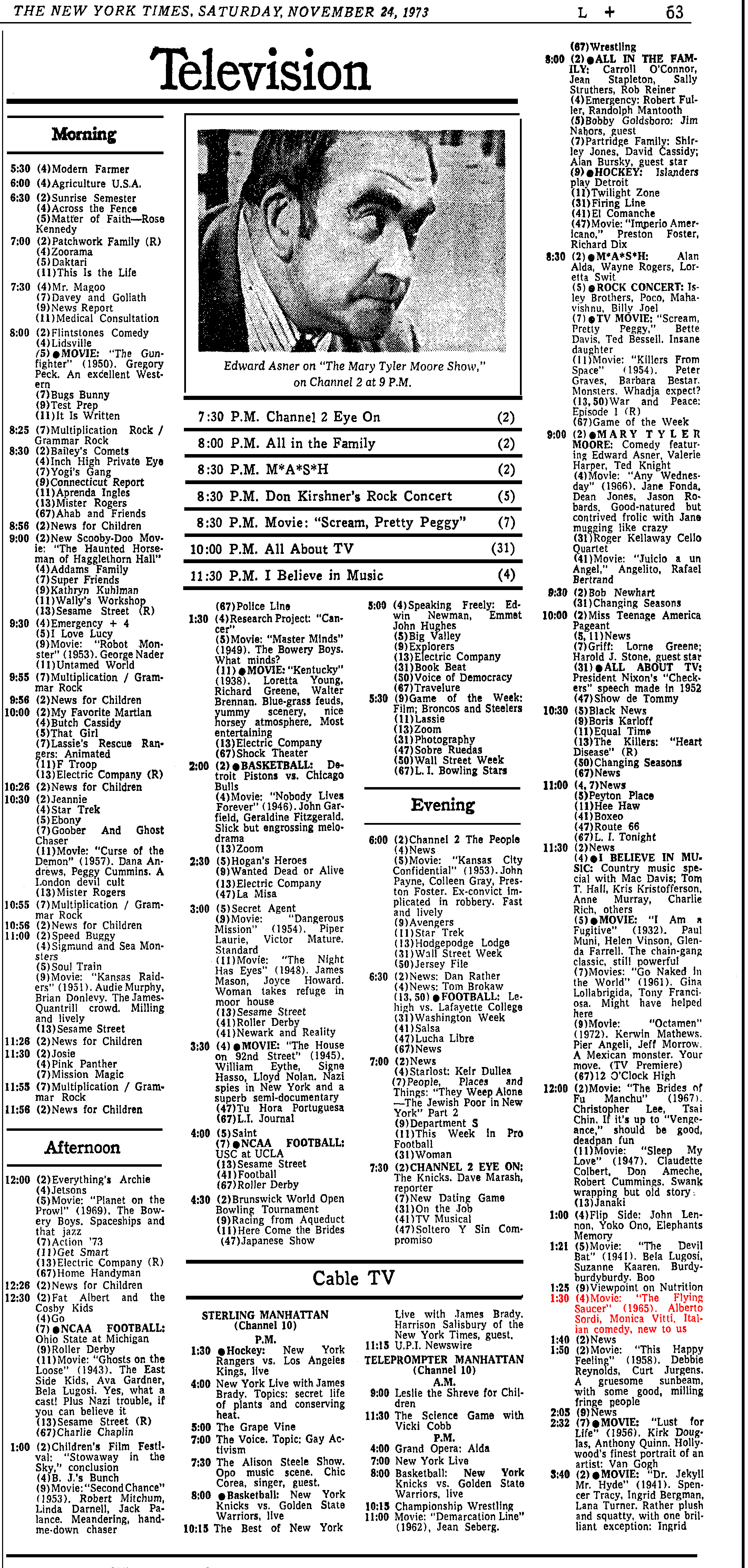
I decided to spend some hours wading through the online newspapers to see what I could discover.
I was not expecting to discover much, but I did!
Apparently, some stations purchased a print, or at least licensed a print for a long term.
Others simply rented prints from exchanges.
There is a good chance that TV stations around the country did swaps or sales as well,
resulting in prints migrating from one station to another.
The capsule summaries were few, and few were at all friendly.
I do not know who wrote them, but whoever wrote most of them was in a really bad mood.
The film had one or two fans, certainly, as you will see.
Those few capsule summaries migrated around the country along with the movie.
More often, though, there was no capsule summary printed in the listings.
The irony is that I was desperate to see this movie,
and yet I did not realize that it was broadcast in Albuquerque when I lived there,
and that it was then broadcast in Buffalo when I lived there.
Had I only known!
https://youtu.be/GKh8ReWuBJ0
This one has English subtitles, and for the most part the result is pretty nice.
For me, personally, it is a boon, like a veil being lifted.
Nonetheless, the creator of the subtitles, “F is for film,” knows English as a second language,
and so some of the captions make no sense, and others are difficult to untangle.
I do not know “F is for film,” yet I began to make some corrections for him(?), but oh heck I just don’t have the time.
You know how it is. Sorry.
If one of you wishes to help fix this, please, do so and let me know. Thanks!
It would also be nice to get a full and accurate Italian transcription. Who has the leisure and desire to do that? Anybody?