THE WORKS OF TINTO BRASS
Snack Bar Budapest
(1988)
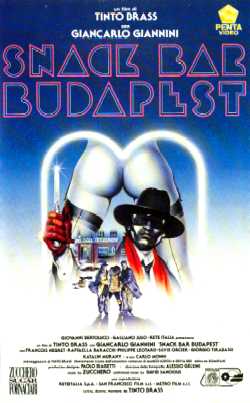
Poster designed by Guazzi
“This is by Tinto Brass?”
That was my silent question from the film’s first
frame. Brass’s films are warm and personal.
Snack Bar Budapest is ice-cold and impersonal.
This seems to have been a commercial venture designed
only to make money. Unfortunately, it didn’t.
Scored with moody
electronic/jazz/rock music by
Zucchero, filled with
dark rooms lit by blue neon, and consisting only of
heartless characters, this is simply not what one
would expect to pour forth from Brass’s editing
suite. The story has a disbarred Lawyer, recently
released from the slammer and now involved with
organized crime, taking Milena, who is both his
girlfriend and his partner Sapo’s girlfriend, to
a hospital in Ostia for an overnight abortion. He
checks into a pension called the Snack Bar Budapest
where Sapo instructs him by phone to make contact
with the up-and-coming local kingpin, a 19-year-old
punk-pimp-gangster named Molecola (Italian for
“molecule”), who is a Buffalo-trained
politician trying to run out the mom-and-pop shops and
turn the town into a giant casino-entertainment
complex, with the Snack Bar as the centerpiece. The
Lawyer (he has no other name) accepts the job of
ridding the town of the Snack Bar’s owners, a
father, mother, and teenage daughter he had once
represented in court. Objecting to the torture
inflicted upon mommy by Pappera, one of
Molecola’s thugs, the Lawyer bludgeons him to
death. In revenge, Molecola and his hookers turn on
the pension with rapid-fire pistols. Though the Lawyer
and Sapo win out against the poor aim of the
hopelessly untrained gunners, they are too late to
rescue Milena, who had been strangled to death just
after her abortion, apparently by Molecola’s
gang.
Snack Bar Budapest uses a
formula that almost always works. It consists of two
parts: if you (1) go to pains to establish that
your story is believable, you can then (2) add
the most preposterous ingredients and your audience
will still buy it. And here, after an hour and a half,
we just accept that a bunch of coked-up hookers, still
dressed in their skimpy come-on outfits, are happy to
send streams of badly aimed bullets into a hotel. It
works! The same holds true with the news media.
Journalists — of all political
persuasions — follow this formula every day to
make us believe whatever their big bosses want us to
believe. And it works!
I doubt the film earned a profit, but
I’m not sure. This could easily have been the sort of sleaze
that the Hollywood studios vomit forth all the time. It is with
embarrassment that I admit I used to work in
cinemas, and for years and years I had to deal with
the ugly crime pics that kept being shoved at me.
Despite their poor earning power, it is still dogma
that they are staples of the box office’s diet. I
can’t even remember most of the crap that I saw
or that I had to force-feed our audiences. But here,
with a distinguished professor given a kindergarten
assignment, we have a film that looks far more smooth
and slick than anything we get from our studio hacks,
and it puts to shame the garbage that plagues our
movie screens. In a sense, it’s exquisite. Brass
was hired to make a thriller, and boy did he make a
thriller. But it’s not exactly a feel-good movie,
if you get my drift. Unlike most of Brass’s
films, the focus is on the men, but unlike
Yankee, this is hardly a celebration of
machismo. Anyway, like some other Brass movies that
disappointed me at first, I found myself becoming
addicted over the following few weeks. There’s
something about his movies that just grows on you (or
at least on me).
MOMENTS WORTH WATCHING FOR:
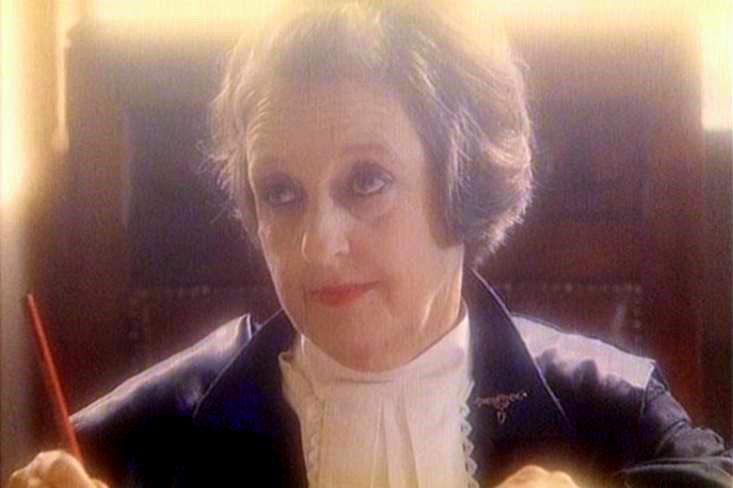
Tinto Brass plays the confused judge (with a Hitler
mustache), and his wife Tinta is also behind the
bench. In another scene, Osiride Pevarello plays a
monk who visits the ballroom at Molecola’s
brothel and has a great time dancing with the girls.
The unexpected appearances of Osiride Pevarello
constitute my favorite running gag in Brass’s
films. When Molecola takes his thugs to attack a local
cinema, the Cine Tabù, he says that he hopes the
Lawyer enjoys “porn” films. And what is this
“porn” film playing there? Why, The
Key, of course! You can’t miss the close-up
of the motor scooter’s license plate:
TB 8 1567. I wonder what those first two
letters stand for. And then Molecola’s license
plate is TB 51 2254. Hey.
TWO GREAT ACTORS YOU’VE NEVER HEARD OF BEFORE AND WILL PROBABLY NEVER HEAR OF AGAIN:
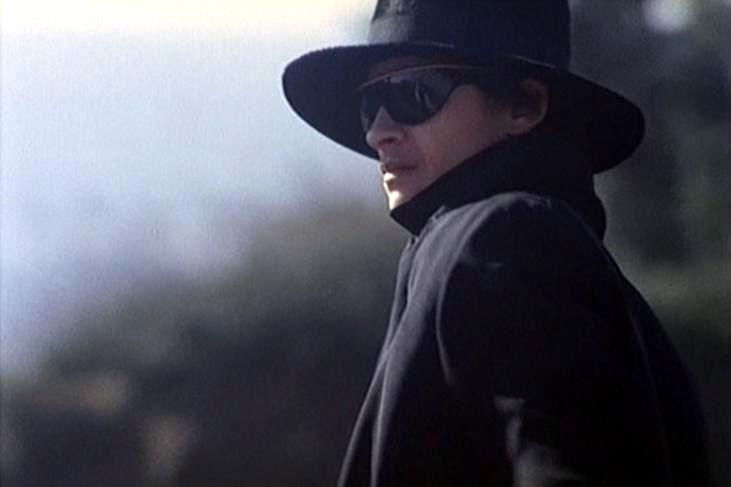
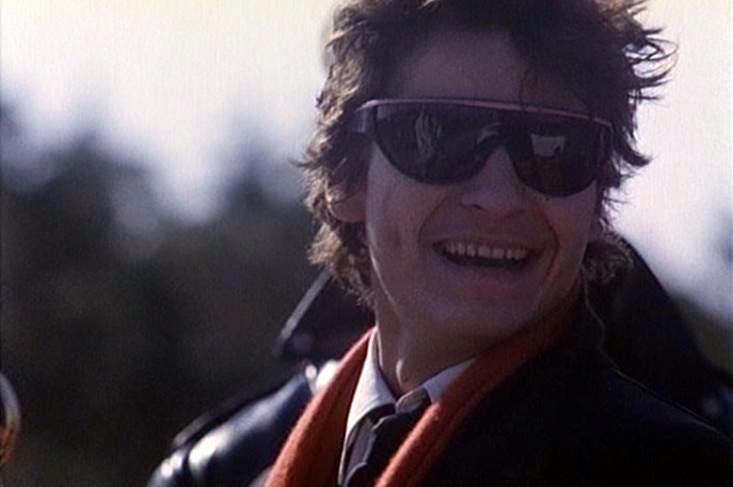
François Négret had appeared a year or so earlier in Louis Malle’s Au revoir les enfants,
with probably his real voice.
Here he’s dubbed into Italian, and he is just perfect as the overly demonstrative crime boss.
He’s supposed to be 19, but he looks more like 15 or 16.
You won’t forget him.
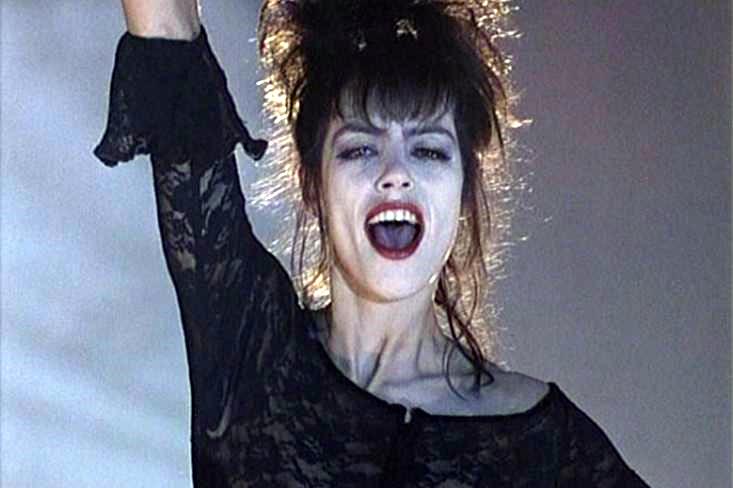
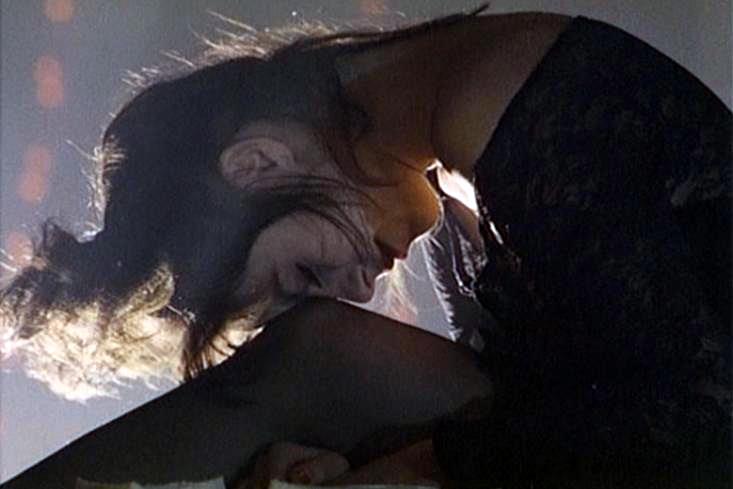
And Sylvie Orcier, who bears an undeniable and probably deliberate resemblance
to Tim Curry’s Frank-n-Furter in The Rocky Horror Picture Show,
has a powerful stage presence as well as an innate comic gift.
She’s a dynamo.
 |
 |
| The phenomenal François Négret |
 |
 |
| The phenomenal Sylvie Orcier |
ROBERTO LERICI. This was the final collaboration between Tinto Brass and
playwright Roberto Lerici,
who would die just a few years later. In the future, without Giancarlo Fusco or Roberto Lerici on hand,
Brass began to repeat himself. Now, that’s not a bad thing, not at all. But it does seem to indicate
that Brass really missed his fellow brainstormers.
TECHNICAL NOTES: The VHS edition was electronically matted at about 1.85:1,
which is too small but doesn’t look bad at all.
The print used in the transfer was a circulating theatrical print, with grease-pencil cue marks every 15 minutes or so.
While the film has no heart, it has technical ultraprecision.
And that makes me wonder why there are two mistaken camera moves during the opening credits,
which was probably the easiest and least expensive shot in the film.
Why didn’t the crew take 15 minutes to re-shoot it?
Odd.
The rest of the film is technically flawless.
 |
| Tinta Brass |
QUESTIONS: The voice that
comes out of Philippe Léotard’s mouth is the
same as the voice that came out of Alberto Lupo’s
mouth in Action. And it looks as though
François Négret delivered his lines in
French. So who dubbed the voices? And can anyone help
us identify the actors?
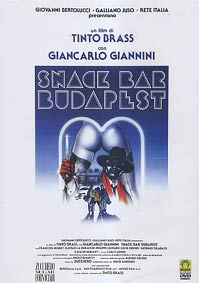
Italian DVD, allegedly wrongly cropped at 1.85:1. No idea about language options.
PAL, which will not play on most US equipment. |
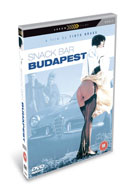
The British Region-2 PAL DVD, which will not play on most US equipment. Correctly
transferred at 1.66:1. Optional English subtitles. No extras. Note the plagiarized summary
on the web site, which I have told the folks at Arrow about several times, to no avail.
(I really don’t usually mind when people plagiarize me, if they only take a few sentences
or paragraphs here and there. But when they don’t understand my jokes, I get upset.) |
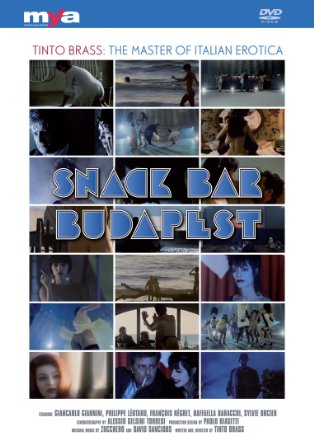
From an outfit called MYA. Haven’t seen it.
NoShame Films once promised to release this on DVD in the US sooner or later,
but I think they closed shop. |
ANICA — Associazione Nazionale Industrie Cinematografiche Audiovisive e Multimediali
Giovanni Bertolucci, Galliano Juso
e Reteitalia presentano
un film di Tinto Brass
Snack Bar Budapest
| Liberamente tratta dal romanzo omonimo di (freely adapted from the novel of the same name by) |
Marco Lodoli and Silvia Bre, edito da (published by) Bompiani |
Collaborazione ai dialoghi di
(collaboration on the dialogue by) |
Roberto Lerici |
| Una coproduzione (a coproduction) |
Reteitalia S.p.A.
San Francisco Film S.r.l.
Metrofilm S.r.l. |
| Operatore alla macchina (camera operator) |
Carlo Montuori |
Collaborazione al montaggio
(assistant editor) |
Fiorenza Müller |
| Aiuto regista (assistant director) |
Roberto Palmerini |
| Montatore del suono (sound editor) |
Sandro Peticca |
| Direttore di produzione (production manager) |
Massimo Ferrero |
| Edizione a cura di (continuity) |
Carla Cipriani |
| Organizzatore amministrativo (accounting manager) |
Mario Sampaolo |
| Organizzatore generale (general manager) |
Aldo U. Passalacqua |
| Costumi di (costumes by) |
Jost Jakob |
| Production designer |
Paolo Biagetti |
Scenografia - Arredamento
(art direction - set décor) |
Massimo Spano, Bruno Cesari |
| Music by |
Zucchero Sugar Fornaciari |
| Additional music by |
David Sancious |
Direttore della fotografia
(director of photography) |
Alessio Gelsini (a.i.c.) |
Scritto, diretto e montato da
(written, directed, and edited by) |
Tinto Brass |
| Segretaria di edizione (continuity) |
Carla Cipriani |
| Ass. regia (assistants to the director) |
Francesco Ascione, Bonifacio Brass |
| Fotografo di scena (still photographer) |
Gianfranco Salis |
| Ufficio stampa (publicity) |
Lucherini - Pignatelli |
| Ass. operatore (assistant camera operator) |
Ettore Corso, Claudio Sabatini |
| Aiuto operatore (focus puller) |
Ivan Casalgrandi |
| Parucchieri (hair dressers) |
Giancarlo De Leonardis, Barbara De Leonardis |
| Truccatori (make-up artists) |
Giovanni Rufini, Claudia Shone, Gabriella Trani |
| Maestro d’armi (stunt coordinator) |
Giorgio Ricci |
| Capo macchinista (key grip) |
Giancarlo Rocchetti |
| Capo elettricista (gaffer) |
Sergio Spila |
| Capo attrezzista (prop master) |
Roberto Magagnini |
| Coreografo (choreography) |
Pino Pennese |
| Effetti speciali (special effects) |
Corridori Studio |
| Fonico (sound) |
Fabio Ancillai |
| Microfonista (boom operator) |
Marco di Biase |
| Costumista (costume designer) |
Massimo Bettini |
| Elettricisti (best boys) |
Marcello Cardarelli, Franco Cardarelli, Walter Romoli |
| Macchinisti (grips) |
Massimo Galiano, Riccardo Ferrero, Roberto Rosati |
| Ass. al montaggio (second asst. editors) |
Benedetto Atria, Emanuele Cassin |
| Sarte (dressmakers) |
Franca Paoletti, Alberta Ceccarelli |
| Ispettore di produzione (unit manager) |
Luciano Pecoraro |
| Segretari di produzione (production secretaries) |
Francesca Andriotto, Mauro Babini, Alessio Juso, Annamaria Severini, Carlo Macrini |
| Amm.ri cassieri (payroll) |
Alessandra Sampaolo, Ruggero Nicolai |
| Teatri di posa (interiors) / Postsincronizzazione |
Cinecittà |
| Negativi (negative stock) |
Kodak S.p.A. |
| Sviluppo e stampa (lab) |
Telecolor S.p.A. |
| Tecnico del colore (color technician) |
Pasquale Cuzzupoli |
| Segretario di doppiaggio (dubbing secretary) |
Corrado Russo |
| Fonico di doppiaggio (dubbing recorder) |
Angelo Raguseo |
| Mixage (mixing) |
Fausto Ancillai |
| Mixage (mixing) |
Cine Audio Effects:
Fernando Caso, Alvaro Gramigna |
| Dolby Stereo Sound Consultant |
Federico Savina |
| Titoli e truke (titles and opticals) |
Studio 4 |
| Sartoria (wardrobe) |
Russo, GP 11 |
| Calzature (footwear) |
L.C.P. S.r.l. |
| Parrucche (wigs) |
Rocchetti - Carboni |
| Giolelli (jewelry) |
Paolo Fidemi |
| Pellicce (furs) |
de Carlis - Roma |
| Arredamento (set décor) |
Dedalo - GRP |
| Mezzi tecnici (technical equipment) |
Cinenoleggio, A.R.C.O. Due S.r.l. |
| Trasporti (transport) |
Romana Trasporti Cinematografici S.r.l. |
| Executive producer |
Michael Torpedine |
| Edizioni musicali (music publishers) |
POLYGRAM DISCHI - BIXIO C.E.M.S.A. - RISPETTO |
| Musical excerpts |
“IL VALZER DELL’ORGANINO” di B. Cherubini - C.A. Bixio, Ed. Musicali BIXIO C.E.M.S.A.
“ARTURO E MARION,” di Vincent Tempera, Ed. Musicali BIXIO C.E.M.S.A.
“SWEET GIRL,” di Farmer - Bixio - Frazzi - Tempera, Ed. Musicali BIXIO C.E.M.S.A.
“L’AMORE È UN PIZZICOR,” di B. Cherubini - C.A. Bixio, Ed. Musicali BIXIO SAM
“FOX TROTT DEGLI SPECCHI,” (Cesare Andrea BIXIO), Ed. BIXIO CESARE ANDREA
“VIOLINO TZIGANO,” (B. Cherubini - C.A. Bixio), Ed. BIXIO C.E.M.S.A.
“RAPP’S BOOGIE,” (L. Humphries - J. Bilsbury - G. Bottger), Ed. BIXIO C.E.M.S.A.
“SHE’S MY LITTLE GIRL,” (Farmer - Bixio - Frizzi - Tempera), Ed. BIXIO C.E.M.S.A. |
| PERSONAGGI E INTERPRETI |
|
| Avvocato |
Giancarlo Giannini |
| Sapo |
Philippe Léotard |
| Molecola |
François Négret |
| Milena |
Raffaella Baracchi |
| Hospital patient |
??? |
| Pappera? |
Giorgio Tirabassi |
| Madre |
Katalin Murany |
| Figlia |
Giuditta del Vecchio |
| ??? |
Valentine Demì |
| ??? |
Claudio Del Falco |
| ??? |
Cyril Aubin |
| Carla |
Sylvie Orcier |
| ??? |
Isabelle Mantero |
| Owner of lingerie shop |
Loredana Romito |
| ??? |
Roberto Trasarti |
| ??? |
Luciana Cirenei |
| ??? |
Tilde De Spirito |
| One of Molecola’s hookers |
Elena Cantarone |
| ??? |
Malisa Longo |
| One of Molecola’s hookers |
Alessandra Bonarrota |
| ??? |
Tiziana Del Poggio |
| Brasile |
Marcia Sedoc |
| A nurse |
Lucia Prato |
| ??? |
Elisabetta Lupetti |
| One of Molecola’s hookers |
Carmen Di Pietro |
| ??? |
Sibilla De Conti |
| ??? |
Giulio Mascolini |
| Padre |
Carlo Monni |
| Il monaco |
Osiride Pevarello [uncredited] |
| Il giudice |
Tinto Brass [uncredited] |
| La giudice |
Carla Cipriani [uncredited] |
|